
Finance teams hear constant AI hype, but most “AI-powered” tools still organize work instead of doing it. Journal prep, reconciliations, close review, variance investigation, and planning each break at scale in different ways, and the right agent depends on which one is eating your team’s time. PwC estimates AI can cut up to 80% of the time spent on core finance processes, yet only around a third of finance executives are actively using AI tools today.
How to judge the top AI agents for finance
Before ranking anything, separate what an agent actually is from what vendors label as one. The finance software market has quietly relabeled workflow tools, so the shortlist below rewards products that perform work, not just route it.
AI agent vs. AI-assisted workflow
The clearest distinction: workflows execute predefined steps, while agents take actions based on user intent and changing context. That is the difference between a checklist that reminds you to reconcile cash and an agent that pulls the bank feed, matches transactions, computes the ending balance, and hands you exceptions. Any serious agent has five practical building blocks:
Instructions that encode policy, materiality, and accounting logic
Tools to read, write, and post into ERPs, banks, and subledgers
Memory of prior periods, approvals, and reviewer feedback
Guardrails for segregation of duties, thresholds, and approvals
Information retrieval across transaction-level source data
Much of what gets sold as “AI-powered” close software is still human-prepared underneath, with AI sprinkled on the review layer. The shortlist below favors systems that do the work.
What effective finance AI agents can actually do
The building blocks above become meaningful in motion. Here is what each agent type actually does when it runs:
Accounting agent: Receives a natural-language instruction like “prepare the cash reconciliation for entity 3,” retrieves the bank feed and GL activity, matches transactions, flags exceptions above materiality, and returns a certified reconciliation for human approval.
FP&A agent: Receives a question like “why did gross margin drop 200 basis points in EMEA last quarter,” decomposes the variance across product mix, pricing, and cost drivers, and returns a ranked explanation with supporting data.
Both involve context retrieval, tool use, and a structured output a human reviews, not a dashboard the human builds from scratch.
The three operating models you are really comparing
The tools on this list span three levels of AI maturity. Level 1 means the platform tracks and routes human work. Level 2 means it applies rules and suggestions to assist. Level 3 means the system prepares outputs end-to-end and routes them for human review.
Record-to-report agents (Level 3 agentic): Prepare journals, reconciliations, matching, and flux end-to-end.
Close orchestration platforms (Level 1-2): Improve visibility, task routing, and review cadence, but depend on human-prepared outputs.
Analytics and planning agents (Level 2-3): Investigate variances, model scenarios, and explore finance data, but do not execute close work.
The criteria behind the rankings
Five criteria separate tools that reduce manual work from tools that just organize it.
AI maturity: Does the agent prepare outputs end-to-end, or does it summarize and draft only? This separates execution from assistance.
Work performed: Does the system produce journals, reconciliations, matching, and flux, or does it surface task status and dashboards? This determines whether manual prep actually shrinks.
Control depth: Does the platform provide transaction lineage, SoD enforcement, approvals, and immutable logs, or just task-level sign-offs? This is the difference between SOX-defensible and SOX-adjacent.
System fit: Does it connect natively to ERP, bank, payroll, and billing feeds, or does it rely on spreadsheet stitching and middleware? Agents that work on summaries instead of source data break under real close conditions.
Scale fit: Does it hold up across multi-entity, multi-currency, high-volume environments, or does it show strain past a single entity? Enterprise close exposes every architectural shortcut.
The 5 tools at a glance
Vendor | Operating model | Primary work performed | Best-fit bottleneck |
|---|---|---|---|
Maxima | Record-to-report agent | Journals, reconciliations, matching, flux | Accounting prep workload |
BlackLine | Close orchestration | Reconciliation certification, close workflow | Reconciliation governance |
FloQast | Close orchestration | Checklist coordination, reviewer workflow | Close cadence and coordination |
Tellius | Analytics agent | Variance investigation, root-cause analysis | FP&A variance and drivers |
Workday Adaptive Planning | Planning agent | Forecasting, scenario modeling | Planning and forecasting cycles |
Other finance AI agent use cases buyers should know
The five tools above cover accounting close, analytics, and planning. “AI agents for finance” is a wider category, and buyers often have operational finance problems outside those three buckets.
AP matching: AP agents compare purchase orders, receipts, and invoices to clear payables without manual three-way matching. None of the five tools are purpose-built AP platforms. Maxima’s transaction matching engine overlaps with AP reconciliation, but dedicated tools like Tipalti or BILL handle the full procure-to-pay cycle.
Treasury cash positioning: Treasury agents aggregate bank balances, forecast short-term cash needs, and flag liquidity gaps. This is distinct from accounting close. If cash forecasting is your primary pain, evaluate dedicated treasury platforms alongside this list.
Compliance monitoring: Compliance agents scan transactions for policy violations or regulatory triggers. Maxima’s SOX-aligned controls and immutable audit trails support compliance evidence, but continuous compliance monitoring is a separate product category from close automation.
Due diligence: Due diligence agents extract and analyze financial data from target companies during M&A workflows. Tellius’s variance investigation is adjacent, but purpose-built tools handle document ingestion and deal-specific analysis that general finance AI platforms do not.
1. Maxima

Maxima is an AI-native accounting platform where agents continuously prepare journal entries, reconciliations, transaction matching, and flux analysis, while accountants review and approve the outputs. It is the clearest example of a Level 3 record-to-report agent: the AI is doing accounting work, not organizing it. Its primary accounting agent, Max, is built for this preparation layer, combining transaction-level context, codified accounting skills, native tool calling, and orchestration to turn reasoning into consistent, auditable execution within governed workflows.
The broader productivity case is already emerging. PYMNTS cited MIT and Stanford research finding that “accountants who used AI handled 55% more clients per week” than accountants who did not.
Best fit
Enterprise accounting teams where manual prep is the real bottleneck, not checklist coordination
Controllers running multi-entity, multi-currency, high-volume closes
SOX-conscious teams that need agentic automation with approvals, lineage, and audit-ready controls
What the agent actually does
Prepares journal entries continuously from bank, billing, payroll, BI, and ERP feeds
Validates and certifies reconciliations with materiality thresholds and automatic clearing
Matches GL and subledger activity across one-to-one, one-to-many, and many-to-many scenarios
Generates first-pass flux analysis with transaction-level drill-down and proposed explanations
Max can query GL accounts and source data, ask clarifying questions mid-task, and route completed work for approval, all inside governed enterprise workflows
At work today: Scale AI is closing 2-3 days faster with over 98% automation, Rippling is cutting cash reconciliation time by 50% and redeploying four FTEs to higher-value work and Zendesk is unlocking 2x more capacity without additional headcount
Control model and integration fit
Unified finance graph connecting ERP, bank, payroll, billing, and BI into one transaction-level model
Connects to ERPs, banks, payroll, billing, and BI systems, with the deepest native integration into NetSuite (direct posting, transaction linking)
Human approval before GL posting, immutable audit trails, architecturally enforced segregation of duties
Max runs inside Maxima’s agentic system of work, where transaction data, controls, approvals, and audit trails already live together, not as a standalone agent layered on top of your GL
Tradeoffs and boundaries
Strongest for record-to-report, not a full CPM or planning replacement
Highest ROI when journal prep, reconciliations, and close review dominate your team’s hours
If treasury forecasting or long-range planning is the primary problem, a planning tool fits better
Maxima holds a 4.8/5 on G2. Pricing is quote-based with a platform fee plus per-module fees.
2. BlackLine

BlackLine is the category-defining close orchestration platform, known for reconciliation certification, standardized close checklists, and process governance at large enterprises. The bottleneck it addresses is oversight and consistency across a distributed close, not the underlying preparation.
Best fit
Large finance organizations focused on reconciliation governance and standardized controls
Teams committed to a structured close operating model that want stronger oversight
Buyers comparing established category leaders against newer agentic platforms
What the agent actually does
Certifies account reconciliations with standardized templates, sign-off workflows, and reviewer routing
Tracks close task status, dependencies, and completion through a central checklist
Applies transaction matching rules against high-volume subledger and bank activity
Routes human-prepared journal entries through structured approval workflows before posting
Surfaces reconciliation risk and aging balances through dashboards while accountants still prepare the schedules
Control model and integration fit
Prioritizes governance and close structure over automation depth
Much of the actual prep happens outside the platform, in ERP, spreadsheets, and email
Reviewers get strong process-level visibility, though transaction-level evidence often lives in attachments
Tradeoffs and boundaries
Orchestration and prep automation solve different problems
Teams with heavy manual journal and reconciliation work should test whether the platform removes that work or just organizes it
If your bottleneck is preparation, an agent like Maxima is the natural contrast point
BlackLine holds a 4.5/5 on G2. Pricing is custom and modular, with market estimates ranging from roughly 40,000 to well over 500,000 per year plus implementation.
3. FloQast

FloQast is a close-management platform that sits over your existing spreadsheet-driven close, adding checklist visibility, reviewer workflow, and tie-outs against source files. The bottleneck it addresses is coordination and cadence, not the underlying preparation. FloQast now markets itself as “The First Accounting Transformation Platform Powered by AI Agents,” but the core operating model remains close orchestration: the platform coordinates and tracks human work rather than autonomously preparing journals, reconciliations, or flux.
Best fit
Teams that want better close cadence and accountability without a major operating model change
Organizations running a spreadsheet-heavy close that need cleaner coordination
Buyers comparing close-management software against true accounting agents
What the agent actually does
Ties close checklists to reconciliation files in shared drives so reviewers see status against source documents
Tracks task ownership, due dates, and sign-offs and surfaces bottlenecks
Reconciles tie-outs between the GL trial balance and supporting spreadsheets, flagging variances
Coordinates review comments and approvals through a shared close workspace
Provides AI-assisted suggestions on reconciliation review while accountants still build the underlying recs
Control model and integration fit
A layer over existing close processes rather than a rebuilt accounting engine
Interacts with ERP data mainly through trial balance imports and reviewer workflow
Controls live at the task and file layer, not at the transaction and posting layer
Tradeoffs and boundaries
Strongest when coordination and close discipline are the pain
Weaker fit when the real issue is accountants still building reconciliations and journals by hand
Lower process disruption comes with lower depth of autonomous execution
FloQast holds a 4.6/5 on G2. Pricing is quote-based, commonly 30,000-60,000-120,000+ for mid-market and enterprise.
4. Tellius
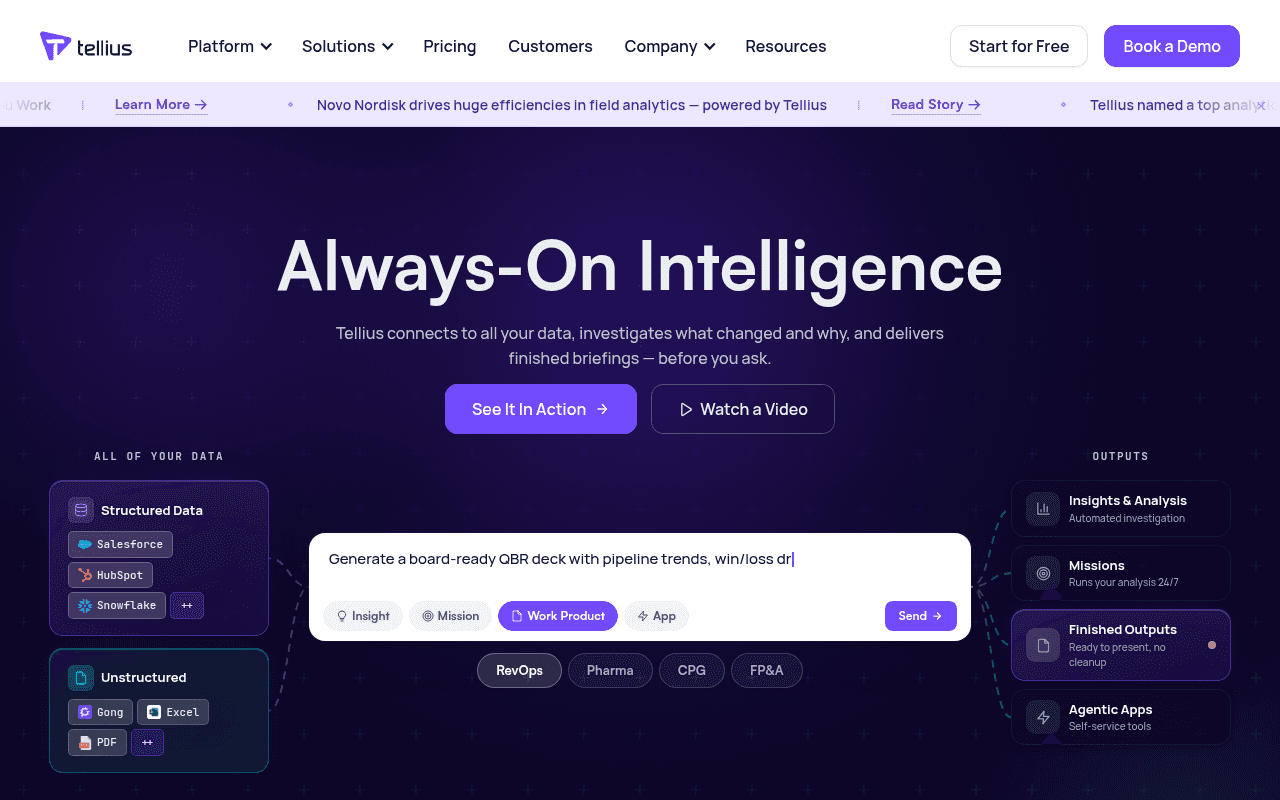
Tellius is an analytics agent focused on automated variance investigation, root-cause analysis, and natural-language exploration of finance datasets. FP&A teams increasingly evaluate it alongside accounting AI, even though it plays a different role. The bottleneck it addresses is insight latency across large, multi-source finance data.
Best fit
FP&A teams that need faster variance investigation and root-cause analysis
Organizations with large, multi-source finance datasets where insight latency is the main problem
Buyers researching AI for finance analysis rather than accounting close execution
What the agent actually does
Decomposes revenue, expense, and margin variances into contributing drivers across product, region, and customer
Answers natural-language questions on finance datasets and returns visualizations with underlying calculations
Automates root-cause analysis on KPIs by comparing segments and surfacing which factors moved the metric
Blends ERP, CRM, and operational data to explain results beyond what a single system shows
Delivers analytical narratives for management reporting without touching close execution or GL posting
Control model and integration fit
Good fit for unifying multiple sources for analysis across finance and operations
An analytics platform, not a system that owns close controls or GL execution
Integration focus is data access and investigation, not posting or reconciliation
Tradeoffs and boundaries
Not the right category if your main pain is journal preparation or account reconciliation
Excellent when you need faster insight, weaker when you need the books prepared continuously
A finance AI platform can be excellent and still not be an accounting agent
Tellius holds a 4.4/5 on G2. Pricing is custom across Premium and Enterprise tiers, with a 30-day free trial.
5. Workday Adaptive Planning

Workday Adaptive Planning is a planning and forecasting platform for driver-based models, scenario planning, and workforce-linked financial plans. “AI agents for finance“ searches often blur planning and accounting, and buyers need to see the boundary. The bottleneck it addresses is planning cycle time and model coherence, not month-end close.
Best fit
Finance teams centered on planning, forecasting, and scenario modeling rather than record-to-report
Organizations that want tighter HCM-finance coordination in planning workflows
Buyers comparing accounting AI agents with broader planning-oriented tools
What the agent actually does
Builds and updates driver-based forecasts by pulling actuals from the GL and refreshing planning models
Runs scenario models across revenue, headcount, and expense assumptions
Integrates workforce plans with financial plans, linking headcount changes to compensation forecasts
Produces management reports and variance-to-plan views for finance leaders and business partners
Supports collaborative budgeting where department owners submit and iterate on plans
Control model and integration fit
Best fit for organizations that already think in planning models, budgets, and forecast ownership
Evaluate through ecosystem fit and planning workflow maturity, not journal automation
Strong when you need HCM-finance connectivity, not transaction-level accounting lineage
Tradeoffs and boundaries
Not the right tool if reconciliations, journals, or transaction matching are the current bottleneck
A strong planning platform does not replace agentic accounting prep
Decide whether your real problem is planning quality or close workload
Workday Adaptive Planning holds 4.3/5 on G2. Pricing is per-user and quote-based, with Viewer tiers around 100-5,000-10,000/year.
FAQs on AI agents for finance
What’s the difference between an AI agent and close automation?
Close automation orchestrates checklists, approvals, and status, while an AI agent performs the underlying accounting work such as preparing journals or reconciliations. The CFA Institute frames it simply: workflows follow predefined paths, agents adapt actions based on context and intent.
Can an AI agent post journal entries directly to the GL?
Well-designed agents prepare entries and route them for human approval before posting, which preserves SOX controls. Direct posting can happen for narrowly scoped, pre-approved rules like recurring accruals, but the standard model is agent-prepared, human-approved.
How does SOX compliance work with agentic AI?
Compliance depends on transaction-level lineage, immutable audit trails, segregation of duties, and human approval built into the workflow. The agent is effectively a preparer, and the controls sit around approval, review, and evidence retention exactly as they would with a human preparer.
Do I still need my close-management tool if I use an accounting agent?
If orchestration is your bottleneck, keep it; if preparation is the bottleneck, an agent reduces the work the checklist is tracking. Many teams run both. The honest test is whether your team spends more time building or reviewing.
What size company benefits most from AI agents for finance?
High-volume, multi-entity, or multi-currency environments see the fastest payback because manual prep hours scale linearly without an agent. Smaller teams can benefit too, but ROI depends on transaction volume and close complexity.
How long does it take to implement a finance AI agent?
Close orchestration tools like FloQast typically go live in four to eight weeks because they layer over existing processes. Record-to-report agents like Maxima require mapping data sources and configuring accounting logic, but are designed for finance-owned deployment without heavy IT involvement, with most teams live in weeks rather than months. The key prerequisite is clean, accessible source data from your ERP, bank, and payroll systems.
Is my financial data safe inside an AI agent platform?
Evaluate vendors on SOC 1 and SOC 2 Type II certification, AES-256 encryption at rest, TLS in transit, and whether the vendor trains models on your data. Some platforms use customer data to improve shared models, which creates confidentiality risk. Ask every vendor for their data processing agreement before signing.
How do I measure ROI from a finance AI agent?
Start with three metrics: hours saved on journal preparation and reconciliations per close cycle, days reduced in close cycle length, and error rate before and after. Set a baseline before the pilot and measure against it at 60 and 90 days.
Conclusion
The right AI agent for finance depends on which work is actually eating your team’s time. Match the operating model to the bottleneck, then evaluate control depth and scale fit within that category.
Best for accounting prep and record-to-report: Maxima
Best for close orchestration and reconciliation governance: BlackLine
Best for close coordination and cadence: FloQast
Best for variance investigation and FP&A analytics: Tellius
Best for planning, forecasting, and scenario modeling: Workday Adaptive Planning

Move closer to an audit-ready, continuous close

Request demo
Insights, news and content
The latest
See all