If you are evaluating Maxima vs BlackLine, you are not picking between two close tools. You are choosing between two operating models for the close: orchestrate human-prepared work, or have AI agents prepare the work continuously so your team reviews and approves.
That distinction sounds small in a demo. It shows up loudly on day three of close, when someone is still keying ending balances into a web form because the real work happened in Excel. It also shows up in the numbers: Zendesk moved core system-to-system reconciliations off BlackLine and onto Maxima, lifting match rates from 88% to over 98% while keeping the SOX control automated and auditable.
This guide walks through where each platform fits, where each one breaks, and how to self-qualify before you even take a vendor call. You will get answers to:
What is each platform actually designed to do?
Where does each one break for fast-moving or mid-market teams?
What does "agentic AI" change in day-to-day accounting?
Which one fits your team's bottleneck right now?
Maxima vs BlackLine at a glance
Dimension | BlackLine | Maxima |
Core operating model | Orchestrate and certify human-prepared work | AI agents prepare JEs, recs, matching, flux continuously |
AI architecture | Add-ons layered on a pre-AI platform | Agentic AI at the core with transaction-level lineage |
Implementation | Typically 3-6+ months with consultants | Weeks, accounting-owned |
Ownership | System admin or IT for changes | Controllers and accountants self-serve |
Reconciliations | Web forms repository, support often uploaded from Excel | Computed balances, auto-clearing, materiality thresholds; 95%+ |
Matching | Powerful rule engine at F500 volume | Agent-prepared (1:1, 1:many, many:many) with continuous ingestion and normalization |
Journal entries | Templates, workflows, approvals | Agent-prepared with data extraction, workbook schedule preparation and audit ready entries |
Flux | Variance presentation with commentary | Transaction-level anomaly detection with proposed explanations |
Support | Ticket-based, premium tier for faster response | Finance-owned configuration, fewer tickets needed |
UX | Legacy, steep learning curve | Modern and intuitive |
Why this comparison exists now
The close software category was built in a pre-AI era to bring order to chaos: standardize templates, centralize sign-offs, and create an auditable trail. That work is real, and BlackLine deserves credit for shaping it. What changed is that the bottleneck moved from coordination to preparation.
Andres Botero, BlackLine's former chief strategy officer and Maxima investor, has discussed publicly that AI is shifting accounting from doing repetitive work to providing meaningful oversight. When the person who helped scale the legacy category invests in an AI-native alternative, it signals a category transition, not just a feature gap.
Implications for accounting teams:
Speed of close is now constrained by prep, not by task status.
Continuous data flows make month-end-only workflows feel artificial.
Audit defensibility now depends on lineage to source transactions, not just sign-off logs.
The "do the work" to "review the work" shift
The core change is not faster month-end coordination. It is that AI agents can prepare journal entries, reconciliations, matches, and flux explanations as data arrives, so accountants spend their time reviewing exceptions instead of building outputs from scratch.
That reframes what a close platform is for. Orchestration becomes table stakes. Preparation becomes the differentiator.
What each product is designed to do
BlackLine
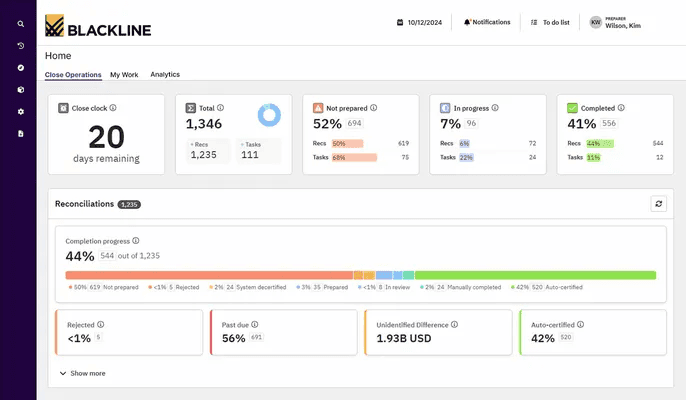
BlackLine is the legacy market leader, with a suite built before the AI wave. It's designed to orchestrate human-prepared close work: routing tasks, tracking status, capturing approvals, and storing support documentation.
Designed for: Large enterprises standardizing close and reconciliation across many entities.
Primary jobs: Task orchestration, reconciliation certification, high-volume matching, sign-off workflows.
Ownership model: System admin or IT typically owns configuration and ongoing changes.
Where it shines: F500-scale complexity, formal change management, existing BlackLine ecosystem.
Natural boundary: Preparation work often still happens in Excel and gets uploaded as support.
Maxima: AI-native preparation across JEs, recs, matching, and flux
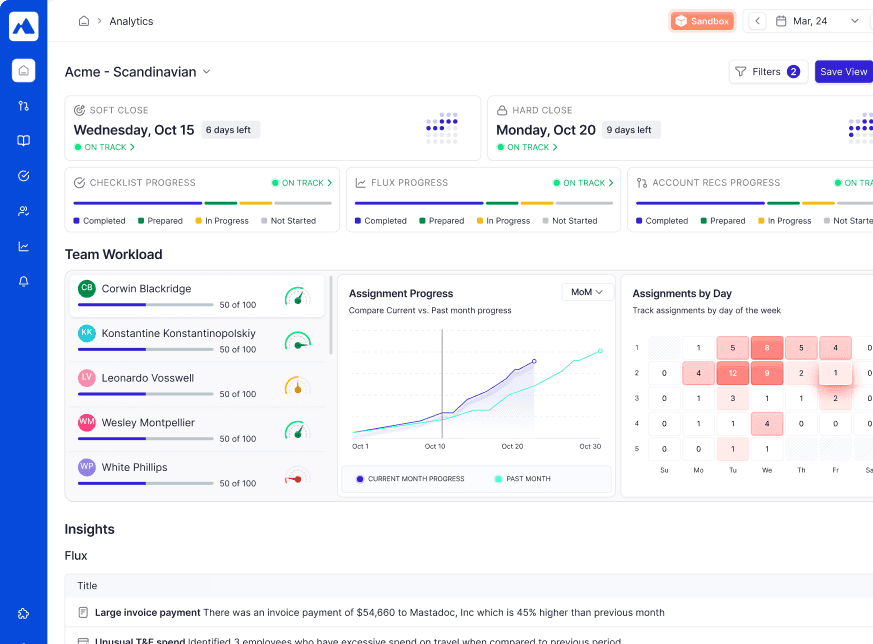
Maxima is an AI-native accounting platform where agents prepare the close artifacts themselves. Journal entries, reconciliations, transaction matching, and flux analysis are generated continuously from connected source systems, validated against controls, and presented to reviewers for approval with transaction-level lineage.
Designed for: Enterprise and high-growth accounting teams whose bottleneck is manual prep.
Primary jobs: Agent-prepared JEs, reconciliations, transaction matching, and flux with transaction-level lineage.
Ownership model: Accounting-owned workflows with minimal IT dependency.
Where it shines: Continuous preparation, weeks-to-value deployment, audit-ready controls without a platform admin.
Natural boundary: Best for teams ready to shift from doing the work to reviewing it
Maxima is SOC 1 Type II and SOC 2 Type II certified and deployed at organizations with over $1B in revenue.
Core workflow comparison
These workflow areas drive most of the close. Here is how each platform handles them in practice.
Account reconciliations
Account reconciliations are where close platforms either become the system of record for the work, or just the place where finished support is stored. The key question is simple: does the platform help prepare the reconciliation, or does it only help certify it?
BlackLine
BlackLine is strong at standardizing the rec process. Teams can assign preparers, route reviews, capture sign-offs, and store support in one place. It also provides structured reconciliation web forms, which are the intended way to work in the platform.
In practice, though, many teams still build the rec in Excel and upload it as support, keying the ending balance into BlackLine. That repository pattern is the under-adopted worst case, and it creates a few common issues:
Ending balances are entered manually instead of computed from source data.
Reconciling items live in spreadsheet tabs.
Auto-clearing only works where rules are already configured.
Materiality thresholds are updated manually.
Audit lineage depends on the quality of the uploaded support.
But the distinction holds even at best-practice adoption. Whether the preparer works in Excel or directly in a BlackLine web form, a human still computes and enters the reconciliation. The platform standardizes and certifies that work; it is process-heavy with basic automation, and it does not prepare the balance from source data. This is not user error — it is what happens when the system manages the process rather than performing it.
Maxima
Maxima treats the reconciliation as the workbench itself. Agents compute ending balances from source systems, apply clearing logic, check thresholds, and attach transaction-level lineage.
The reviewer starts with a prepared rec, not a blank template or uploaded spreadsheet.
In practice:
Balances are computed from source data.
Reconciling items stay linked to transactions.
Auto-clearing and thresholds are applied continuously.
Exceptions are surfaced for review.
The audit trail is attached to the rec by default.
So the real contrast isn't Excel versus web form, it's human-prepared versus agent-prepared. BlackLine helps teams certify the reconciliation. Maxima prepares it.
For instance, Zendesk moved its NetSuite-to-Coupa reconciliations — a set of system-to-system SOX controls — off BlackLine and onto Maxima. They replaced a painful export-and-import process with a direct data feed, and the match rate rose from 88% to over 98%, with the control automated and audit-ready.
Transaction matching
BlackLine's matching engine handles Fortune 500 volume and complex cardinality. That capability is real.
The operational cost is also real: building and maintaining rules typically lands on a system admin, and rule drift compounds as banks, billing systems, and entities change. Teams also report a high rate of false matches (false positives that get sent back to a manual review queue, which adds work during close rather than removing it).
Maxima prepares matches across one-to-one, one-to-many, and many-to-many relationships with continuous ingestion and normalization, automating 95%+ of matching so the team only touches true exceptions.
Matching need | BlackLine fit | Maxima fit |
|---|---|---|
High-volume one-to-one bank matching | Strong | Strong, agent-prepared |
One-to-many and many-to-many | Strong with tuned rules | Agent-prepared with continuous normalization |
New bank or subledger added mid-quarter | Admin ticket | Finance self-serve |
Exception handling | Manual review queue, with false positives to clear | Exception-first workflow with lineage |
Journal entries
Journal entries are one of the most manual parts of the close because the work usually starts across bank files, payroll registers, billing exports, ERP reports, and spreadsheets. The real comparison is not whether the platform can route an entry for approval. It is whether the platform helps create the JE package in the first place.
BlackLine
BlackLine helps manage the JE workflow. It assigns tasks, routes approvals, tracks status, stores support, and creates a review trail. It is capable here, but clunky, with meaningful setup overhead to template and configure.
The gap is preparation. A person usually still builds the entry, gathers the support, and resolves exceptions before the platform tracks the approval.
Maxima
Maxima prepares JEs from connected source systems. Agents pull from bank, billing, payroll, BI, and ERP data, apply logic templates, run validations, and route the entry for review before GL posting.
The reviewer starts with a drafted, controlled JE, not a blank spreadsheet.
In practice:
BlackLine tracks JE preparation and approval.
Maxima prepares the JE and routes it for approval.
BlackLine stores the support package.
Maxima keeps source-level lineage attached to the entry.
Both still require human judgment for policy decisions, unusual treatments, and final approval.
The difference is where the work begins. With BlackLine, the accountant usually prepares the JE before the workflow starts. With Maxima, the workflow starts with a JE already prepared for review.
For instance, At Zendesk, recurring entries such as PTO accruals and Coupa vendor accruals, migrated from manual data extraction and manipulation to Maxima calculating, preparing, and posting the entries into NetSuite, removing the manual labor and the error risk that came with it.
Flux analysis and variance explanation
Flux analysis sits between accounting and storytelling. It is not enough to know that revenue, opex, payroll, or cash moved. The team needs to explain what drove the movement and support that explanation with source-level evidence.
BlackLine
BlackLine helps surface variances and capture commentary. That works well for review, presentation, and sign-off.
The gap appears when the reviewer has to investigate the movement manually. If the explanation is built from exports, spreadsheets, or memory, the variance workflow still depends on human prep — the explanations are manual.
Maxima
Maxima's flux agents start at the transaction level. When a variance crosses a threshold, the system traces the movement back to the underlying entries and proposes an explanation with source-level lineage.
The reviewer does not start with a blank commentary box. They start with a transaction-backed explanation they can approve, edit, or override.
In practice:
BlackLine shows that a number moved.
Maxima shows what drove the movement.
BlackLine helps teams document commentary.
Maxima prepares the first explanation for review.
This matters most for unexpected swings, entity-level mix shifts, and quarter-end timing differences.
For instance, Zendesk's Australia flux process migrated from manual variance analysis on trial-balance deltas (with no transactional insight) to Maxima's automated, transaction-level flux and anomaly detection that explains the "why" and lets the team do enhanced review instead of prep.
Close checklist
Both platforms give you a close checklist. The difference is what sits behind each step.
BlackLine tracks the work: it shows task status, owners, and sign-offs across the close. That visibility is useful, but a completed checkbox only tells you a task was marked done, not that the underlying work was prepared correctly.
Maxima's Close Orchestrator executes the work. Agents follow up on open items, collect the supporting evidence, and call the underlying tools, and each checklist step is tied to a real, completed output (a posted entry, a finished reconciliation, an approved flux). Progress reflects work actually done, not boxes checked.
Cash and bank workflows
Cash and bank workflows are high-volume, time-sensitive, and often full of exceptions. They are also one of the clearest places to see whether a platform is reducing close work or just helping the team organize it.
BlackLine
BlackLine has a strong matching engine, especially for large enterprises with stable bank feeds and admin support. When rules are well configured, it can handle high-volume matching reliably.
The friction starts when the environment changes. New bank accounts, changing bank formats, acquisitions, or new entities often require admin configuration. If rules drift, exceptions pile up during close.
And for many teams, the reconciliation still happens in Excel. The final support gets uploaded into BlackLine for certification, but the platform is not always where the rec is actually built.
Maxima
Maxima treats cash and bank work as a continuously prepared workflow. Bank transactions are ingested, normalized, matched, and tied to reconciliation balances as they post.
That changes the close experience:
Matches are prepared before month-end.
Exceptions are surfaced with transaction context.
New bank accounts can be added by finance.
Ending balances are computed from source data.
The rec becomes the workbench, not just the approval record.
If your team spends days each close cycle reconciling cash, the bottleneck is preparation, not sign-off. For instance, Rippling cut cash reconciliation time by 50% with Maxima and redeployed four FTEs from manual reconciliation to higher-value work.
Integrations and data model
Integrations determine how much of the close can actually be automated. If the platform only sees data after exports, uploads, or scheduled syncs, the team still needs manual work to bridge the gap between source systems and close outputs.
BlackLine
BlackLine connects with major ERPs and supports certified connectors and data imports. In more complex setups, especially with less common ERPs, payroll, billing, or bank systems, teams may need middleware or custom integration work.
The practical issue is timing. Data often reflects the last scheduled sync, not the latest source-system activity. During close, preparers may still pull fresh exports to verify balances, reconcile exceptions, or support JEs.
Maxima
Maxima is built around its Unified Finance Graph: a unified data layer across ERPs, banks, payroll, billing, and BI systems. Transactions are ingested continuously, normalized, and linked to the close work they support. The platform is not just storing imported data. It is preparing reconciliations, matches, JEs, and explanations from source-level records.
In practice:
Bank activity can be matched as it posts.
Billing and payroll data can feed accruals before close begins.
New systems can be connected without a middleware project.
Agent-prepared outputs stay linked to the original source transaction.
This matters because AI is only as useful as the data underneath it. If the platform runs on stale imports, the team still has to reconcile against the latest records. If the data is continuous and source-linked, preparation can happen before the close sprint starts.
Controls and audit trail
Both platforms support SOX-aligned close workflows. The difference is where the audit trail lives.
BlackLine is strong at documenting review. It captures preparer/reviewer roles, approvals, sign-offs, and supporting files.
The gap appears when the actual work happens outside the platform. If a reconciliation or JE is prepared in Excel and uploaded later, BlackLine stores the approval record, but not always the full path behind the number.
Maxima keeps that path attached to the work. Each agent-prepared reconciliation or JE includes source-system lineage, validations, changes, exceptions, and approval history. This is the heart of Auditable AI: nothing reaches the GL without a human approver who is separate from the preparer, and auditors can re-perform any reconciliation or entry against the underlying records.
In practice:
BlackLine shows who reviewed and approved the work.
Maxima shows who approved it, where the number came from, and how it was prepared.
BlackLine's audit support depends on how well preparers documented the work.
Maxima preserves the trail by default.
If auditors only need proof of review, sign-off workflows may be enough. If they ask where a number came from and what changed along the way, the real gap is lineage.
Total cost of ownership
Cost driver | BlackLine | Maxima |
|---|---|---|
License | Modular subscription, often 50K-150K+ annually | Subscription based on scope |
Implementation | 3-6+ months, consultant-led | Weeks, finance-led |
Admin headcount | Fractional to full admin | Minimal |
Change requests | Ticket or consulting hours | Self-serve |
Spreadsheet labor | Often continues post-go-live | Designed to eliminate |
Support tier | Premium (paid) tier guarantees a 24-hour response, not resolution | Included |
Hidden costs accounting leaders miss
Admin headcount (a senior accountant spending 30% of time on configuration).
Consulting retainers (recurring statements of work for workflow updates).
Persistent spreadsheet labor (Excel recs uploaded as support after go-live).
Ticket cycle time (waiting two business days during close week — even on premium support, the SLA covers response, not resolution).
Premium support add-ons (paid tier for guaranteed response, not resolution).
Training drift (new hires onboarded into the spreadsheet workaround, not the tool).
Re-implementation work (re-tuning after an ERP migration or acquisition).
Audit prep time (assembling lineage that the tool does not natively maintain).
Implementation, time-to-value, and operating overhead
When workflows are rigid, change requests get routed to system admins and ticketing queues. That overhead is manageable when your close is stable and standardized. It becomes a drag when your close evolves quarterly.
Modern platforms push configuration to the finance team. A controller adds an account, updates a threshold, or adjusts a template without filing a ticket.
Topic | BlackLine typical pattern | Maxima typical pattern |
Implementation length | 3-6+ months with consultants | Weeks, finance-led |
Primary owner | System admin or IT | Controller or accounting manager |
Data connectivity | Connectors plus middleware in many cases | Native integrations to 100+ ERPs, banks, payroll, billing, BI |
Workflow changes | Often consultant or admin ticket | Self-serve, no-code templates |
Time-to-first-close | After full configuration | Continuous prep starts as data connects |
Ongoing admin | Dedicated or fractional admin time | Minimal; finance-owned |
How to self-qualify before your first vendor call
The honest answer is that both platforms can close books. The question is which operating model fits where your team is actually losing time. Use the criteria below to self-select before you sit through a demo.
Choose BlackLine if…
You are a Fortune 500 or large enterprise with a stable, standardized close that has not changed significantly in years.
You already have a dedicated system admin or IT resource who owns the platform and has capacity to maintain it.
Your primary pain is visibility and sign-off governance across dozens of entities, not the volume of manual prep work your team does each month.
You are already deep in the BlackLine ecosystem and the switching cost of moving reconciliations, matching rules, and workflows outweighs the productivity gap.
Your close is SOX-compliant and audit-ready today, and you need incremental improvement rather than a structural change to how work gets prepared.
You have budget and timeline for a 3-6 month implementation and the organizational change management to support it.
Choose Maxima if…
Your team's biggest time sink is prep work: downloading data, building recs in Excel, assembling JEs, and uploading support into a repository tool.
You want finance to own the platform without filing IT tickets every time a threshold changes or a new account goes in scope.
You need to be live and getting value within weeks, not months, because you cannot absorb a long implementation during an active close cycle.
You are SOX-compliant or heading toward it and need transaction-level lineage baked in architecturally, not assembled manually for each audit.
Your team is burning out on repetitive data entry and you want to redeploy them toward analysis, business partnering, and exception review instead.
You have tried BlackLine or a similar tool and found that the work still happens in Excel, with the platform acting as a filing cabinet rather than a workbench.
If you answered yes to most of the BlackLine criteria, the platform is a reasonable fit for your operating model. If you answered yes to most of the Maxima criteria, your bottleneck is preparation, not orchestration, and an agentic platform will move the needle faster.
FAQs: Maxima vs BlackLine
Do I need IT to run Maxima day to day?
No. Maxima is designed for finance-owned configuration. Controllers and accounting managers add accounts, adjust templates, and update thresholds without filing IT tickets. IT is typically only involved for initial source-system authentication.
How do approvals and segregation of duties work?
Approvals are enforced architecturally before any GL posting. Maxima includes SOX-aligned controls with built-in segregation of duties, approval workflows, change logs, and exception routing. No agent output reaches the GL without a human approver who is separate from the preparer role.
Can auditors trace every number back to source transactions?
Yes. Every agent-prepared output carries transaction-level lineage from the source system through validations to the GL. Auditors can re-perform reconciliations and JEs against immutable audit logs, which shortens walkthroughs and substantive testing.
What happens if the agent is wrong?
If an agent-prepared output fails validation or looks unusual, it is routed as an exception. Nothing posts without human approval. The system preserves the original source data, validation history, reviewer action, and final approved output.
Can it handle many-to-many matching at high volume?
Yes. Maxima supports one-to-one, one-to-many, and many-to-many matching with 24/7 ingestion and normalization. The agentic approach reduces the rule maintenance burden that typically grows over time on legacy matching engines.
What systems can you connect to without middleware?
Maxima offers native integrations to 150+ ERPs, banks, payroll, billing, BI systems etc. Connections are direct and continuous, with no middleware layer required. Data flows into the platform as it posts, so agent-prepared outputs reflect current source-system activity rather than the last scheduled batch sync.

Move closer to an audit-ready, continuous close

Request demo
Insights, news and content
The latest
See all