
Today, we’re introducing Max: your 24/7 accounting agent that teams can delegate recurring accounting work to.
Max can prepare reconciliations, generate journal entries, build workbook schedules, perform flux analysis, and execute dozens of other accounting workflows. Naturally, the question we hear most often is this: how can one agent do so many different types of accounting work?
The answer is skills.
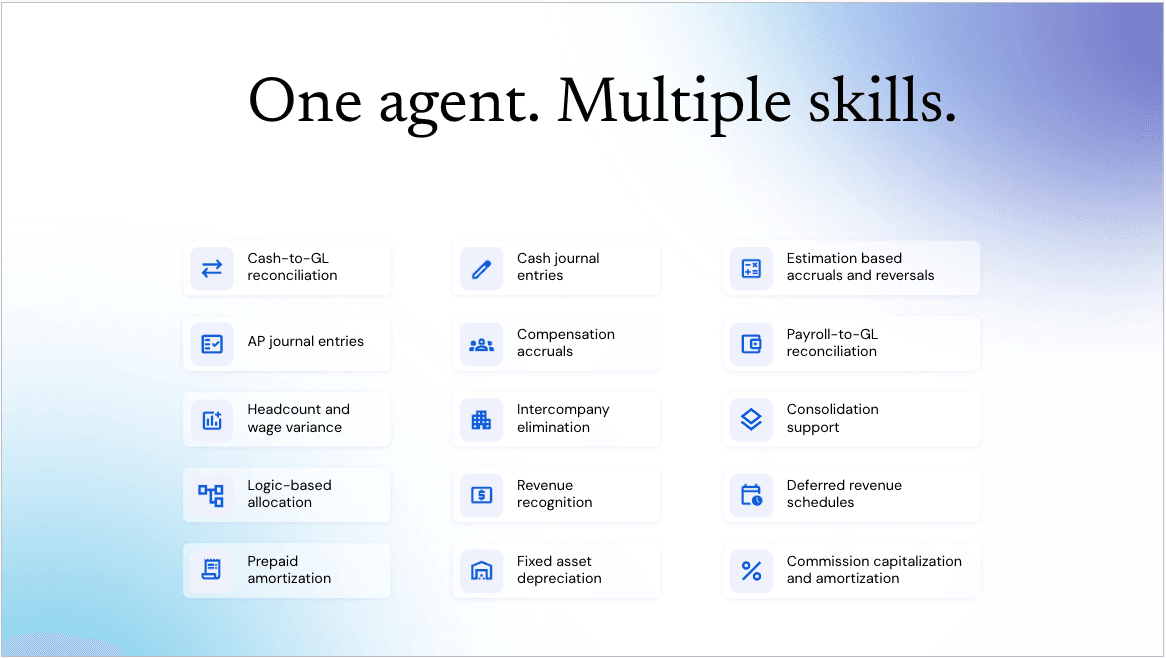
Just as accountants build expertise across different disciplines throughout their careers, Max is equipped with specialized accounting skills that allow it to prepare work across a broad range of workflows. Today, those skills span cash accounting, accruals and AP, payroll, intercompany, allocations, and revenue accounting. Over time, as Max learns new skills, it will be able to take on an increasingly diverse set of accounting work.
Intelligence is no longer the bottleneck
Ask two accountants to prepare the same accrual using the same AI model and you will often get two different outputs.
Same company. Same task. Same model. Different result.
The reason is simple. The model may be intelligent, but it does not know how your accounting team works.
Large language models have become remarkably capable. They can explain accounting concepts, answer technical questions, and even draft plausible journal entries. But producing consistent accounting work still depends heavily on the person using the model. Someone has to tell it which accounting standard to apply, which thresholds are acceptable within your company’s accounting policy, how estimates should be calculated, which GL accounts and cost centers should be impacted, what supporting evidence to attach, and how the output should be formatted for review.
More importantly, someone has to supply the written and unwritten knowledge that exists inside every accounting organization. The senior accountant who knows how vendor accruals are estimated when invoices have not yet arrived. The controller who knows the allocation methodology for cross department expenses. The reviewer who knows exactly what support needs to be attached before approving an entry.
That expertise does not live inside the LLM. It lives inside people. And that is why AI has largely improved individual productivity rather than institutional capability. A skilled accountant can generate a strong output from a model, but that expertise stays trapped in individual experience, transferring slowly, inconsistently, and only through repeated explanation.
AI made accountants faster. It did not make accounting reliable.
What is a skill?
A skill is the codified accounting expertise that tells Max how to perform a specific type of work correctly.
At a surface level, many AI products appear capable of accounting tasks. They can read spreadsheets, summarize transactions, draft journal entries, and answer technical questions. But capability alone does not produce reliable accounting work. A capability without a skill is simply a chatbot with spreadsheet access. A skill is the accounting judgment that turns a mechanical action into a defensible accounting output.
Consider a simple example. The capability is the ability to pull a vendor’s trailing invoices, build a schedule, and generate a journal entry. The skill is knowing that an uninvoiced AWS liability should be accrued, which estimation method is appropriate, what materiality threshold applies, and which accounts the entry should impact. The first is mechanical. The second is the judgment an experienced accountant carries in their head.
That judgment is exactly what we have codified.
Each skill captures the best practices, methodologies, intuition, and experience our accountants and auditors have built from years of performing the work themselves. These are not scraped from the internet or generated by a model. They are written by professionals who came from the Big Four and have spent years operating inside accounting organizations. Once a skill exists, Max can apply that expertise every time the workflow runs, across periods, entities, and teams, instead of relying on one person to explain the task again and again.
Every skill captures the accounting treatment to apply, the judgment required, the calculations and validations that must occur, the supporting evidence that should be attached, and the output a reviewer expects to see. In other words, a skill makes institutional accounting knowledge reusable. The judgment that once lived inside a handful of experienced accountants becomes something Max can apply across thousands of workflows, at full volume, with the same consistency every time.
Why accounting needs skills
Accounting is one of the most demanding environments for AI. It is highly domain-specific, deeply interconnected, exception-heavy, and governed by strict requirements around accuracy, controls, and auditability. A plausible answer is not sufficient. The output has to be correct.
AI in accounting is only useful if the system underneath it actually knows the work. It has to know how revenue recognition under ASC 606 works in practice, not in summary. It has to know how a multi-entity structure rolls up, what intercompany eliminations look like inside that roll-up, and how to carry consolidation support that holds together. It has to account for the fact that every controller’s chart of accounts is its own quiet exception to the rule. And it has to produce audit-grade traceability: the kind of lineage and evidence a Big Four reviewer expects to see before they put their name on the financials.
A general-purpose model carries none of that on its own. Reliable accounting work requires more than intelligence. It requires accounting expertise applied consistently within a controlled system.
Why this matters
Every accounting organization has expertise that lives in a handful of experienced people. They know how accruals are estimated, how reconciliations are reviewed, how exceptions are handled, and what evidence must be attached before work can be approved. Historically, that knowledge has been difficult to scale.
Skills change that. When Max prepares the work, it is applying accounting expertise codified, tested, and reused across thousands of workflows. The supporting evidence, audit trails, and documentation come from the system of work it runs inside, attached from the start.
This does not remove the accountant from the process. Accountants still review, approve, and exercise judgment where judgment is required. Max prepares the work; accountants provide oversight. The result is accounting preparation that is more consistent, more reliable, and less dependent on institutional knowledge being concentrated in a small number of people.
The model provides the intelligence. Skills provide accounting expertise. The system of work makes that work accurate, governable and auditable. Together they let Max apply the knowledge of experienced accountants consistently across every workflow and every period

Move closer to an audit-ready, continuous close

Request demo
Insights, news and content
The latest
See all