Accounting
5 variance analysis software tools for accounting teams
Written by

The Maxima Team
{
"@context": "https://schema.org",
"@type": "FAQPage",
"mainEntity": [
{
"@type": "Question",
"name": "Is variance analysis software the same as flux tools?",
"acceptedAnswer": {
"@type": "Answer",
"text": "Flux tools are one category within variance analysis software, not a synonym. Flux commentary tools help accountants draft explanations for account changes, while close platforms like Maxima prepare the underlying journals and reconciliations that create those changes. The difference is what work each category actually performs during close."
}
},
{
"@type": "Question",
"name": "Do I need variance analysis software if I already have an ERP?",
"acceptedAnswer": {
"@type": "Answer",
"text": "ERPs produce the data but rarely prepare variance explanations at the transaction level. Native ERP reporting reaches its boundary quickly once you cross multi-entity structures or six-figure monthly transaction counts. A dedicated layer becomes worth adding when your team is exporting to Excel to do the actual analysis."
}
},
{
"@type": "Question",
"name": "How does agent-prepared flux differ from AI-assisted commentary?",
"acceptedAnswer": {
"@type": "Answer",
"text": "AI-assisted commentary helps draft the explanation after a variance has been identified. The accountant still has to verify the source data and build the support. Agent-prepared flux uses transaction-level lineage to stage the investigation, evidence, and proposed explanation before review. The difference is whether the tool helps write the explanation or prepares the analysis behind it."
}
},
{
"@type": "Question",
"name": "When does spreadsheet-based flux stop working?",
"acceptedAnswer": {
"@type": "Answer",
"text": "Manual flux typically breaks down once you're managing multi-entity closes with 100,000+ monthly transactions, where reconciling data across systems consumes more time than analyzing it. SOX documentation requirements compound the problem, since spreadsheet-based analysis is difficult to make re-performable for auditors. That's the point where a preparation-first platform becomes the practical answer."
}
}
]
}
Most searches for variance analysis software return a jumbled mix of FP&A planning tools, flux commentary layers, and full close-execution platforms. They share a keyword. They do not share a job to be done.
If you've sat through three demos and walked away more confused than when you started, that's why. This shortlist cuts through it by category, so you can match the tool to the actual bottleneck in your close, whether that's reporting, commentary drafting, or the prep work that happens before either of those.
What is variance analysis software?
Variance analysis software helps accounting and finance teams identify, explain, and act on differences between expected and actual financial results. The category spans three distinct use cases: budget vs. actual reporting for FP&A teams, flux analysis and variance reporting during the close cycle, and transaction-level close analysis where AI agents prepare the underlying accounting work. Knowing which problem you're solving determines which type of tool actually fits.
Benefits of variance analysis software for accounting teams
Faster close cycles: AI-native platforms like Maxima prepare flux analysis continuously, so accountants review staged work instead of assembling it from scratch. PwC estimates AI can cut up to 80% of the time spent on core finance processes, and teams running agent-prepared close workflows are seeing close cycle reductions of multiple days.
Sharper root-cause visibility: Transaction-level tools surface the specific activity driving a variance, not just the account-level delta. That distinction matters when auditors ask why a number moved.
Stronger auditability: Close-management and AI-native platforms maintain immutable audit trails and approval workflows. Spreadsheet-based flux analysis rarely produces evidence that's re-performable for SOX review.
Less reviewer burden: Flux commentary tools like Numeric reduce time spent drafting explanations. AI-native platforms go further by preparing the underlying evidence before the reviewer opens the file.
Better internal justification for FP&A: Spreadsheet-centric tools like Vena give finance teams a structured budget vs. actual view that's easier to present to leadership than a raw ERP export.
Common variance analysis use cases
The term "variance analysis software" covers more ground than close-cycle flux. Here are the four use cases most accounting and finance teams are actually solving for, and which category fits each one best.
Close flux analysis: Identifying and explaining account-level changes period over period during the close cycle. AI-native platforms like Maxima prepare this work continuously with transaction-level lineage. Flux commentary tools like Numeric accelerate the explanation drafting step.
Budget vs. actual reporting: Comparing plan to actuals for leadership review and FP&A cycles. Spreadsheet-centric tools like Vena are built for this use case and keep finance teams in an Excel-native environment.
Cash flow and treasury variance analysis: Tracking differences between forecasted and actual cash positions across entities or accounts. AI-native platforms with continuous bank and ERP ingestion handle this at scale; lighter tools depend on manual exports.
Revenue and forecast variance analysis: Explaining gaps between forecasted and recognized revenue, often tied to billing, deferred revenue, or contract changes. This use case benefits most from transaction-level drill-down into billing and subledger data.
How to evaluate variance analysis software without mixing up three different categories
Before you shortlist vendors, figure out which category you're buying. Most tools fall into three operating models, and they solve different bottlenecks. Confusing them is the main reason tool selections stall after demo three.
Most tools fall into three operating models
Each category solves a different bottleneck. Knowing which one matches your situation is more useful than comparing feature lists across all three. One practical way to separate the categories is how much context they preserve behind the GL balance: trial balance trends can show where a number moved, but the explanation often depends on the transaction and source-system activity behind it.
Spreadsheet-centric planning tools handle budget vs. actual reporting and FP&A modeling. They work from consolidated GL and plan data, which makes them a natural fit for FP&A teams living in Excel. Their boundary is the same as any human-built model: limited transaction depth, manual upkeep, and context that often has to be rebuilt through exports or supporting schedules.
Flux analysis and close-management tools surface account changes, draft explanations, and coordinate reviewers. They operate mostly at the account-level trend layer, with some drill-through. That helps when the bottleneck is commentary or review routing, but it does not fully remove the prep work of connecting upstream transaction activity back to the GL before the explanation is ready.
AI-native close platforms prepare journals, reconciliations, and flux analysis with transaction-level lineage. They ingest ERP, bank, billing, payroll, and other source-system data continuously, so the platform can connect source activity to the GL before review starts. The practical difference is that accountants review staged explanations with supporting evidence instead of manually reconstructing why the number moved.
Category choice matters more than feature checklists. A tool that ranks first for FP&A reporting or close review can still be the wrong pick for a controller trying to reduce the manual prep behind close.
Top variance analysis software at a glance
Tool | Category | Best For | Workflow Depth | Pricing Model | G2 Rating |
|---|---|---|---|---|---|
Maxima | AI-native close platform | Enterprise teams automating record-to-report | Agent-prepared flux with lineage | Fully custom | 4.8/5 |
Numeric | Flux analysis layer | Mid-market teams speeding up commentary drafting | AI-assisted commentary | From $30/user/month | 4.8/5 |
FloQast | Close-management platform | Teams standardizing reviewer collaboration | AI-assisted review routing | From ~$12,000/year | 4.6/5 |
BlackLine | Enterprise close governance | Large orgs with 20+ entities and SOX frameworks | Governed close orchestration | Fully custom | 4.5/5 |
Vena | Spreadsheet-centric FP&A | FP&A teams doing budget vs. actual in Excel | FP&A reporting and modeling | Fully custom | 4.3/5 |
The five tools below span all three categories. Each entry covers operating model, what it does well for variance analysis, best fit, and natural boundary so you can match the tool to your actual bottleneck.
1. Maxima
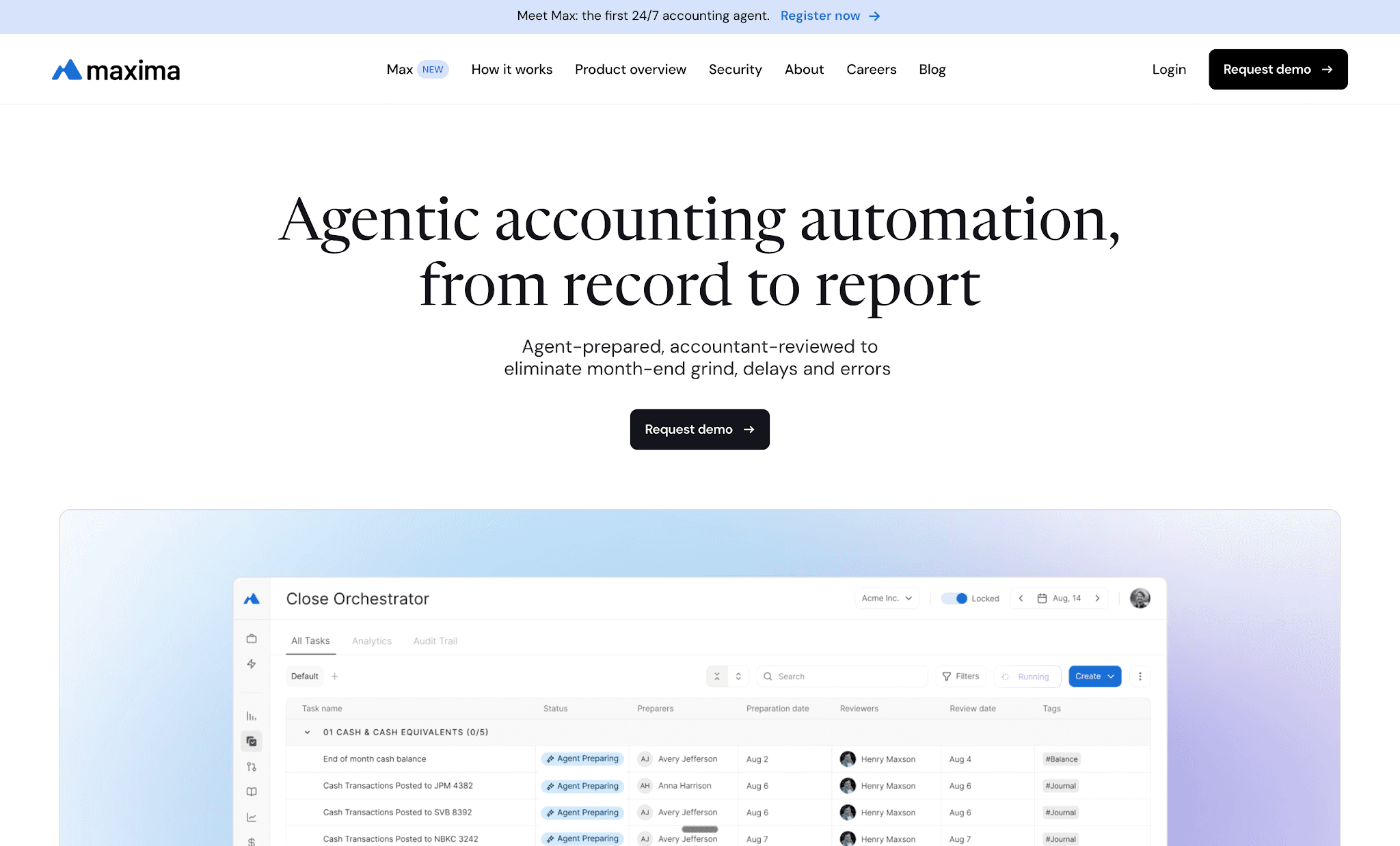
Maxima is an AI-native accounting platform where agents prepare flux analysis inside the close, not alongside it. Max, the platform's accounting agent, detects variances at the transaction level, proposes explanations with full drill-down lineage, and stages the work for reviewer approval. For example, a Current Assets movement can be broken into the drivers behind it, such as Accounts Receivable, Other Current Assets, and Bank, instead of remaining a single account-level delta.
It runs on a unified finance graph that ingests ERP, bank, payroll, billing, and BI data continuously, so flux analysis is already in motion before day one of close. Teams like Rippling, Scale AI, and SpotOn use it to compress close cycles on high-volume ledgers where account-level flux tools stop scaling.
Operating model
AI-native platform where agents prepare flux analysis inside the close workflow, not just assist commentary.
Works from ERP, bank, payroll, billing, and BI data unified in one continuous finance graph.
Keeps accountants in approval control with transaction-level lineage, validations, and immutable audit trail.
Continuous preparation model replaces month-end scramble with work already staged for review.
Built to meet SOX control requirements around AI-prepared journal entries and reconciliations.
What it does well for variance analysis
Native integrations to upstream source systems, and deep connectors to ERPs
Flags material variances at the transaction level, not just at account summary level.
Proposes explanations with drill-down evidence tied to the underlying activity.
Connects flux directly to reconciliations, journal entries, and close status in one system of work.
Delivers audit-ready outputs with deterministic logic and full source lineage.
Best fit
Enterprise accounting teams closing 5+ entities or processing hundreds of thousands of transactions per period.
Teams targeting a 3-5 day reduction in close timeline through preparation automation.
Controllers who want review-first workflows instead of spreadsheet assembly.
Organizations that need SOX-aligned controls around AI-prepared accounting work.
Natural boundary
More platform depth than a lightweight reporting or commentary tool, which is a design choice, not a criticism.
Best when variance analysis sits inside broader record-to-report automation.
Full value shows up once ERP, bank, and billing systems are connected into the finance graph.
Pricing is custom SaaS, sized to scope rather than published per seat.
2. Numeric
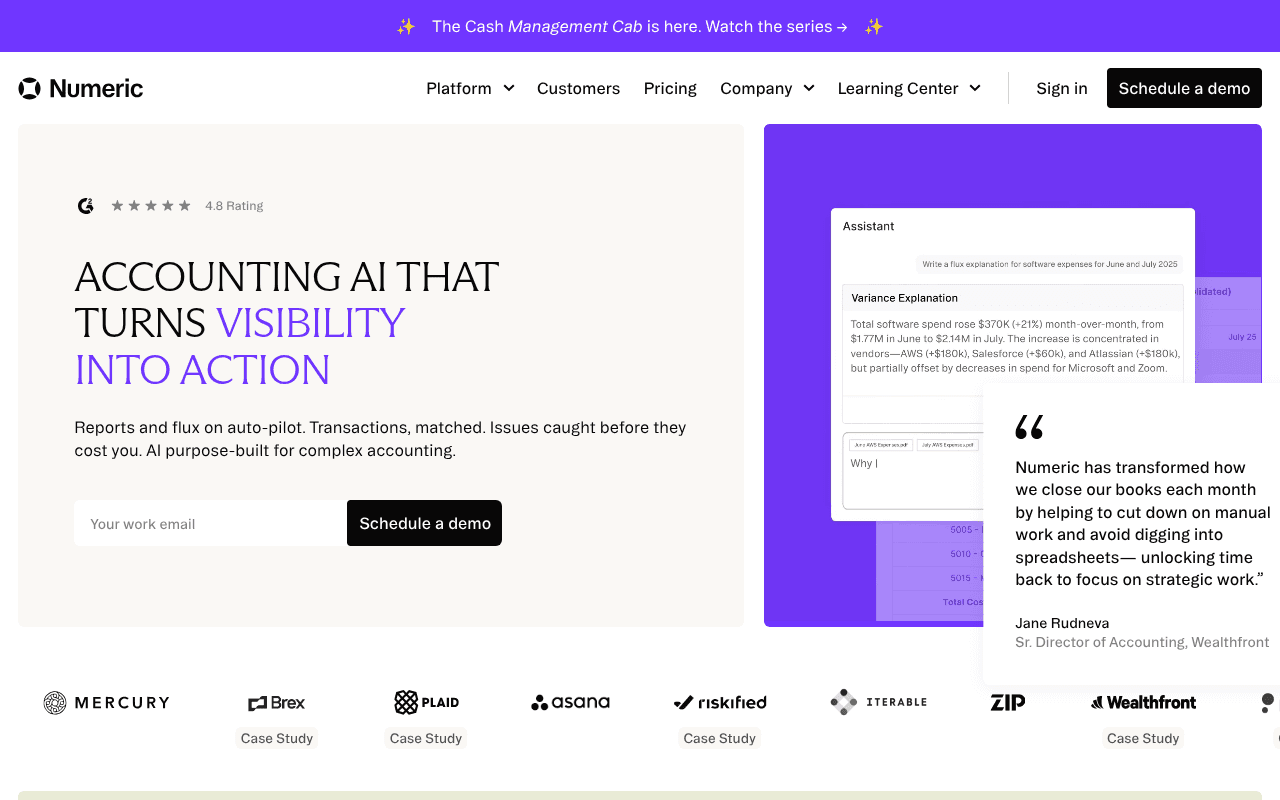
Numeric is an AI-assisted flux analysis layer focused on variance reporting workflows. It pulls ERP data into flexible templates, surfaces core drivers, and helps accountants start explanations faster than writing them from scratch. It sits comfortably in the middle of the market for teams whose main bottleneck is commentary drafting, not underlying transaction prep.
Operating model
AI-assisted flux analysis layer centered on variance reporting workflows.
Pulls ERP data into customizable templates and trend views.
Helps teams start explanations faster instead of writing from scratch.
What it does well for variance analysis
Automates flux analysis and surfaces core variance drivers across accounts.
Supports flexible, custom templates and real-time ERP data integration.
Reduces time spent on close-cycle explanation drafting for account-level reporting.
Best fit
Mid-market accounting teams (roughly 3-6 accountants) upgrading from manual flux decks.
Organizations focused on account review more than end-to-end close automation.
Teams whose bottleneck is commentary drafting, not underlying transaction prep.
Natural boundary
Stronger in flux analysis than in full journal and reconciliation preparation.
Less suited when variance explanations require source-to-GL lineage across many transaction systems.
Essentials starts at $30/user/month; Growth and Enterprise are quote-based.
3. FloQast
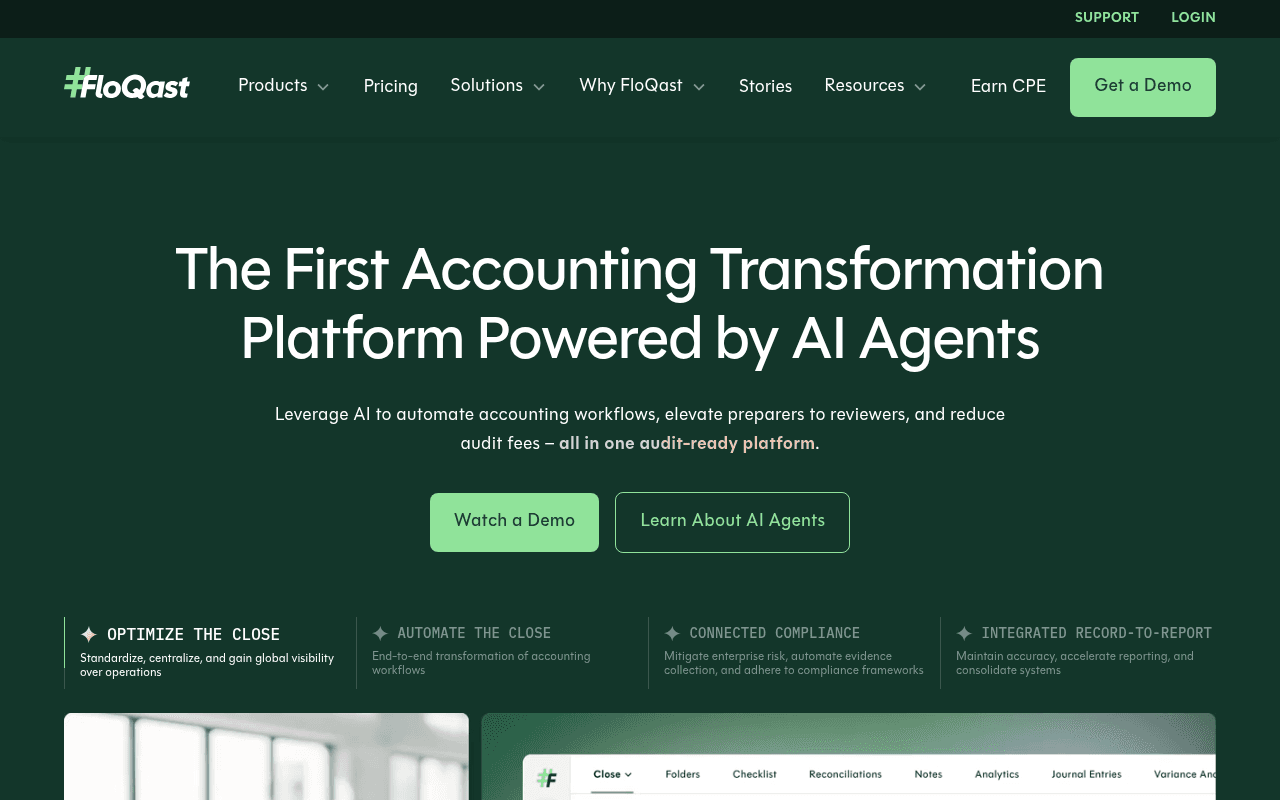
FloQast is a close-management platform that layered AI-assisted variance review on top of its checklist-driven workflow. It routes items needing attention via alerts and collaborative review notes, and is used by more than 3,500 companies for close orchestration. The variance module fits teams that already run close on FloQast and want tighter review coordination without swapping platforms. FloQast now markets itself as "The First Accounting Transformation Platform Powered by AI Agents," but the core operating model remains close orchestration: the platform coordinates and tracks human work rather than autonomously preparing flux analysis or journal entries.
Operating model
Close-management platform with AI-assisted variance review inside the close cycle.
Uses alerts, review notes, and collaboration to route items needing attention.
Designed to orchestrate tasks and handoffs across accounting teams.
What it does well for variance analysis
AI-assisted flux analysis with automatic notifications for fluctuations above threshold.
Customizable budget variance comparisons and shared review notes across teams.
Reduces manual scanning by surfacing items requiring reviewer attention.
Best fit
Accounting teams of 5-15 people standardizing close coordination and reviewer collaboration.
Teams already aligned around checklist-driven close management.
Organizations closing in 8-10 days who want tighter coordination, not fewer prep hours.
Natural boundary
Emphasis is task orchestration and AI-assisted review, not agent-prepared execution.
Transaction-level investigation and source-to-GL tie-outs often still happen before the review workflow begins.
Pricing is quote-based and typically starts around $12,000/year at the entry level.
4. BlackLine

BlackLine is the established financial close platform for large enterprises, built around reconciliations, controls, and governance across many entities. Its variance analysis fits inside a broader close-process framework rather than functioning as a standalone flux tool. It suits organizations that need standardized, SOX-aligned workflows across 20+ entities and multi-layer approval chains.
Operating model
Established financial close platform spanning controls, reconciliations, and governance.
Approaches variance analysis from a standardized close-process perspective.
Built for organizations formalizing close structure across larger teams.
What it does well for variance analysis
Brings process discipline and visibility to period-end review.
Fits enterprises that need governed workflows across many entities.
Works well when variance review sits inside a broader control framework.
Best fit
Large enterprises with 20+ entities and formal SOX control frameworks.
Accounting organizations of 30+ people prioritizing standardization and process control.
Buyers with complex approval chains and multi-layer close procedures.
Natural boundary
Category strength is governance and orchestration, not agent-prepared accounting execution.
Strong for governed close workflows, but not the same as a preparation layer that connects upstream transaction activity to GL-level variance explanations.
Pricing is fully custom based on modules, entity count, and volume.
5. Vena
Vena is a spreadsheet-centric FP&A platform with an Excel-like interface for budget variance reporting and ad hoc analysis. It consolidates plan and actual data, supports drill-through, and keeps FP&A teams in the environment they already know. It is an FP&A-first budget variance tool rather than a close-readiness platform.
Operating model
Spreadsheet-centric FP&A platform with Excel-like workflows for variance reporting.
Consolidates data for budget vs. actual analysis and ad hoc reporting.
Keeps teams in a familiar planning and reporting environment.
What it does well for variance analysis
Automatic spreadsheet integration with Excel-native modeling and drill-through capabilities.
Strong for budget variance reporting and ad hoc analysis across plan versus actual.
Comfortable transition for finance teams that live in Excel.
Best fit
FP&A-heavy environments focused on plan vs. actual reporting.
Teams of 3-8 FP&A analysts that want software without abandoning spreadsheet habits.
Companies where variance analysis lives on the FP&A side, not the controllership side.
Natural boundary
Still depends on human-built models, templates, and reporting logic.
Less suited for transaction-level accounting prep during close.
Two packages (Professional and Complete) with fully custom pricing tied to modules and users.
How to choose: match the category to the bottleneck
Before picking a vendor, pick the category. If the bottleneck is drafting commentary and flux explanations faster, evaluate Numeric. If the bottleneck is coordinating reviewer workflows and standardizing the close checklist, evaluate FloQast or BlackLine. If the bottleneck is the prep work underneath the commentary — the journals, reconciliations, and transaction-level investigation that produce the numbers being explained — evaluate Maxima. If the work lives entirely in FP&A and Excel, evaluate Vena. The most common mistake is evaluating tools across categories and comparing features that solve fundamentally different problems.
For a broader comparison of how these operating models apply beyond variance analysis, see Maxima's guide to the best AI agents for finance teams in 2026.
FAQs: variance analysis software
Is variance analysis software the same as flux tools?
Flux tools are one category within variance analysis software, not a synonym. Flux commentary tools help accountants draft explanations for account changes, while close platforms like Maxima prepare the underlying journals and reconciliations that create those changes. The difference is what work each category actually performs during close.
Do I need this if I already have an ERP?
ERPs produce the data but rarely prepare variance explanations at the transaction level. Native ERP reporting reaches its boundary quickly once you cross multi-entity structures or six-figure monthly transaction counts. A dedicated layer becomes worth adding when your team is exporting to Excel to do the actual analysis.
How does agent-prepared flux differ from AI-assisted commentary?
AI-assisted commentary helps draft the explanation after a variance has been identified. The accountant still has to verify the source data and build the support. Agent-prepared flux uses transaction-level lineage to stage the investigation, evidence, and proposed explanation before review. The difference is whether the tool helps write the explanation or prepares the analysis behind it.
When does spreadsheet-based flux stop working?
Manual flux typically breaks down once you're managing multi-entity closes with 100,000+ monthly transactions, where reconciling data across systems consumes more time than analyzing it. SOX documentation requirements compound the problem, since spreadsheet-based analysis is difficult to make re-performable for auditors. That's the point where a preparation-first platform becomes the practical answer.
Conclusion
The right variance analysis software depends less on flashy AI language and more on where your close actually breaks. Report on variances, help explain them, or prepare the close work behind them are three different jobs, and the best tool depends on which one you need done.
Use this quick recap to self-select:
Maxima: enterprise teams that need granular agent-prepared flux tied to journals, reconciliations, and transaction level lineage.
Numeric: mid-market teams whose main bottleneck is drafting flux commentary faster.
FloQast: close-management shops standardizing reviewer collaboration and task orchestration.
BlackLine: large enterprises formalizing governed close processes across many entities.
Vena: FP&A-heavy environments doing plan vs. actual reporting in an Excel-native workflow.

Move closer to an audit-ready, continuous close

Request demo
Insights, news and content
The latest
See all