If you've run a month-end close on BlackLine, you already know the platform's real job: it tracks and governs the work your team prepares. The harder question, when you start shopping for alternatives, is whether you need better orchestration, deeper reconciliation, AI-prepared accounting outputs, or a broader close-plus-consolidation platform. Those are four different operating models, and most shortlists mix them together.
This guide compares eight BlackLine alternatives by what they actually automate, not by feature checklist parity.
Who this is for: Controllers, accounting managers, and finance leaders evaluating a BlackLine replacement or first-time close platform.
What it compares: Operating model, automation depth, implementation effort, G2 rating, and best-fit scenario.
How to use it: Identify your bottleneck first, then read the two or three vendor sections that match.
What BlackLine is, and what it was built for
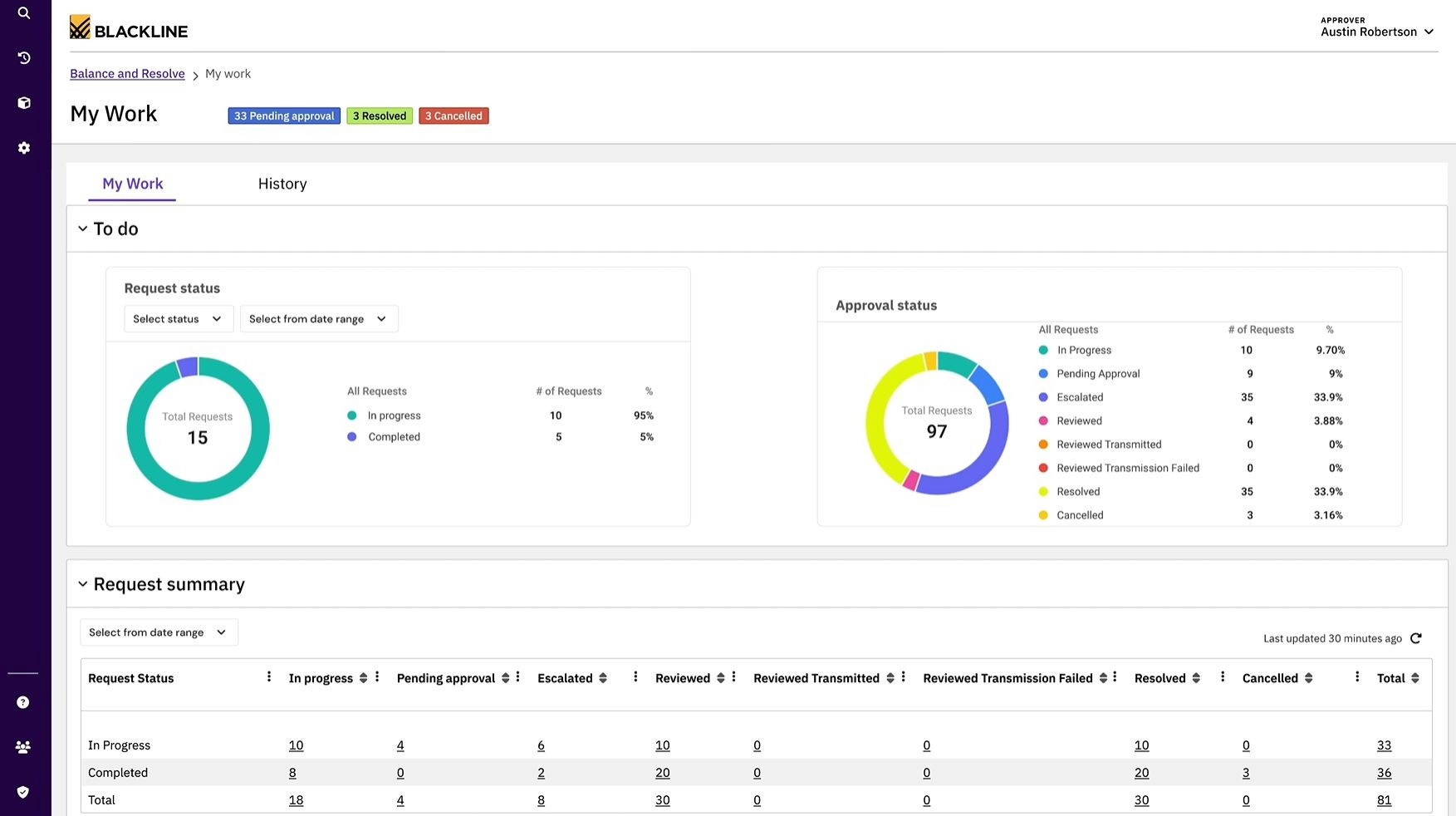
BlackLine is an enterprise close management and financial controls platform built to bring structure to the record-to-report process. It centralizes account reconciliations, journal entry management, transaction matching, and close task workflows in one system, replacing the spreadsheet-and-email coordination most teams default to.
The platform was designed around visibility and control: real-time close status, standardized reconciliation templates, and enforced review workflows across large teams. What it does not do is prepare the accounting work itself. Your team still builds the reconciliations, drafts the journal entries, and investigates variances. At enterprise list pricing of 150K to 500K annually and 6 to 9 month implementations, that distinction matters.
Compare operating models before feature checklists
Most BlackLine alternative comparisons fail because they evaluate unlike tools as if they did the same job. Before you open a single demo, sort the market into four buckets. Then compare only inside the bucket that matches your actual problem.
Close orchestration: Tracks and coordinates human-prepared work (checklists, dashboards, reviewer routing).
Reconciliation-led automation: Automates matching, certification, and high-volume rec workflows.
Agent-prepared accounting: AI agents prepare journals, reconciliations, and flux end-to-end for human review.
Consolidation-led finance platforms: Treat close, consolidation, and reporting as one platform decision.
Map your bottleneck to the right replacement path
Before you shortlist anything, ask which work still consumes reviewer hours at month-end.
Is the close blocked by manual JE prep, balance-sheet recs, or high-volume matching? Prioritize automation depth.
Is the pain status visibility, reviewer coordination, and control discipline across entities? Go deeper on close management.
Are close and consolidation being scoped together? An enterprise finance platform belongs in the shortlist from day one.
Is audit readiness or ASC 606 complexity the real blocker? Add a specialist alongside the close tool, not instead of it.
Methodology
The nine platforms below were selected based on how frequently they appear in BlackLine replacement searches, G2 category rankings, and practitioner conversations.
Operating model: What work the software prepares versus tracks.
Automation depth: Coverage across JE, reconciliation, matching, and flux.
Implementation effort: Realistic timeline and internal admin load.
G2 rating and fit: Where the platform actually wins by company stage and bottleneck type.
Pricing: Not a primary column because most platforms quote custom; called out where transparent pricing exists.
Quick comparison of the best BlackLine alternatives
At-a-glance comparison table
Product | Operating model | Likely tradeoff | Implementation effort | G2 rating |
Maxima | Agent-prepared accounting | Newer category, not a broader CPM suite | Light (native to 100+ systems) | 4.8/5 |
FloQast | Close orchestration | Coordinates work your team still prepares | Light to moderate (4-8 weeks) | 4.6/5 |
Trintech Cadency | Enterprise R2R, rule-based | Heavy admin ownership and config | Heavy (3-6 months) | 4.5/5 |
HighRadius | Reconciliation-led R2R, AI matching | Long deployment, rule maintenance | Heavy | 4.3/5 |
OneStream | Consolidation-led finance platform | Overkill if only the close is broken | Very heavy (6-12 months) | 4.4/5 |
Workiva | Reporting and controls, close-adjacent | Lighter on core JE and rec prep | Moderate to heavy | 4.6/5 |
Sage Intacct | ERP-native close and recs | Ceiling at enterprise scale | Light to moderate for existing customers | 4.3/5 |
Zuora Revenue | ASC 606 revenue close specialist | Not a full BlackLine replacement alone | Heavy (3-6 months) | 4.1/5 |
1. Maxima
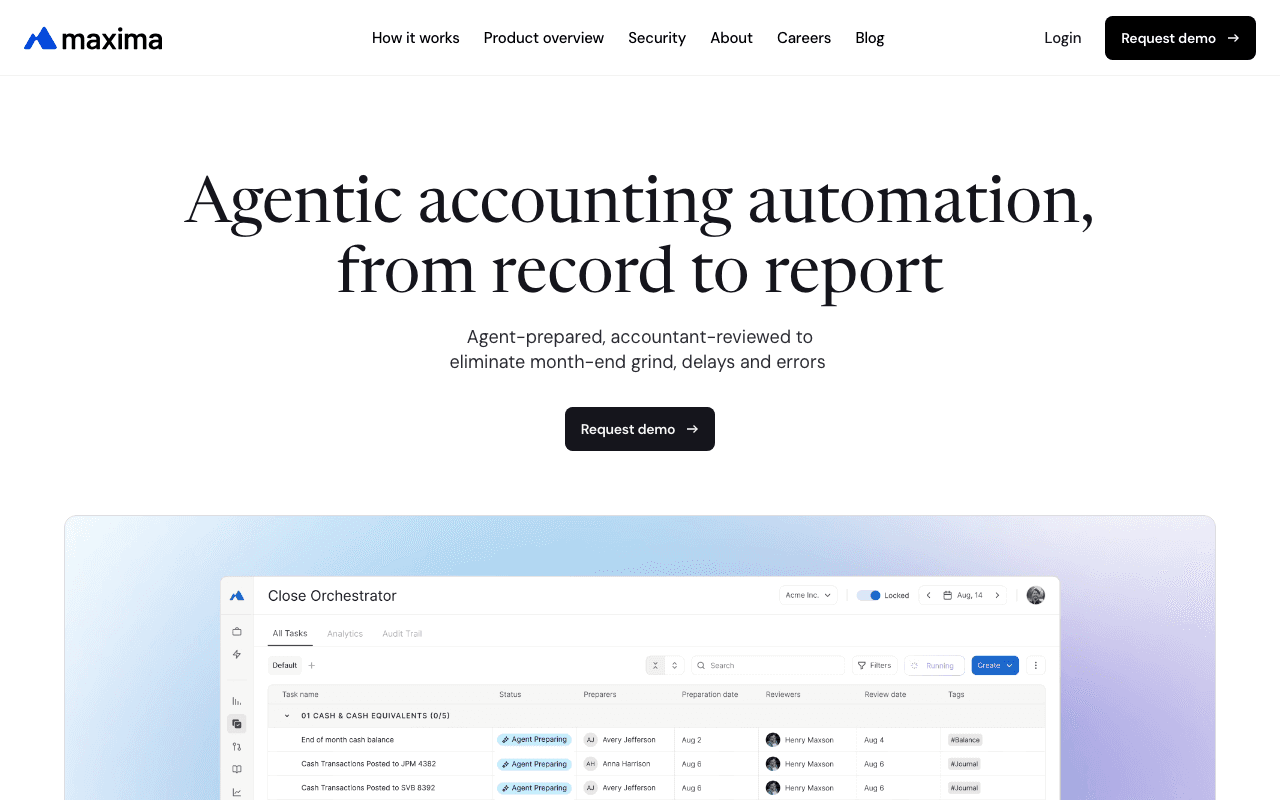
Maxima is an AI-native accounting platform where agents prepare journal entries, reconciliations, transaction matches, and flux analysis continuously, then route them for human review with full lineage. It is built for enterprise teams whose bottleneck is the prep work itself, not the checklist that tracks it.
Best fit
Enterprise accounting teams at high-growth SaaS and tech companies running multi-entity structures with high transaction volume across banks, billing systems, and payroll.
Controllers whose teams spend the first week of close preparing journals, reconciling clearing accounts, and chasing flux explanations rather than reviewing finished work.
Organizations that need AI-prepared outputs routed for human review with full transaction lineage, not AI suggestions layered on top of manual spreadsheet work.
SOX-compliant teams that need audit-ready controls built into the preparation layer, not bolted on after the fact.
What stands out
Continuous preparation as data flows in, not month-end spikes driven by manual effort.
Transaction-level lineage on every journal entry, reconciliation, and flux output so reviewers can drill down without chasing source data.
Unified finance graph connecting ERP, bank, billing, and payroll in one data model, eliminating the reconciliation gaps that come from disconnected systems.
SOX-aligned approval controls and immutable audit trails enforced architecturally, not configured manually per workflow. This auditability should be generated automatically. As Goel explained in CPA Practice Advisor, “A properly configured AI system can log data sources, rule changes, and user overrides automatically.”
Zendesk migrated system-to-system SOX reconciliations from BlackLine to Maxima, lifting match rates from 88% to over 98% with the control automated and audit-ready.
Natural tradeoffs
Maxima is built for prep-work bottlenecks. If the pain is close coordination or reviewer routing rather than preparation volume, a lighter orchestration tool is sufficient.
If consolidation or CPM is in scope, Maxima sits as the preparation layer within that architecture, not a replacement for consolidation or planning functionality.
Implementation effort
Light. Native connectivity to 150+ ERPs, banks, payroll, and billing systems removes most integration lift.
Configuration centers on data mapping, materiality thresholds, and approval workflows rather than building integrations from scratch.
G2 rating: 4.8/5.
2. FloQast

FloQast is a close management platform built by accountants for accountants, organized around checklists, dashboards, and reviewer coordination. It overlays your existing ERP rather than replacing source-system workflows.
Best fit
Teams that primarily need cleaner close coordination, checklist discipline, and real-time status visibility across reviewers and task owners.
Organizations where the prep work is already handled reasonably well and the gap is coordination: who owns what, what's blocked, and what's still open at day three of close.
Mid-market accounting teams that want to go live quickly without a heavy implementation project or dedicated platform admin.
What stands out
Intelligent checklists and close dashboards with real-time status tracking across the full close cycle.
Reconciliation workflow support and tight integrations with collaboration tools your team already uses.
G2 data shows roughly 2.9x faster go-live than BlackLine (1.7 months vs. 5) and a 2x shorter payback period.
Natural tradeoffs
FloQast coordinates work your team still prepares manually. Faster deployment does not reduce the underlying burden of spreadsheet-heavy reconciliations or JE prep.
If reviewers are spending more time building the work than reviewing it, a checklist layer will not move the needle on close cycle time in any meaningful way.
Implementation effort
Light to moderate. Most mid-market teams are live in 4 to 8 weeks. Pricing typically runs 30K to 80K annually.
G2 rating: 4.6/5.
3. Trintech
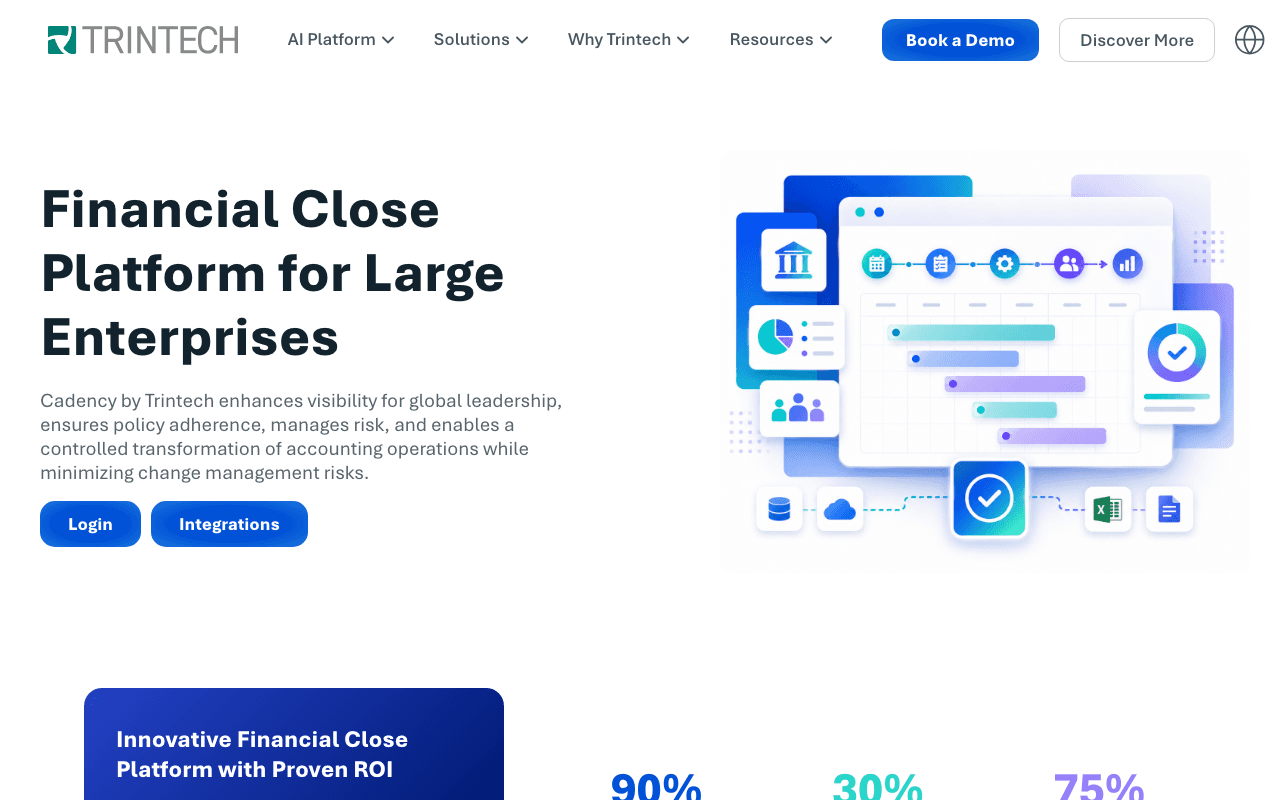
Trintech is a mature enterprise close and reconciliation platform with deep transaction matching, JE management, and compliance workflows. It targets the same enterprise buyer as BlackLine and competes head-to-head on R2R breadth.
Best fit
Large enterprises that need a mature close and reconciliation platform with transaction matching, journal entry management, intercompany, and compliance depth across many entities.
Organizations with complex control frameworks that require significant configurability across business units, legal entities, and geographies.
Teams evaluating a direct BlackLine replacement on enterprise R2R scope, not a lighter close coordination layer.
What stands out
Broad enterprise scope spanning close, reconciliation, intercompany, audit, and reporting workflows.
Strong configurability for complex control frameworks across many entities and geographies.
Natural tradeoffs
This is a true enterprise platform evaluation, not a lightweight checklist replacement. The breadth that makes it competitive with BlackLine is also what drives implementation timelines and ongoing admin overhead.
Teams that underestimate the internal ownership required for configuration, data migration, and process mapping often find the platform underperforms expectations in year one.
Like BlackLine, Trintech governs and tracks the work your team prepares. If the bottleneck is prep volume rather than control discipline, the operating model is the same problem in a different package.
Implementation effort
Heavy. Expect 3 to 6 months for full deployment, with significant process mapping, data migration, and internal admin ownership required throughout.
G2 rating: 4.5/5.
4. HighRadius

HighRadius positions a unified R2R platform that spans close, reconciliation, consolidation, and reporting with AI-led transaction matching. It is built for high transaction volume and ERP complexity.
Best fit
Mid-market and enterprise teams with heavy transaction volume, bank and ERP complexity, and a need for reconciliation-led R2R automation at scale.
Organizations where autonomous transaction matching across high-volume GL and subledger data is the primary automation priority.
Finance teams evaluating broader process standardization across close, reconciliation, consolidation, and reporting rather than solving a single workflow gap.
What stands out
Close, reconciliation, consolidation, reporting, and AI-led matching on one R2R platform.
Strength in autonomous matching at scale, particularly for high-volume bank and subledger reconciliation.
Natural tradeoffs
HighRadius belongs on the shortlist when the goal is broader finance-process standardization, not just a cleaner close checklist. Scoping it for a narrow problem means paying for platform breadth you will not use.
Matching rule configuration and exception workflow setup require dedicated project ownership. Teams without internal platform admin capacity tend to find ongoing maintenance heavier than expected.
Implementation effort
Heavy. Matching rule configuration, ERP integration, and exception workflow setup require dedicated project ownership. Single-module licenses commonly start in the 50K to 100K to 250K+ annually.
G2 rating: 4.3/5.
5. OneStream
OneStream is a unified enterprise finance platform that treats close, reconciliations, consolidation, and planning as one decision. It is a finance architecture choice, not a close tool swap.
Best fit
Finance organizations evaluating close, reconciliations, and consolidation as one platform decision, typically with executive sponsorship across finance, IT, and FP&A.
Global enterprises where multi-entity consolidation, intercompany eliminations, and close execution are tightly coupled and cannot be solved by separate point solutions.
What stands out
Unified platform across close, planning, reconciliations, transaction matching, and broader finance data.
Strong multi-entity consolidation depth that eliminates the integration overhead of stitching close and consolidation tools together.
Natural tradeoffs
OneStream is not the right answer if the immediate problem is close visibility or a narrow reconciliation workflow. The implementation investment is only justified when consolidation and planning are genuinely part of the same decision.
Teams that scope it as a close tool replacement often find they are paying for and managing platform capability they will not activate for 12 to 18 months post-go-live.
Implementation effort
Very heavy. Most deployments involve a systems integrator, run 6 to 12 months, and start around $150K annually for mid-market, stretching into seven figures for global enterprises.
G2 rating: 4.6/5.
6. Workiva

Workiva is a connected reporting and controls platform that links close outputs directly to disclosure, SOX documentation, and audit evidence. It is built for teams where the handoff between close and external reporting is a recurring source of manual rework.
Best fit
Public companies and pre-IPO organizations where audit readiness, SOX compliance, and disclosure management are as critical as close execution.
Teams where the handoff between close outputs and external reporting, board materials, or SEC filings is a recurring source of manual rework and version control risk.
What stands out
Connected reporting and controls layer that links close data directly to audit documentation, board reporting, and SEC filings.
Reduces manual handoff between close and disclosure by keeping data connected across the full reporting chain.
Natural tradeoffs
Workiva is strongest when reporting and controls are the primary buying driver. Teams whose main pain is reconciliation prep or JE automation will find core close workflow capabilities lighter than dedicated R2R platforms.
It solves the reporting and controls layer, not the preparation layer. Treat it as a complement to a close or reconciliation platform, not a replacement for one.
Implementation effort
Moderate to heavy. Connecting close outputs to disclosure workflows, SOX control documentation, and audit evidence requires coordination across accounting, IT, and external audit.
G2 rating: 4.5/5.
7. Sage Intacct
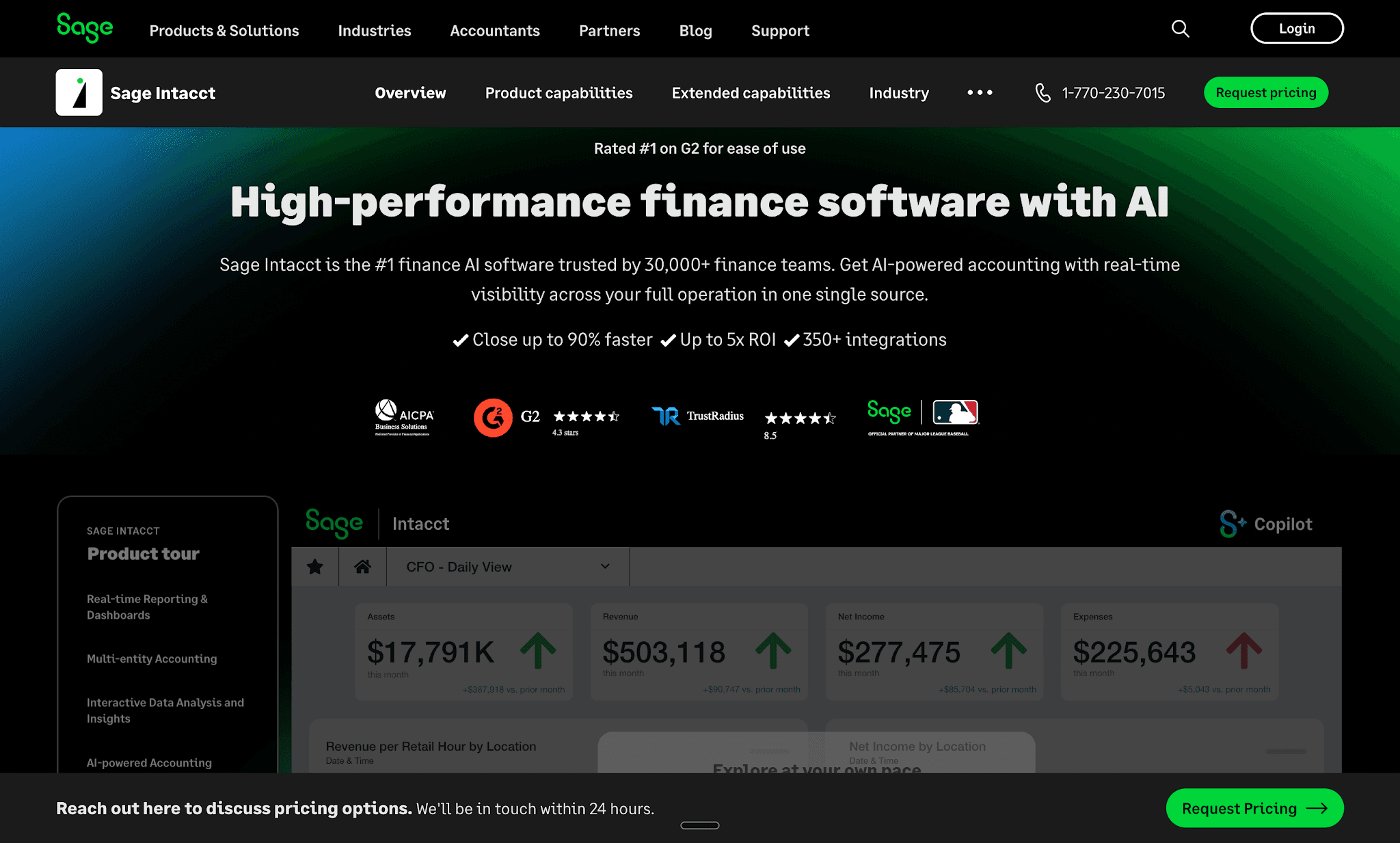
Sage Intacct is a mid-market cloud ERP with native multi-entity close, consolidation, and reconciliation capabilities built into the GL layer. For existing Intacct customers, it is often the lowest-friction path to tighter close workflows without adding a standalone platform.
Best fit
Mid-market accounting teams already running on Intacct that want tighter close workflows, multi-entity consolidation, and reconciliation support without adding a separate close platform.
Organizations that want to consolidate tooling by using ERP-native close capabilities rather than managing a standalone close tool alongside the GL.
What stands out
Native multi-entity and multi-currency close built into the ERP layer, eliminating the integration overhead of a standalone close tool.
Natural tradeoffs
Teams needing deep transaction matching, AI-prepared reconciliations, or SOX-grade audit trails at enterprise scale will hit the ceiling faster than on a dedicated R2R platform.
ERP-native close capabilities are convenient for existing Intacct customers but are not designed to compete with purpose-built close and reconciliation platforms on automation depth or control rigor.
Implementation effort
Light to moderate for existing Intacct customers. Migrating from a different ERP is a heavier lift.
G2 rating: 4.3/5.
8. Zuora Revenue
Zuora Revenue is a specialist ASC 606 revenue recognition platform built for subscription and usage-based businesses. It addresses the revenue close specifically, not the broader balance sheet.
Best fit
SaaS and subscription businesses where ASC 606 complexity is the primary close bottleneck: contract modifications, multi-element arrangements, variable consideration, and the reconciliation between billing systems and recognized revenue in the GL.
Teams where revenue recognition rules are too complex to manage in a general-purpose close platform and require dedicated rule enforcement and audit trail at the contract level.
What stands out
Automated revenue scheduling, contract modification handling, and recognition rule enforcement that removes the manual revenue close work generic close platforms do not touch.
Natural tradeoffs
Zuora Revenue is deep on a narrow problem. Teams still need a separate close management or reconciliation platform for the rest of the balance sheet.
Do not scope it as a BlackLine replacement on its own. It solves one part of the close, and a meaningful part for the right business, but it does not cover JE management, general reconciliations, or close orchestration.
Implementation effort
Heavy. ASC 606 rule configuration, contract data migration, and billing system integration require significant upfront scoping. Expect 3 to 6 months.
G2 rating: 3.9/5.
Which BlackLine alternative should you choose?
The right answer depends on what's actually slowing your close.
Choose Maxima if manual journal prep and reconciliations are the real bottleneck
If your team spends month-end preparing JEs, reconciling banks and clearing accounts, matching transactions, and chasing flux explanations, the operating model itself has to change. Maxima prepares those outputs continuously with AI agents and routes them to reviewers with full transaction lineage, instead of asking your team to keep building the work that a checklist tool would track.
Compare Maxima first against HighRadius if reconciliation-led automation is the scope, then against FloQast for a lighter, more data-connected starting point.
Signal: reviewers spend more time preparing than reviewing.
Choose Trintech Cadency or Maxima for heavier enterprise R2R demands
Both belong on the shortlist when volume, complexity, and control rigor are the buying center's first concerns. Compare workflow breadth, transaction-matching depth, exception routing, and reconciliation certification across many entities, and be honest about how much ongoing platform administration your team can absorb.
Choose OneStream when close and consolidation are inseparable
OneStream is the right path when finance leadership is making a broader platform decision, not just swapping a close tool. If multi-entity close is tied tightly to consolidation, reporting, and shared finance data, a unified platform avoids stitching close and consolidation together later. The implementation investment is only justified when consolidation and planning are genuinely part of the same decision.
Choose Workiva when audit readiness and disclosure are part of the same problem
Workiva fits public companies and pre-IPO organizations where SOX documentation, audit evidence, and external reporting are directly connected to close outputs. It is not the answer if the core pain is reconciliation prep or JE automation. It solves the reporting and controls layer, not the preparation layer.
Choose Zuora Revenue when ASC 606 complexity is the close bottleneck
Zuora Revenue is right when the close is blocked by revenue recognition: contract modifications, multi-element arrangements, variable consideration, and the reconciliation between billing systems and recognized revenue in the GL. Plan for it to complement rather than replace a broader close tool.
FAQs: BlackLine alternatives in 2026
Is BlackLine still a good fit for large enterprises?
Yes, for the right operating model and governance needs. BlackLine remains strong when visibility, control discipline, and standardized review across many entities are the primary requirements. If the bottleneck is prep work rather than coordination, a different operating model is the answer. Maxima is the clearest alternative in that case: agents prepare journals, reconciliations, and flux continuously, and reviewers approve finished outputs instead of building them.
What is the closest BlackLine replacement?
Maxima is the closest replacement if prep work is the bottleneck: agents prepare journals, reconciliations, and flux end-to-end, and reviewers approve finished outputs instead of building them. Trintech Cadency, Maxima and HighRadius are the closest enterprise-process comparisons when control breadth and R2R depth are the primary criteria. "Closest" is less useful than matching the product to the work you actually want automated.
What is the best BlackLine alternative for faster implementation?
Maxima deploys the fastest while FloQast typically goes live in 4 to 8 weeks (roughly 1.7 months on average versus BlackLine's ~5 months per G2).
Which alternative is best for AI-driven reconciliations and journal entries?
HighRadius and Maxima lead here, with FloQast entering for lightweight data-connected reconciliation workflows. Maxima differs by having agents prepare full JEs, recs, and flux end-to-end for review, rather than suggesting or assisting. Ask vendors to demo prep, not just dashboards.
Do you need a consolidation platform to replace BlackLine?
No, for most teams. OneStream enters scope only when close and consolidation are part of the same buying decision. If close execution is the issue, stay narrow.
Do Workiva or Zuora Revenue replace BlackLine on their own?
No for most teams. Workiva covers reporting and controls; Zuora Revenue covers ASC 606 recognition. Neither replaces a close management or reconciliation platform end to end. Treat them as complementary tools that belong on the shortlist only when their specific problem is the primary buying driver.
Conclusion
There is no universal best BlackLine alternative because the platforms in this market are built for different jobs. Match the operating model to the bottleneck that actually slows your close, then compare two or three vendors inside that bucket.
Prep work is the bottleneck: start with Maxima.
Close coordination is the problem: start with FloQast or Maxima.
Enterprise R2R depth is the issue: compare Trintech Cadency and HighRadius.
Close and consolidation are one decision: start with OneStream.
Audit readiness and disclosure are the driver: evaluate Workiva.
ASC 606 complexity is blocking the close: evaluate Zuora Revenue.

Move closer to an audit-ready, continuous close

Request demo
Insights, news and content
The latest
See all