
Manual journal entry prep is breaking in ways it never used to. ERP modernization deadlines, the accounting talent shortage, and tighter audit scrutiny are hitting the same teams at the same time, and the old workaround (throw more preparers at close week) no longer works. Controllers are being asked to close faster with fewer people and stronger controls, which is why journal entry automation software has moved from "nice to have" to a real line item in the finance stack.
This shortlist is built for controllers and accounting leaders comparing legacy platforms against newer AI-native tools. It focuses on the practical questions that actually decide fit, not marketing category labels.
Who this is for: controllers, accounting managers, and finance leaders comparing tools to reduce manual JE prep at scale.
What was evaluated: automation model, journal coverage, controls and integrations, and best-fit tradeoffs.
How the tools differ: some prepare entries from source data, some route human-prepared work, and some coordinate the close around it.
What to compare before you shortlist a tool
Vendors that manage journal work are often compared side by side with vendors that actually prepare it. Those are different products solving different problems.
What journal entry automation software actually does
The workflow starts when source data lands and ends when a validated entry posts to the ERP. It has five stages: data import, logic application, validation, approval, and ERP posting. Where a tool sits on that spectrum matters more than any feature checklist.
Map your own workload against this list before demos:
Journal type | Typical trigger | Automation depth to expect |
Recurring | Fixed schedule | High across most tools |
Accruals | Period-end estimates | High in prep-focused tools, medium in routing tools |
Reversing | Prior-period accruals | High across most tools |
Adjusting | Reviewer decisions | Medium, human-driven |
Intercompany | Multi-entity activity | Varies widely; test with real data |
Allocations | Cost drivers | High in prep-focused tools |
Clearing | Suspense and interim accounts | Medium |
Reclassification | Coding corrections | Medium, often manual |
Stock comp | Equity events | Low to medium; specialized |
Close checklists, reporting tools, and simple recurring-entry schedulers are adjacent products. They matter, but they are not the same category.
The criteria used in this list
The single most important split is between tools that prepare journal work and tools that route, standardize, or manage it. Public pricing is limited, so fit, scope, and implementation model matter more than list price.
Automation model: This determines whether the tool does the work or manages it. Look for agent-prepared or rule-based prep, not just approval routing.
ERP integrations: Posting fidelity depends on native connectivity. Native connectors with no middleware, tested against your specific ERP version, are the standard to hold vendors to.
Approval workflows: Controls hinge on segregation of duties. Configurable maker-checker with role-based permissions is the minimum for any SOX-adjacent environment.
Audit trail quality: Auditors need to re-perform, not just review. Transaction-level lineage and immutable logs are what that actually requires in practice.
Validation depth: Bad entries caught before posting protect the GL. Look for materiality thresholds, computed balances, and pre-post checks that run automatically.
Exception handling: Real close time is spent on exceptions, not clean entries. Exceptions should be flagged, routed to the right reviewer, and carried forward with context until resolved.
Scale: Multi-entity, multi-currency environments change the requirements significantly. High-volume automation should not degrade control quality as transaction counts grow.
Implementation burden: Long rollouts kill ROI before the tool delivers value. Finance-owned deployment measured in weeks, not quarters, is the bar worth holding vendors to.
Must-have journal entry automation software features
Before comparing vendors, get clear on which capabilities your close actually requires. These are the features that separate functional automation from a glorified routing layer.
Automated ERP posting
The tool should post finished entries directly into your ERP via native API or a controlled file-based method. Posting method matters less than whether the control chain stays intact: every post should require approval, carry lineage, and be reversible with a full log.
Reusable templates and batch processing
High-volume close environments need templates that run on a schedule and batch-post without manual intervention. Look for support for recurring, reversing, and adjusting entries that execute automatically once configured, not just saved for reuse.
Automated validations
Validations should run before posting, not after. That means checking GL codes, cost centers, debit-credit balance, materiality thresholds, and policy rules automatically. A tool that catches errors pre-post protects the GL and cuts rework time.
Approval routing and maker-checker controls
Every entry needs a configurable approval path with role-based permissions and segregation of duties. The preparer and approver should never be the same person, and the workflow should enforce that architecturally, not just by policy.
Complete audit trail
Auditors need to re-perform, not just review. That means immutable logs capturing source data, logic applied, validations run, exceptions encountered, and approvals captured. Transaction-level lineage from source to GL is the standard to hold vendors to.
Exception handling
Real close time is spent on exceptions. The tool should flag failed validations, route them to the right reviewer, carry unresolved items forward with context, and keep them visible until resolved. Exceptions that disappear into a queue are worse than no automation.
Use this checklist before demos:
Native ERP posting with approval gate before GL write
Reusable templates with scheduled and batch execution
Pre-post validations on GL codes, balances, and policy rules
Configurable maker-checker with role-based permissions
Immutable audit logs with transaction-level lineage
Exception routing with carry-forward and resolution tracking
Support for recurring, reversing, accrual, intercompany, and allocation entry types
At-a-glance comparison of all 10 tools
Product | Category | Best for | Primary tradeoff |
Maxima | AI-native (agentic prep) | Enterprise teams with multi-source manual prep pain | Deeper than small teams need |
BlackLine | Legacy enterprise | Governed journal operations at scale | Orchestration-heavy vs. transaction-level AI prep |
Trintech Cadency | Legacy enterprise | Policy-led control environments | Heavier implementation |
FloQast | Close management | Coordination and reviewer follow-up | Limited native prep automation |
HighRadius | Orchestration / finance automation | Standardized high-volume posting | Template-driven scope |
Redwood | Orchestration | SAP-heavy structured estates | Rule-based rigidity |
Aurum Solutions | Orchestration (journal file) | Cross-ERP journal ingestion | Narrow scope |
SolveXia | Orchestration (configurable) | Broader finance workflow automation | Design effort |
Oracle NetSuite | ERP-native | NetSuite-centric mid-market teams | Weak cross-system prep |
CCH Tagetik | Legacy enterprise (CPM) | Consolidation-led buyers | More platform than JE-focused buyers need |
1. Maxima
Maxima is an AI-native accounting platform where agents prepare journal entries, reconciliations, transaction matching, and flux analysis end-to-end, and accountants review and approve. It is built on a unified finance graph that connects ERP, bank, payroll, billing, and BI data at the transaction level. It does the close work, not just the coordination around it.
On G2, Maxima holds a 4.8/5 rating, with journal entry automation flagged repeatedly as a top use case.
Automation model
Maxima runs a dual engine: deterministic automation for the large majority of repeatable accounting work, while Max handles the smaller set of judgment-heavy exceptions and changing workflows. Preparation happens continuously as source data flows in.
Deterministic workflows execute in seconds with strong controls for cash coding, accruals, and payroll.
Max reasons through ambiguity, reads unstructured documents like PDFs and contracts, and escalates when unsure.
Nothing posts to the GL without human review and approval.
Journal entry coverage
Accruals, cash coding, allocations, payroll, intercompany, stock comp, and PTO.
Auto-reversing entries with budget-owner notifications.
Workbook schedules for prepaids, fixed assets, commissions, and amortization.
Subledger management including a true revenue waterfall.
Transaction matching feeding JE preparation upstream.
Every entry ties back to the underlying transactions with full source-to-GL lineage.
Controls, integrations, and scale fit
Maker-checker workflows, segregation of duties, and SOX-aligned approvals enforced architecturally.
Transaction-level lineage with immutable audit logs and re-performable evidence.
100+ native connectors across ERPs, banks, payroll, billing, and BI with no middleware required.
Multi-entity, multi-currency support for high-volume enterprise environments.
Finance-owned deployment in weeks.
Best fit and tradeoffs
Best for enterprise accounting teams whose real bottleneck is manual prep across many source systems.
Best for controllers who need audit-ready automation without a black box.
Tradeoff: deeper than small teams need if they only want recurring journal templates.
Tradeoff: strongest value shows up when close complexity and control requirements are already painful.
2. BlackLine

BlackLine is the reference point most controllers know: a legacy enterprise platform that formalized governed close operations across the Fortune 1000. Its journal entry module standardizes creation, approval, and posting inside a broader close orchestration suite.
On G2, BlackLine sits at 4.5/5 across 1,000+ reviews.
Automation model
BlackLine's model centers on structured workflows, templates, and approvals rather than agentic preparation. It excels at making human-prepared journal work consistent, auditable, and repeatable.
Structured templates for recurring and standard journal types.
Approval routing and workflow visibility built for enterprise scale.
BlackLine has published that customers automate up to 97% of entries with the module.
Journal entry coverage
Centralized journal creation and standardization across entities.
Approval routing tied to policy.
ERP-connected posting with logs.
Recurring and adjusting journal workflows during close.
Batch handling for high-volume users.
Controls, integrations, and scale fit
Strong audit readiness and standardized templates.
Enterprise workflow visibility with role-based permissions.
ERP integration depth built over years of deployments.
Published ROI signal of 379% referenced in BlackLine materials.
Best fit and tradeoffs
Best for large enterprises that want formal controls and standardized journal operations across a broad close stack.
Best for teams already invested in BlackLine for reconciliations.
Tradeoff: stronger at governed orchestration than transaction-level AI preparation.
Tradeoff: can feel heavier than needed for teams looking for faster-to-deploy automation.
3. Trintech Cadency

Trintech Cadency is an enterprise-grade journal and close platform built for policy-led environments. It is often shortlisted alongside BlackLine when governance requirements dominate the decision.
On G2, Trintech holds a 4.5/5 rating across 500+ reviews.
Automation model
Cadency emphasizes standardization, automated validation, approval routing, and repeatability. It fits the legacy enterprise model more than the new agentic model.
Automated validation and compliance checks before posting.
Configurable approval workflows enforcing policy.
Structured exception handling for adjustments and errors.
Journal entry coverage
Recurring journals and batch postings.
Reversing entries and reclassifications.
Accruals with reusable templates.
Intercompany processing workflows.
Exception routing on failed validations.
Controls, integrations, and scale fit
Automated validations and configurable approvals.
Full audit trails on every journal action.
ERP posting workflows across major systems.
Fit for enterprises with strong control requirements.
Best fit and tradeoffs
Best for large enterprises that need strict process control and consistent journal operations across teams.
Best for organizations that value formal governance over experimental AI workflows.
Tradeoff: implementation and change management can be heavier than lighter modern tools.
Tradeoff: less suited to ambiguity-heavy prep work that changes often at the transaction level.
4. FloQast

FloQast is a close management platform first, with journal-related workflows layered around the close process itself. Its identity is coordination and accountability, not preparation.
On G2, FloQast sits at 4.6/5 across 1,400+ reviews.
Automation model
FloQast is strongest when the pain is coordination, accountability, and checklist execution. It manages the humans doing the close, more than it prepares journals.
Structured close checklists with owners and deadlines.
Reviewer routing and status tracking.
Automation layered around the process rather than replacing preparation.
Journal entry coverage
Journal request workflows and reviewer assignments.
Close task coordination across teams.
Approvals tied to close checklists.
Adjacent process management (recs, flux, sign-offs).
Some templated JE support depending on module.
Controls, integrations, and scale fit
Spreadsheet-friendly adoption for Excel-heavy teams.
ERP connectivity for status and posting visibility.
Process visibility during close cycles.
Suits teams that want more discipline without replacing the whole operating model.
Best fit and tradeoffs
Best for accounting teams whose main issue is close coordination, deadlines, and reviewer follow-up.
Best for organizations that want structure without a major process redesign.
Tradeoff: weaker fit if your bottleneck is preparing high-volume journals from source data.
Tradeoff: less differentiated if you need software to perform the prep layer end to end.
5. HighRadius Journal Entry Management
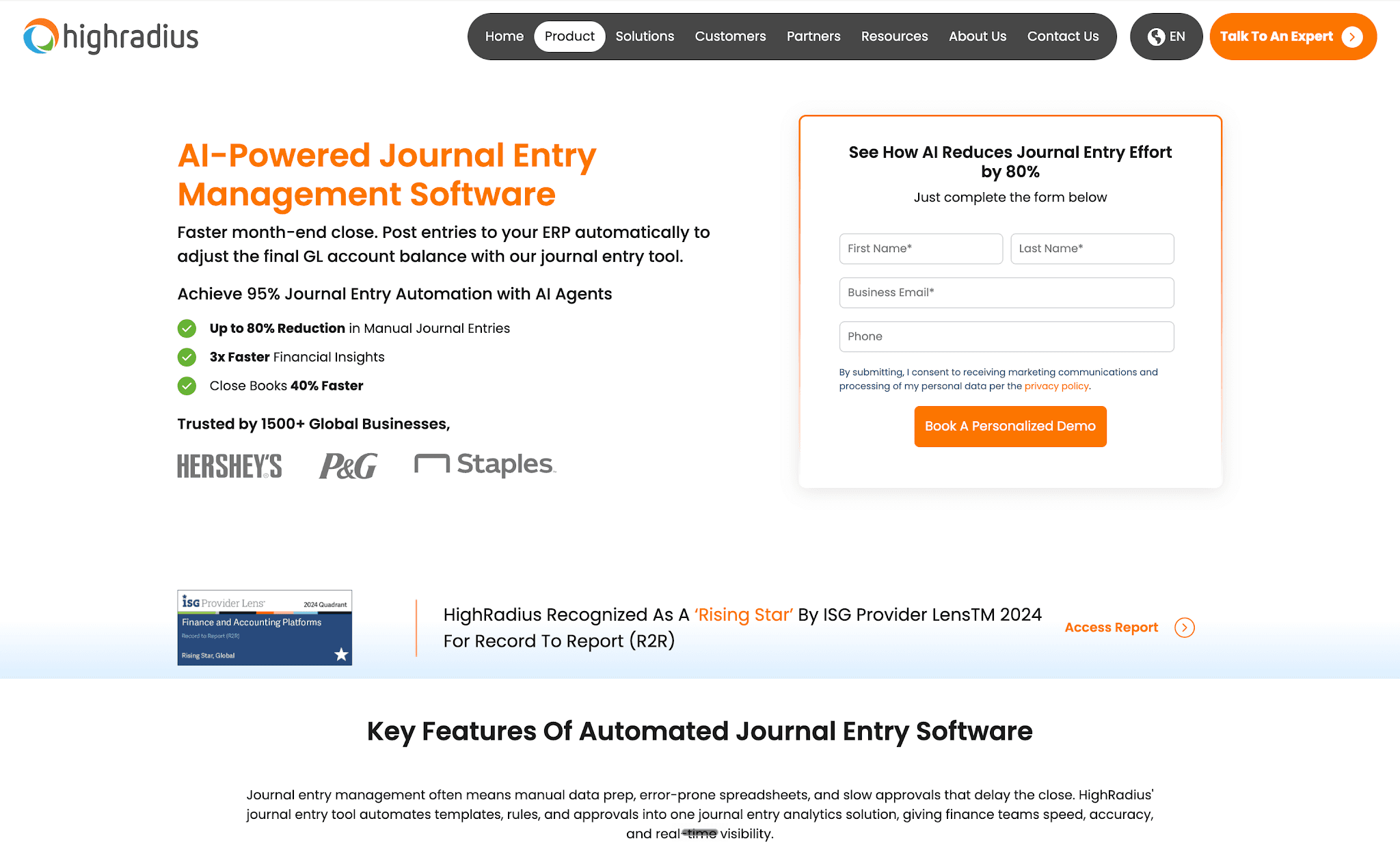
HighRadius offers a structured finance automation product with journal preparation and ERP posting inside its broader close suite. Its published angle is a 30% reduction in close time.
On G2, HighRadius Financial Close & Reconciliation holds a 4.0/5 rating across 2 reviews.
Automation model
HighRadius uses a template- and rules-led model, particularly around standardized data preparation.
Templates for standardized journal preparation.
Rules-driven output formatting for ERP posting.
Auto-posting into SAP and Oracle with configurable controls.
Journal entry coverage
Automated journal preparation on templated inputs.
Output file formatting for ERP consumption.
ERP auto-posting for standardized entries.
Final GL adjustments handled inside the workflow.
Operational close throughput for high-volume teams.
Controls, integrations, and scale fit
SAP and Oracle connectivity with configurable templates.
System-of-record flexibility across finance stacks.
Fit for enterprises seeking posting discipline and faster close cycles.
Outcome-based pricing tied to KPI improvements per HighRadius materials.
Best fit and tradeoffs
Best for teams that want to standardize high-volume journal preparation and auto-posting into major ERPs.
Best for organizations already evaluating broader finance automation from the same vendor.
Tradeoff: strongest in template-driven environments rather than judgment-heavy prep.
Tradeoff: may not be the cleanest fit for one platform across prep, matching, and variance workflows.
6. Redwood Finance Automation

Redwood is a finance automation and orchestration platform built to replace manual journal processing at scale. It positions directly against S/4HANA deadlines, the talent shortage, and audit findings on manual controls.
On G2, Redwood RunMyJobs holds a 4.8/5 rating across 314 reviews.
Automation model
Redwood's angle is rule-based automation plus control enforcement across upstream systems.
Rule-driven journal creation from upstream sources.
Automated approvals with control enforcement.
Orchestration across ERP and non-ERP systems.
Journal entry coverage
Journal creation from structured rules.
Approvals routed by policy.
Recurring workflows with predictable outputs.
ERP posting tied to business rules.
Upstream data validation before entry generation.
Controls, integrations, and scale fit
Audit readiness with automated approval trails.
Upstream connectivity across ERP and operational systems.
Control enforcement embedded in workflow.
Notable strength in SAP-centered or highly structured enterprise estates.
Best fit and tradeoffs
Best for enterprises that need reliable, governed automation around repetitive journal workflows.
Best for organizations under pressure to remove manual finance work before ERP transitions.
Tradeoff: rule-based systems can be less graceful when source data is messy.
Tradeoff: buyers wanting AI-driven prep with human-like reasoning should compare against newer models.
7. Aurum Solutions
Aurum Solutions is a journal file automation specialist focused on getting entries into the ERP cleanly and consistently. It publishes support for 40+ ERP integrations, meaningful for teams with fragmented system landscapes.
On G2, Aurum Solutions holds a 4.0/5 rating across 1 review.
Automation model
Aurum's operating model is structured, rules-based, and integration-oriented rather than full accounting workflow automation.
Customizable rules for journal file creation.
Integration-first orientation across ERPs.
Repeatable posting workflows over experimental logic.
Journal entry coverage
Automated journal file creation from source inputs.
Posting workflows into 40+ ERPs.
Collaboration features for review and sign-off.
Repeatable journal processing at scale.
Support for standardized inputs from operational systems.
Controls, integrations, and scale fit
Customizable rules with audit-ready records.
40+ ERP integrations per Aurum materials.
Practical appeal for teams juggling many source files.
Scalability and control drive the shortlist inclusion.
Best fit and tradeoffs
Best for organizations that need a reliable journal-file layer between operational systems and the ERP.
Best for finance teams standardizing journal imports across a fragmented system landscape.
Tradeoff: narrower scope than platforms built to automate reconciliations, flux, and other upstream prep.
Tradeoff: not the best fit if the goal is to redesign the close operating model end to end.
8. SolveXia

SolveXia is a configurable finance automation platform rather than a pure-play journal entry product. Its attraction is no-code and low-code workflow automation across finance operations.
On G2, SolveXia holds a 4.7/5 rating across 31 reviews.
Automation model
SolveXia offers broad configurability, which is the strength and also the responsibility. Setup effort is often higher.
No-code workflow automation across finance processes.
Configurable journal calculation and output generation.
Scheduled and event-driven execution.
Journal entry coverage
Scheduled journal workflows with reusable logic.
Data transformations feeding journal outputs.
Reconciliations tied to journal generation.
Adjacent automation across finance operations.
Repeatable calculations across systems.
Controls, integrations, and scale fit
Configurable workflows with approvals and audit logs.
Cross-system process automation.
Suits teams comfortable owning process design and refinement.
Platform flexibility drives both the strength and the fit dependence.
Best fit and tradeoffs
Best for finance teams that want to automate journals as part of a broader reconciliations and reporting workflow.
Best for organizations that value configurable automation over a narrower, opinionated product.
Tradeoff: more design effort than plug-in-style journal tools.
Tradeoff: buyers wanting accounting-specific AI reasoning should test how much domain depth they need.
9. Oracle NetSuite
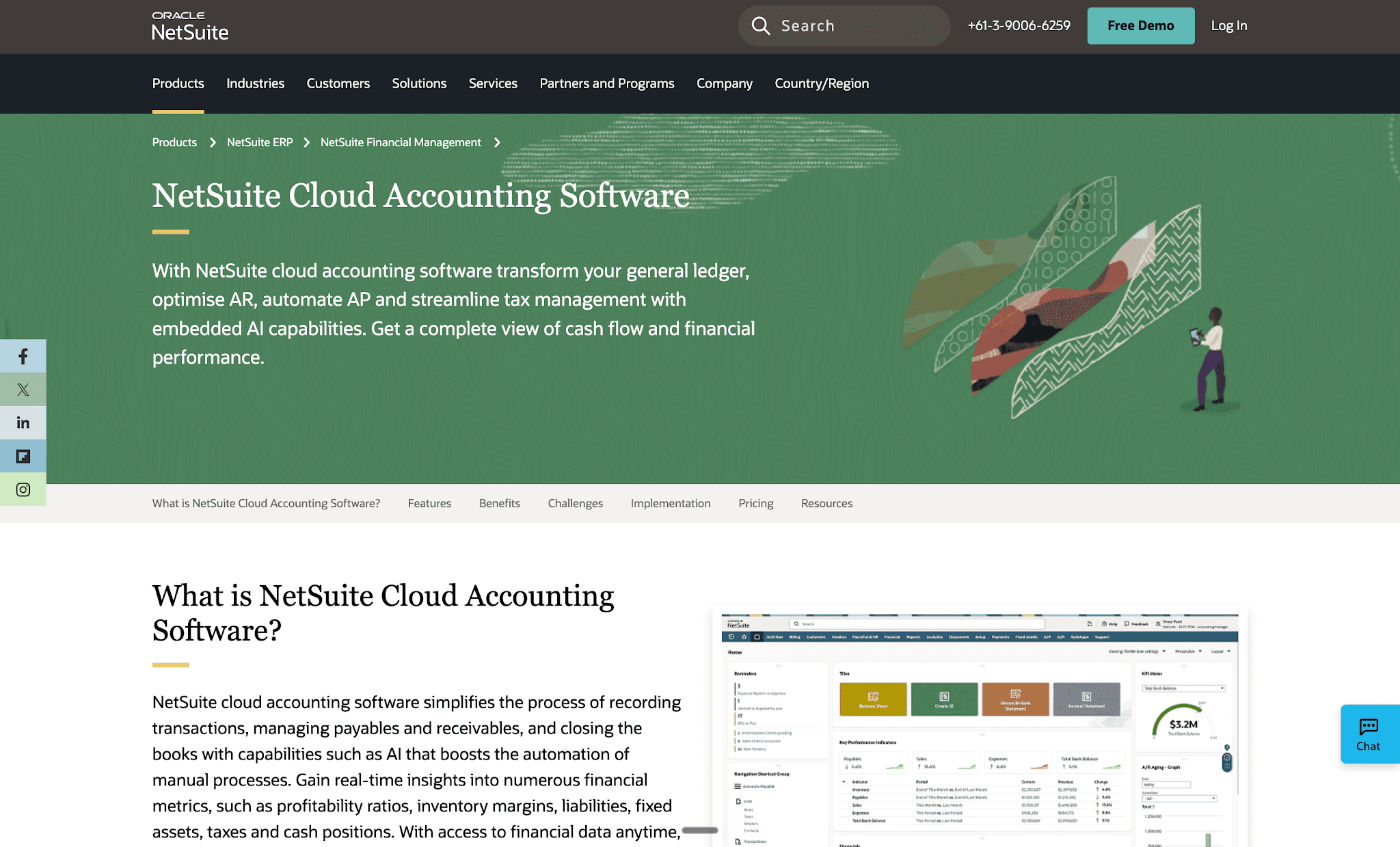
NetSuite is the ERP-native option many buyers evaluate before adding a dedicated journal automation layer. Its native workflows are often good enough for smaller, centralized environments.
On G2, Oracle NetSuite holds a 4.1/5 rating across 4,000+ reviews.
Automation model
Native automation is attractive when the goal is basic standardization inside one system.
Native recurring journal automation inside the ERP.
Standard approval and posting workflows.
Simpler admin model when everything lives in one stack.
Journal entry coverage
Recurring journals with scheduled posting.
Native approvals and routing.
Direct posting inside the ERP.
Standard reversing and adjusting entries.
Basic templates for common entry types.
Controls, integrations, and scale fit
Data stays in the ERP with native control structures.
Familiar interface for finance teams already on NetSuite.
Deeper automation depends on configuration, admins, or add-ons.
Trade native convenience against long-term flexibility and automation depth.
Best fit and tradeoffs
Best for mid-market teams that want to automate standard journals without adding another major platform.
Best for organizations whose processes are simple, centralized, and mostly NetSuite-native.
Tradeoff: weaker fit for multi-source, transaction-heavy prep outside the ERP.
Tradeoff: limited if the goal is continuous preparation across banks, payroll, billing, and subledgers.
10. CCH Tagetik

CCH Tagetik is an enterprise finance platform that usually enters the conversation through close, consolidation, and governance needs. It is not a JE-first specialist, but often lands on enterprise shortlists.
On G2, CCH Tagetik holds a 4.3/5 rating across 72 reviews.
Automation model
CCH Tagetik focuses on governed processes inside a broader CPM footprint. It is more platform than point solution.
Governed workflows tied to consolidation and reporting.
Structured JE processes inside the CPM model.
Fit inside broader finance architecture decisions.
Journal entry coverage
Governed journal processes for close and consolidation.
Structured approvals tied to reporting cycles.
Enterprise reporting workflows with journal linkage.
Standard adjusting and reclass entries within consolidation.
Multi-entity journal handling inside consolidation.
Controls, integrations, and scale fit
Enterprise governance with structured workflows.
Fit for complex reporting environments.
Suits organizations already standardizing around CPM and consolidation.
Value depends on how tightly journals link to the wider finance platform decision.
Best fit and tradeoffs
Best for enterprises evaluating journals in the context of a broader close and performance-management stack.
Best for teams that prioritize governed enterprise finance architecture over point-solution speed.
Tradeoff: less direct if your only goal is faster journal prep automation.
Tradeoff: can be more platform than a buyer needs when the bottleneck is narrow.
Legacy templates vs. AI-native automation
The clearest way to separate the shortlist is by how much of the actual journal work the tool performs.
Where legacy tools still make sense
Stable, standardized processes with defined templates.
Strong existing controls and mature policy documentation.
High volume of predictable, repeatable entries.
Enterprise environments where governance risk outweighs speed.
Legacy, template-led systems remain rational for large enterprises with mature workflows. This is a natural fit when the work is structured and the main risk is governance rather than manual prep bottlenecks.
What AI-native tools change in practice
Operating model | What it automates | Where it breaks | Best fit |
Rule-based routing | Approval and posting of human-prepared entries | Ambiguous data, changing policies | Stable, standardized processes |
Assistive AI | Anomaly detection and review support | Deep upstream prep at multi-entity scale | Close visibility and review-first teams |
Agent-prepared | End-to-end preparation from source data | Very small teams with only template needs | Multi-source prep pain at enterprise scale |
With agent-prepared tools, teams stop doing prep at month-end and start reviewing work prepared continuously. If ambiguity, document variation, and multi-system matching are your bottlenecks, AI-native architecture matters more than template depth.
Common roadblocks when rolling out journal entry automation
Messy upstream source data
Automation only works as well as the data feeding it. Inconsistent GL codes, missing cost centers, and unreconciled subledger balances break rule-based journals fast.
Sample a full month of source files and count entries needing manual cleanup.
Fix consistent breakage upstream before selection.
Favor tools that reason across transactions when source data is unstable.
Integrating with older ERPs
Older SAP versions, on-prem Oracle, and custom-built GLs often lack modern APIs and require file-based posting or middleware.
Confirm native connectors and refresh cadence with the vendor.
Verify support for your specific ERP version without custom development.
Budget for integration testing time; posting failures erode team trust fast.
Change management with the accounting team
Preparers who have owned journals for years resist tools that change their review role or feel like a black box.
Involve senior preparers in configuration and pilot design.
Start with entries they already trust before expanding scope.
Make the review workflow explicit: who approves what, when, and with what evidence.
Configuring controls for compliance
SOX-controlled environments need role-based permissions, segregation of duties, immutable audit logs, and evidence lineage from day one.
Involve internal audit early and map each automated control to an existing objective.
Test the audit trail with a real auditor walkthrough before closing on the tool.
Confirm deterministic checks sit alongside any AI-driven logic.
How to choose the right tool for your close
Match the tool to your real bottleneck
If your pain is manual prep from banks, payroll, billing, and subledgers, steer toward deeper prep automation like Maxima.
If your pain is reviewer routing and controls on standardized journals, structured enterprise tools like BlackLine or Cadency are often enough.
If your pain is close coordination and visibility, close-management-first tools like FloQast can solve the right problem faster.
If your journals mostly live inside one ERP, test native NetSuite capabilities before adding another platform.
If implementation burden is the blocker, compare finance-owned deployment against consultant-heavy rollouts.
Questions to ask in every demo
What percentage of journals does the platform actually prepare, not just route or review?
Which source systems connect natively and how often does data refresh?
How does the tool handle validations, reversals, exceptions, and intercompany complexity?
What evidence attaches to each entry, and what can an auditor re-perform?
Who configures the workflows: finance, IT, vendor services, or consultants?
How is success measured: hours saved, days to close, exception rate, reviewer load, and audit findings?
What happens when source data is ambiguous or a document format changes?
Conclusion
The right journal entry automation software depends on whether you need a tool that tracks the close or one that actually prepares the work. Legacy platforms remain strong for governed, standardized enterprise environments, while AI-native tools like Maxima are built for teams whose bottleneck is manual prep across many source systems.
Best for enterprise prep automation: Maxima.
Best for legacy governance at scale: BlackLine and Trintech Cadency.
Best for close coordination: FloQast.
Best for ERP-native teams: Oracle NetSuite.
Best for broader finance process automation: HighRadius, Redwood, and SolveXia.
FAQs: journal entry automation software
What is a journal entry in the context of automation?
A journal entry is a debit-credit record posted to the general ledger that reflects an accounting event, whether recurring, accrual, adjusting, reversing, intercompany, or allocation. Automation targets the preparation, validation, approval, and posting of these entries, not the underlying accounting judgment.
What is the cost of manual journal entry processes?
Manual journal entry processes typically cost preparers 20-40 hours per close cycle, add 1-3 extra days from rework and revisions, and introduce error rates of 3-8% on keyed entries. Audit findings tied to weak evidence and inconsistent approvals compound the problem. At multi-entity scale, teams often lose a full close week to JE prep and review cycles alone.
What journal entries should you automate first?
Start with recurring, high-volume, rules-based entries that already follow a stable review pattern. Common first candidates are accruals, payroll entries, allocations, cash postings, and routine reversals. Judgment-heavy entries like complex reserves and one-off adjustments can come later.
Can journal entry automation software post directly to the ERP?
Yes, but posting method and control depth vary significantly by product. Some tools post natively through APIs with full lineage attached. Others use file-based posting for older ERPs, often requiring middleware. Regardless of method, the SOX-safe default is a reviewed human approval gate before anything writes to the GL.
Do AI journal entry tools work in SOX-controlled environments?
They can, if the tool is built for it. The minimum bar is role-based permissions with segregation of duties, maker-checker approvals before GL posting, immutable audit logs with transaction-level lineage, and deterministic validation on critical calculations. The controls need to be enforced architecturally, not just documented in policy. Ask vendors to show you what the auditor sees, not just what the preparer sees.
How do you measure ROI on journal entry automation software?
Start with hours removed from manual prep per close cycle, days to close, and the number of late-close exceptions. Then track reviewer touch time and the percentage of entries the platform actually prepares automatically. Factor in error corrections, control issues, and audit evidence effort, plus whether finance can own the system without constant IT involvement. Measure before implementation and again after two full closes to see the real impact.
How does journal entry automation software handle recurring and reversing entries?
Most tools in this category handle recurring entries well: you configure the template once, set the schedule, and the system executes on cadence. Reversing entries are typically generated automatically from the prior-period accrual, with the reversal date set at posting time.
Where tools differ is in what triggers the recurring entry. Rule-based tools execute on a fixed schedule. Agent-prepared tools like Maxima can trigger preparation as source data arrives, so the entry is ready before close week rather than generated during it.
How does automation handle intercompany journal entries?
Intercompany is one of the harder entry types to automate because it requires matching across entities, enforcing elimination rules, and often reconciling currency differences. Not every tool handles it with the same depth.
Prep-focused platforms with multi-entity support can automate intercompany workflows end to end, including matching, elimination entries, and approval routing across entities. Routing-only tools typically manage the approval workflow but leave the preparation to the preparer. Test intercompany with real data in any demo.
What approval workflow features should journal entry software include?
At minimum: configurable maker-checker controls, role-based permissions that enforce segregation of duties, and an approval gate before any entry posts to the GL. Better implementations add multi-level approval routing by entry type, entity, or materiality threshold, plus automated escalation when approvals are overdue.
For SOX environments, the approval record needs to be immutable and attached to the entry permanently, not just logged in a separate system. Ask vendors to show you what the auditor sees, not just what the preparer sees.
How does journal entry automation improve accuracy?
Manual keying introduces errors at a rate of roughly 3-8% per entry. Automation removes the keying step entirely for rule-based entries and replaces it with validated logic applied consistently every period. Pre-post validation checks catch GL code mismatches, unbalanced entries, and policy violations before they reach the ledger.
Agent-prepared tools add another layer: they reason across source transactions rather than applying a fixed formula, which means they can handle variation in source data that would break a rigid rule. The result is higher accuracy on the entries that are hardest to standardize.
What are the most important features to look for in journal entry automation software?
The features that matter most depend on your bottleneck. If manual prep is the problem, prioritize source system connectivity, automated entry generation, and pre-post validations. If governance is the problem, prioritize approval routing, audit trail depth, and SOX-aligned controls. If close coordination is the problem, prioritize task management, reviewer workflows, and status visibility.
The single most useful question to ask any vendor: what percentage of my journal entries will the platform actually prepare, versus route or review? That answer separates the categories faster than any feature checklist.

Move closer to an audit-ready, continuous close

Request demo
Insights, news and content
The latest
See all