Finance teams can spend the majority of their month-end effort just getting the books to a place they can trust, and too much of that work still happens in spreadsheets. Financial close software replaces manual checklists and copy-paste workflows with automation, controls, and real-time visibility, turning a close that drags on for weeks into one that can be completed in days.
As accounting teams face higher transaction volumes, more systems, tighter audit scrutiny, and constant pressure to close faster, the best financial close platforms are redefining what automation actually means.
In 2026, the market is splitting into two realities:
Close management platforms improve visibility and coordination, but still leave most preparation work in spreadsheets, files, and manual cleanups.
Close automation platforms go further by preparing intercompany reconciliations, journal entries, transaction matching, variance explanations, and compliance documentation so teams review and approve rather than prepare from scratch.
AI is accelerating this shift. But this is not just another list comparing close checklists and suites. In this guide, we cover the top financial close platforms so you can shortlist the right tools based on your complexity, ERP ecosystem, and desired level of automation.
What is financial close and month-end close software?
Financial close and consolidation software helps finance teams manage and accelerate period-end close, especially when the process involves many accounts, stakeholders, source systems, or legal entities. These platforms sit alongside an ERP. The ERP records transactions and maintains the general ledger, while close and consolidation tools run the workflows, controls, and reporting steps required to finalize the books.
Most solutions provide a structured way to execute the close, including task management, approvals, and audit trails. Many also support key close activities such as reconciliations, transaction matching, journal entry workflows, and variance or flux review. For organizations with multiple entities, consolidation functionality extends the platform to handle entity rollups, intercompany eliminations, currency translation, and consolidated reporting.
The practical differences between tools come down to scope and depth. Some products focus mainly on coordinating work and providing visibility into status. Others automate more of the underlying preparation work so teams spend less time exporting data, updating spreadsheets, and assembling support.
The biggest value is not just efficiency. When repetitive preparation work is reduced, finance teams can spend more time on analysis, decision support, and business partnership without scaling headcount at the same rate as transaction volume and complexity.
How We Selected the Best Financial Close Software
Financial close software is a significant operational decision. Your team will rely on it daily during the most time-sensitive part of the month. When evaluating the best financial close platforms, we focused on the following criteria:
Automation depth: We prioritized platforms that reduce manual preparation work, not just task coordination. The best tools pull data directly from ERPs, transform it into accounting-ready formats, and prepare reconciliations, journals, and variance explanations so teams can review and approve rather than create from scratch.
Ease of use and implementation speed: We looked for solutions that don't require 6-12 month implementations or extensive technical training. Fast time-to-value matters when teams are already stretched thin during close.
Integration and ERP compatibility: We gave priority to platforms that integrate seamlessly with major ERPs like NetSuite, SAP, Oracle, Sage Intacct, and QuickBooks without requiring constant manual exports or complex API configuration.
Scalability and complexity handling: We evaluated whether each platform can handle growing transaction volumes, multi-entity structures, and increasing system complexity without degrading performance or creating bottlenecks.
Audit and compliance controls: We focused on platforms that provide complete audit trails, approval workflows, segregation of duties, and evidence lineage that meets SOX and audit requirements.
G2 and user reviews: We consulted third-party review platforms to validate vendor claims and understand real user experiences with implementation timelines, support quality, and actual close time reductions achieved.
Based on these criteria, we selected platforms that represent different approaches to the close: from coordination-focused tools to full close automation platforms with AI capabilities.
Why automate the month-end close process?
Month-end close is still one of the most manual, time-compressed workflows in finance. Even with close software in place, many teams still spend close week pulling data from multiple systems, cleaning it in spreadsheets, and stitching it together just to get to a point where reconciliations and reviews can begin.
That operating model creates three predictable problems:
Close becomes a recurring fire drill. Manual prep work piles up at month-end, creating late nights and constant context switching.
Risk increases under pressure. Spreadsheets and handoffs create more opportunities for errors, inconsistent policy application, and missing support.
Insights arrive too late. The longer close takes, the less useful the numbers are for timely decisions.
Automating the close changes the shape of the month. The goal is not just better task tracking. It is reducing the manual work required to get from raw transactions to finalized, audit-ready financials. The best platforms do this by combining workflow controls with two foundational capabilities: reliable data pulling and automated transformation.
Financial close automation outcomes
Before automation | After automation |
|---|---|
Teams manually export and stitch data across systems | Data is pulled directly from ERPs and upstream tools on a schedule or continuously |
Close timelines are driven by human capacity | Close timelines improve as preparation work is automated and standardized |
Reconciliations depend on spreadsheet logic and sampling | Matching and reconciliation rules run consistently, with exceptions queued for review |
Journal entries are assembled from scattered inputs | Journals are created and routed in a controlled workflow with support attached |
Variances are investigated late under deadline | Variances surface earlier, with faster triage and fewer surprises |
Audit support is chased at the end | Evidence and audit trails are captured as the work happens |
The biggest value is not just efficiency. When repetitive preparation work is reduced, finance teams can spend more time on analysis, decision support, and business partnership without scaling headcount at the same rate as transaction volume and complexity.
Best financial close software in 2026
Platform | Best for | Setup time | Core strengths |
|---|---|---|---|
High-volume, multi-entity teams that want AI-prepared close work | Weeks | Agent-prepared journals, reconciliations, flux analysis; SOX-aligned controls; 100+ native integrations | |
Mid-market teams that need close visibility and checklist coordination | 1–3 months | Close checklists, task ownership, Excel-connected workflows, fast rollout | |
Large enterprises with SAP or Oracle ecosystems and governance requirements | 4–12 months | Reconciliations, matching, journal workflows, controls, large partner ecosystem | |
Controls-first teams evaluating enterprise (Cadency) or mid-market (Adra) options | 3–9 months | Exception management, controls monitoring, record-to-report coverage | |
Enterprises already in the Oracle ecosystem needing consolidation plus close | 6–12+ months | Multi-entity consolidation, currency translation, enterprise reporting governance | |
Complex enterprises standardizing on a single CPM platform | 6–18 months | Consolidation, planning, reporting, and close in one platform | |
Public companies needing controlled SEC and disclosure workflows | 1–4 months | Disclosure management, SEC filing, audit collaboration, XBRL tagging |
1) Maxima: AI-native record to report platform
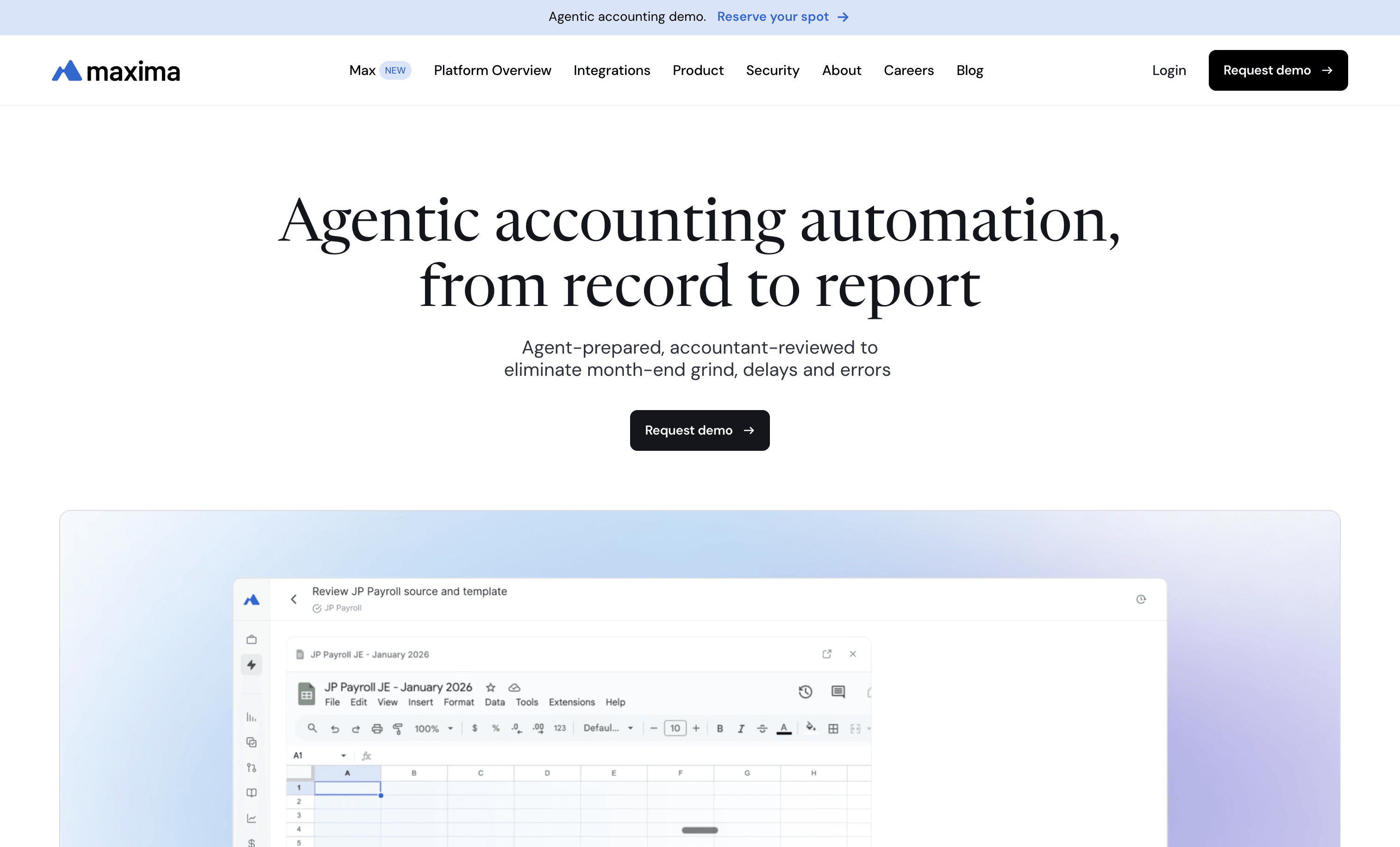
Best for: Accounting teams that want close prep automated, so they spend more time reviewing and less time running month-end fire drills.
Maxima is the first agentic AI platform for enterprise accounting, built to automate the most manual parts of record-to-report. AI agents do the preparation work end to end and produce accurate, auditable outputs that accounting teams can review and approve.
What Maxima does
Pulls data from ERP and upstream systems and keeps it current during the period
Prepares journal entries from upstream activity and routes them for review and approval
Automates matching and reconciliations at scale with clear exception handling
Produces variance and flux explanations with supporting detail
Supports continuous close so work moves forward throughout the month
Where Maxima stands out
Reduces manual preparation work, not just close coordination
Shrinks reliance on spreadsheets by automating preparation inside the platform
Scales better as transaction volume and complexity grow
Considerations
Review-first workflows can require process change for teams used to spreadsheet execution
Some organizations still use separate tools for planning and consolidation, depending on needs
Maxima may be a better fit if...
Your close is constrained by manual preparation work, not just coordination or visibility
You are running high transaction volumes across multiple entities and upstream systems
Your team needs to move from a create-everything model to a review-and-approve model
SOX compliance and audit-ready controls are non-negotiable requirements
You want AI that prepares complete journal entries and reconciliations, not just flags anomalies or suggests edits
Pricing and setup
Pricing: Custom quote
Typical rollout: Weeks, not months. Finance teams can self-serve without IT involvement.
2) FloQast: close management software
Best for: Mid-market teams that want an easy-to-adopt close checklist and better coordination.
FloQast is a popular close management product known for usability and fast rollout. It helps teams standardize close workflows and keep work moving.
What FloQast does
Close checklists, assignments, approvals, and dashboards
Structured review workflows
Spreadsheet-connected execution for teams that want to keep working in Excel
Where teams should be careful
Many workflows remain coordination-first, with preparation still happening in spreadsheets
Improvements can plateau after the checklist layer is implemented
As transaction volume grows, spreadsheet execution becomes the bottleneck again
FloQast may be a better fit if...
You are a mid-market company and your primary need is close visibility, task ownership, and checklist-driven coordination
Your team already works in Excel and wants to keep that workflow while adding structure and accountability
You need a fast rollout with minimal implementation complexity and a low learning curve
Your close pain is disorganization and missed deadlines rather than high-volume manual preparation work
Pricing and setup
Pricing: Custom quote
Typical rollout: 1–3 months, especially when scope is focused on core close coordination.
FloQast is a good choice for close visibility and coordination. It is less suited for teams whose primary constraint is manual preparation work.
3) BlackLine: enterprise financial close software
Best for: Enterprises that want a broad suite and can support platform complexity.
BlackLine is a longstanding enterprise platform spanning reconciliations, matching, journals, task management, and controls. It is often chosen for standardization and governance in large environments.
What BlackLine does
Reconciliations, transaction matching, and journal workflows
Close task management, approvals, audit trails
Controls-oriented workflows
Where teams should be careful
Implementation effort can be substantial, which delays time to value
Admin and configuration burden can grow over time as rules, mappings, and workflows expand
Many organizations still rely on spreadsheets for parts of preparation depending on data readiness and module adoption
BlackLine may be a better fit if...
You are a large enterprise with an existing SAP or Oracle ecosystem and need deep, proven integration with those platforms
Your organization has the budget, internal resources, and 9 to 12 months to support a structured implementation program
Governance, controls standardization, and audit trail depth are the primary drivers of your evaluation
You need a platform with a long track record and a large partner ecosystem for ongoing support and customization
Pricing and setup
Pricing: Custom quote
Typical rollout: 4–12 months, usually with a dedicated project team and implementation partner.
BlackLine can be strong for coordination and controls. Buyers seeking meaningful reduction in preparation work should test that explicitly in a pilot.
4) Trintech Cadency and Adra: record to report automation
Best for: Teams that want close automation with a strong focus on controls and exception management.
Trintech is often evaluated for record-to-report automation, especially where governance and controls are a key requirement. Cadency is typically used in larger enterprises. Adra is commonly positioned for mid-market environments.
What Trintech does
Close workflows for reconciliations, matching, and journal processes
Exception management and controls monitoring
Broader record-to-report coverage depending on modules and rollout
Where teams should be careful
Outcomes vary widely based on platform choice and deployment depth
Configuration and ownership can be meaningful, especially in complex environments
Buyers should validate how much preparation work is truly reduced versus simply tracked and routed
Trintech may be a better fit if...
Controls-first close governance is your top priority and you need strong exception management workflows out of the box
You are evaluating Cadency for a large enterprise environment with complex reconciliation volumes and a dedicated implementation team
You are a mid-market team considering Adra and want a more focused, faster-to-deploy alternative to full enterprise suites
Your organization has evaluated BlackLine and wants a comparable controls-oriented platform with a different commercial model
Pricing and setup
Pricing: Custom quote for both Cadency and Adra
Typical rollout: 3–9 months depending on platform tier and deployment complexity.
5) Oracle EPM: financial consolidation and close suite
Best for: Large enterprises that want close capabilities inside a broader Oracle EPM environment.
Oracle EPM Cloud is commonly evaluated when consolidation and enterprise performance management are already strategic priorities. It can support close workflows, but it is typically selected for suite breadth and consolidation depth rather than for eliminating day-to-day close preparation work.
What Oracle EPM Cloud does
Close management workflows alongside consolidation capabilities
Multi-entity rollups, translation, and eliminations
Enterprise reporting and governance features
Where teams should be careful
Implementation and ownership can be significant at enterprise scale
Best fit tends to be organizations already deep in Oracle ecosystems
Buyers should validate how much reconciliation and journal preparation work is reduced versus managed
Oracle EPM may be a better fit if...
You are already running Oracle ERP Cloud or Oracle Fusion and want to consolidate your finance technology stack within a single vendor
Multi-entity consolidation, currency translation, and intercompany eliminations are your primary requirements alongside close management
Your organization has a dedicated Oracle implementation partner and a multi-year technology roadmap that includes EPM standardization
Enterprise reporting and disclosure governance are as important as close execution speed
Pricing and setup
Pricing: Custom quote
Typical rollout: 6–12+ months, typically requiring a dedicated Oracle implementation partner.
6) OneStream: CPM suite with close management
Best for: Complex enterprises that want consolidation and CPM standardization, with close as part of that program.
OneStream is a CPM platform that includes consolidation alongside planning and reporting. It is often shortlisted when finance is standardizing CPM tooling across the enterprise. Close outcomes depend on how the organization designs and deploys close processes within the broader CPM program.
What OneStream does
Consolidation engine for multi-entity complexity
Planning, reporting, and analytics alongside close capabilities
Platform approach for enterprise standardization
Where teams should be careful
Larger implementation and operating model shift than close-focused platforms
Best ROI when consolidation and CPM standardization are strategic priorities
Buyers should validate how quickly the platform will reduce close preparation work in the first rollout phase
OneStream may be a better fit if...
Your finance organization is standardizing on a single CPM platform for consolidation, planning, budgeting, and reporting, and close is one component of that broader program
You are replacing a legacy Hyperion or SAP BPC environment and need a modern consolidation engine with a unified data model
Your primary pain is multi-entity consolidation complexity rather than day-to-day close preparation work
You have the implementation runway and internal resources to support a multi-phase CPM deployment
Pricing and setup
Pricing: Custom quote
Typical rollout: 6–18 months for full CPM deployment; close modules may go live earlier in a phased approach.
7) Workiva: SEC reporting and disclosure workflow
Best for: Public-company teams that need controlled reporting workflows for SEC, disclosure, and audit collaboration.
Workiva is often evaluated alongside close software because it sits at the end of the process. It is typically not the system that runs reconciliations or prepares journals. Instead, it governs the reporting workflow and controls disclosures and filings.
What Workiva does
Controlled document collaboration with audit trails
SEC and disclosure workflows, reporting governance
Review, sign-off, and traceability across reporting packs
Where teams should be careful
Workiva complements close execution rather than replacing it
Buyers should plan for a close platform to handle reconciliations, journals, and preparation work
Workiva may be a better fit if...
You are a public company with SEC filing requirements and need a controlled, auditable environment for disclosure management and external reporting
Your close execution platform is already in place and you need a purpose-built tool for the reporting and sign-off layer that follows close
Audit collaboration, XBRL tagging, and multi-stakeholder review workflows are core requirements
Your primary gap is in the reporting and disclosure process, not in reconciliation or journal preparation
Pricing and setup
Pricing: Custom quote
Typical rollout: 1–4 months, depending on the number of reports and disclosure workflows in scope.
How to choose the right financial close platform
1. Start with your transaction volume and close complexity
A platform that works for a low-volume, single-ERP close can break down when you are matching millions of transactions, supporting multiple entities, or pulling data from many upstream systems.
Use the guideposts below to decide what category of platform to prioritize:
Lower volume and simpler workflows: Close management may be enough. You primarily need checklists, ownership, approvals, and visibility so close runs consistently.
High volume or high complexity: Close automation becomes much more valuable. When reconciliations, journals, and variance investigation become data intensive, the bottleneck is not coordination. It is preparation work. Automation prevents headcount and spreadsheet risk from scaling with volume.
Full-cycle automation: Prioritize platforms that can pull and structure data and then prepare the work products, not just track completion. The right tool changes the operating model from create to review.
If the work still happens in Excel after go-live, you bought close management, not close automation.
2. Evaluate with an automation-first lens
Data pulling
Does the platform pull the right data from your ERP and upstream systems without constant exports?
Can it stay current throughout the period, not just at month-end?
Data transformation
Can it normalize messy raw inputs into accounting-ready datasets?
Can you trace how inputs were transformed into outputs?
Execution depth
Does it actually prepare journals, reconciliations, and explanations, or does it mainly manage tasks and approvals?
After go-live, how much work still happens in spreadsheets?
Assess fit for volume, complexity and auditability
Volume & complexity
Can it handle your transaction volume without degrading performance or creating unreadable exception queues?
Does it support multi-entity structures, different policies by entity, and multiple upstream sources?
Auditability
Can you drill from any output to the underlying source data and support?
Are approvals, evidence, and control steps captured automatically?
Best financial close software by ERP
Your ERP ecosystem often narrows the shortlist before you run a single demo. Here is a quick guide to platform fit by ERP:
NetSuite: Maxima integrates natively with NetSuite and posts finished work directly back into the GL with full source-to-GL lineage. FloQast also has a strong NetSuite user base for close coordination.
SAP: BlackLine has deep, proven SAP integration and is a common choice for large SAP environments. Trintech Cadency is also frequently evaluated in SAP shops with a controls-first mandate.
Oracle: Oracle EPM Cloud is the natural fit for organizations already running Oracle ERP Cloud or Fusion. BlackLine also has strong Oracle connectors for close execution.
Sage Intacct: FloQast and Maxima both support Sage Intacct. Maxima is the stronger fit when transaction volume and automation depth are the priority; FloQast when close coordination is the primary need.
Workday: BlackLine and Workiva both have established Workday integrations. BlackLine handles close execution; Workiva handles the reporting and disclosure layer that follows.
Best financial close software by industry
Industry context shapes which capabilities matter most. Here is a quick guide to platform fit by sector:
SaaS and high-growth tech: Transaction volume scales faster than headcount, and revenue recognition complexity adds pressure. Maxima is built for this environment, with native integrations into billing, payroll, and ERP systems and AI-prepared reconciliations that handle high-volume, multi-entity structures. FloQast works well at earlier stages when close coordination is the primary need.
Retail and e-commerce: Payment processor reconciliation, high transaction counts, and multi-location reporting create the biggest close bottlenecks. Platforms with strong transaction matching and bank-to-GL reconciliation capabilities, such as Maxima or BlackLine, are better fits than checklist-only tools.
Healthcare: Complex revenue cycles, intercompany activity across entities, and strict audit requirements push teams toward platforms with deep controls and audit trail depth. BlackLine and Trintech Cadency are commonly evaluated here. Maxima is a strong fit when automation of the preparation layer is the priority alongside SOX-aligned controls.
Manufacturing: Inventory accounting, cost allocations, and multi-entity consolidation are the dominant close challenges. Oracle EPM and OneStream are frequently shortlisted when consolidation is the primary driver. BlackLine handles close execution in many large manufacturing environments.
Key features of financial close software
Data integration and ERP connectivity
Close automation depends on having the right inputs, at the right time, from the right systems. Look for more than "we integrate with your ERP." The question is whether the platform reduces exports and spreadsheet stitching in practice.
Key capabilities to look for:
Direct ERP connectivity and refresh cadence that matches your close rhythm
Support for upstream sources beyond the ERP when relevant such as banks, payroll, billing, and expenses
Stable mappings as chart of accounts, entities, and systems evolve
Clear controls around access, permissions, and data handling
Automated data transformation
Extracting data is necessary. Transforming it is what makes automation possible. Raw transactions are rarely accounting-ready. They often arrive with inconsistent formats, missing identifiers, duplication, and different structures across systems.
Key capabilities to look for:
Normalization and mapping across systems and entities
De-duplication, enrichment, and standardized identifiers
Join logic and lookups that produce accounting-ready datasets
Traceability that shows how raw inputs became outputs
Account reconciliation and transaction matching
Reconciliation is often the largest time sink in the close. Strong platforms support configurable matching logic, clear exception handling, and audit-ready documentation so teams focus on discrepancies, not on reviewing everything.
Key capabilities to look for:
Configurable matching rules and tolerances by account type
Multi-way matching when data spans multiple systems
Exception workflows that route issues to the right owner
Drill-down to underlying transactions and support
Journal entry workflows and controls
Journals often slow close when they are prepared in spreadsheets, routed over email, then posted late. The best tools centralize the workflow and enforce governance.
Key capabilities to look for:
Standardized journal preparation and review workflows
Approvals, segregation of duties, and policy enforcement
Posting controls and traceability back to source inputs
Support attachments and rationale captured in-system
Consolidation and multi-entity close
If you operate across multiple entities, consolidation needs can drive the shortlist. Consolidation-focused platforms should handle rollups, eliminations, translation, and reporting in a controlled way.
Key capabilities to look for:
Intercompany eliminations and reconciliation support
Currency translation and entity hierarchies
Top-side adjustments with governance
Consolidated reporting and audit trails
Close dashboards, reporting, and exception management
Dashboards are only useful if they reflect reality. Look for visibility into both operational progress and the exceptions that actually block close.
Key capabilities to look for:
Real-time close status and bottleneck reporting
Exception queues with prioritization and ownership
Variance views tied to supporting detail
Process metrics that help improve close over time
Financial close software ROI model
Do not evaluate platforms only on subscription cost. Model the operational impact:
Hours reduced in preparation versus review
Fewer errors, fewer late adjustments, and less rework
Faster audit cycles
Close days reduced and fewer shutdown periods
Capacity redeployed to analysis and strategy
Financial close software FAQs
What's the difference between close software and consolidation software?
Close execution tools run close operations such as reconciliations, matching, journals, and close tasks. Consolidation tools produce multi-entity consolidated financials such as rollups, eliminations, translation, and reporting. Many complex organizations use both.
What's the difference between financial close software and an ERP system?
An ERP like NetSuite, SAP, or Oracle is your system of record. It captures transactions, posts entries to the general ledger, and produces the official books.
Financial close software is your system of process. It sits on top of the ERP to run the work required to close the books. It coordinates workflows and approvals, automates reconciliations and matching, manages journal entry workflows, tracks close status, supports variance or flux analysis, and when needed handles multi-entity consolidation and audit-ready evidence.
In most organizations, the ERP holds the data. Close software makes the close repeatable, controlled, and faster.
How long does financial close software implementation take?
Implementation timelines vary widely based on the platform, the number of entities and source systems, and how much configuration you need.
As a rough guide:
Enterprise suites like BlackLine, Oracle EPM, or OneStream often take 4 to 12 months, typically with a dedicated project team and partner support.
Mid-market close tools like FloQast often take 1 to 3 months, especially when rollout scope is focused.
AI native close automation platforms like Maxima connect directly to ERPs and start with specific workflows that can show value in a few weeks, depending on integrations and data readiness.
The key is matching the tool to your urgency. Longer implementations push ROI out and keep manual work in place longer.
How does financial close software integrate with ERPs like NetSuite, Sage Intacct and SAP?
Most close platforms connect to existing ERPs through pre-built connectors or APIs to pull the data needed for close activities such as trial balance, journal activity, and subledger detail.
The real differentiator is whether the integration is reliable and low-maintenance as your chart of accounts, entities, and upstream systems evolve, and whether you can drill from any output back to the underlying source data.
What ROI can companies expect from financial close software?
ROI usually shows up as a faster close, fewer mistakes and less rework, reduced audit prep, and fewer late nights for the team.
Close management tools drive gains by improving visibility and speeding up approvals, but close automation platforms tend to deliver larger returns because they cut down the hours spent assembling work in spreadsheets.
How does financial close software improve audit readiness?
Financial close software improves audit readiness by standardizing close processes with audit trails. It captures who did what, when, and who approved it.
Close automation platforms go further by keeping support tied to the work itself, such as reconciliation detail, journal backup, and variance explanations with traceable source data. That reduces last-minute evidence chasing and makes it easier for auditors to validate the numbers.
How do I know if my organization is ready for financial close automation?
You are ready if the close is constrained by manual effort, not accounting judgment. Common signs include a close that routinely runs beyond five days, recurring errors or late adjustments, reconciliations that live in spreadsheets, and a team that cannot scale without adding headcount. Audit issues related to close controls are another clear signal.
If several of these are true, you are not early. You are already paying the cost in overtime, rework, and slower business insight.
Should I choose a specialized close platform or a broader CPM suite?
Choose a specialized close platform if your biggest pain is execution. You need faster reconciliations, journal workflows, matching, variance review, stronger controls, and a repeatable close process. These tools tend to go live faster and deliver the most immediate impact on close speed and effort.
Choose a CPM suite if your priority is a single system for consolidation plus planning, budgeting, forecasting, and reporting. You get a broader platform, but implementations are typically longer and the close automation may be less purpose-built.
A simple rule is this: if month-end is the fire drill you need to eliminate, start with close automation. If your core problem is standardizing enterprise performance management across finance, lead with CPM

Move closer to an audit-ready, continuous close

Request demo
Insights, news and content
The latest
See all