Automate account reconciliations, from source data to sign-off
Agent-prepared reconciliations, with source data, workpaper, and tie-outs ready for review.

Request demo

Spend less of the close preparing reconciliations
Automate the data pulls, workpaper updates, rollforwards, and tie-outs behind every reconciliation.
Catch discrepancies before close
Surface differences as balances change, not for the first time at month-end.
Keep every reconciliation under control
Track status, ownership, review, and sign-off across the balance sheet.
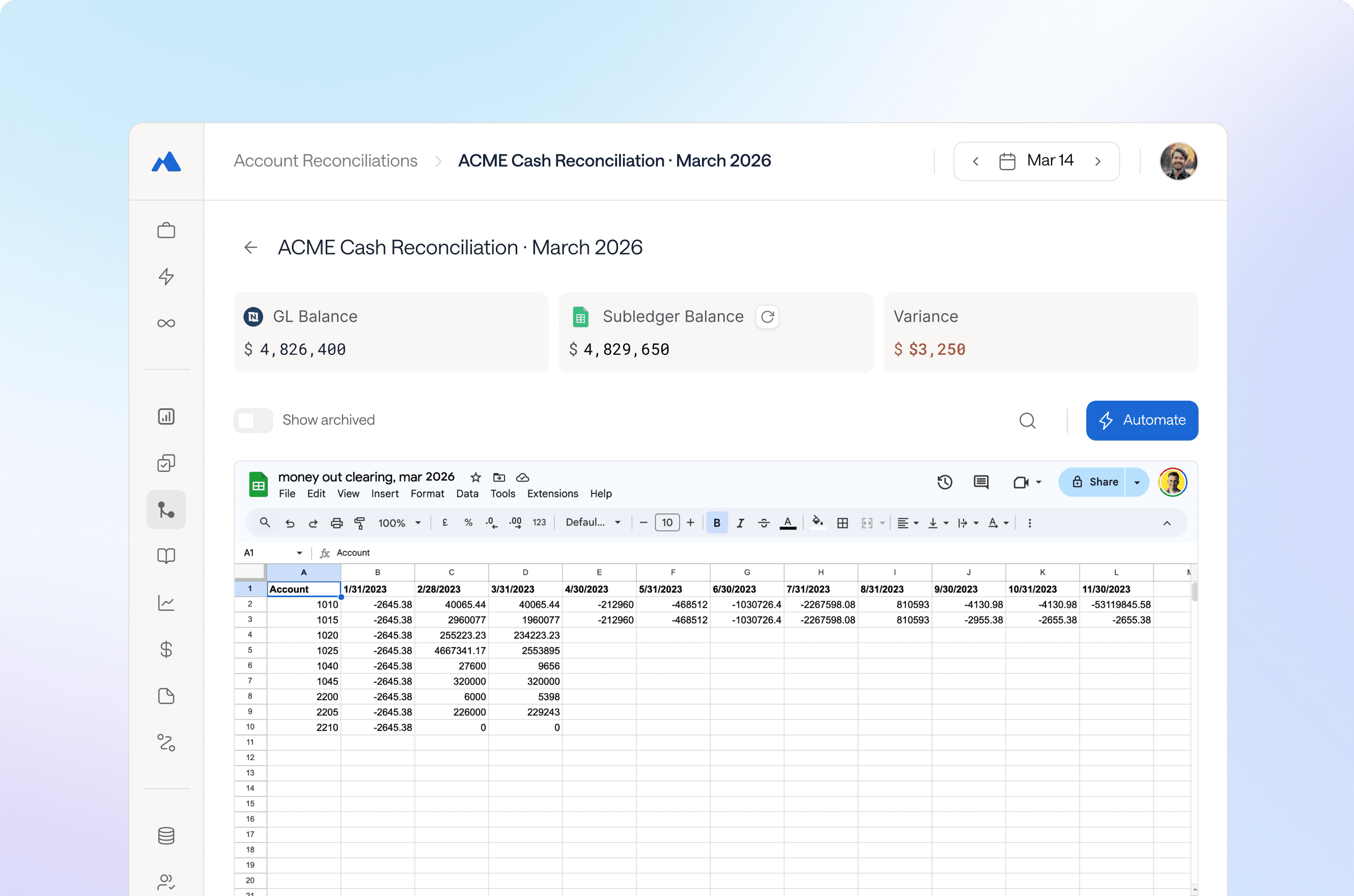


See the whole balance sheet
Track status, balances, variances, and completion across accounts and entities.
Know what needs attention
See which reconciliations are preparing, ready for review, blocked, or overdue.
Keep ownership clear
Approved logic and locked periods stay permissioned.
Sign off at scale
Review and sign off individual accounts or groups of reconciliations without opening every workpaper.

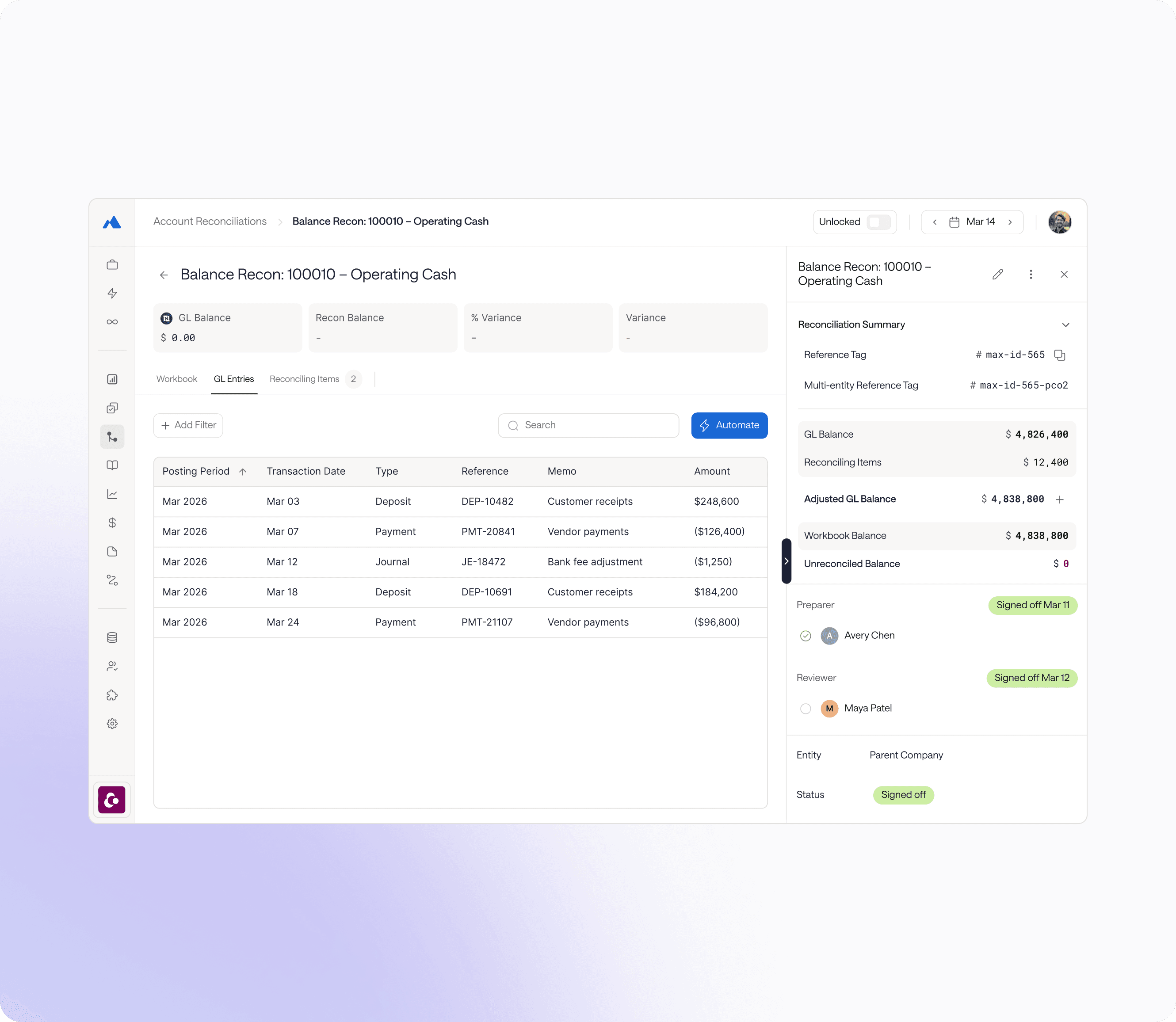
Complete populations
Trace balances and supporting populations back to the GL and source systems.
Re-performable workpapers
Review the formulas, rollforwards, tie-outs, and calculations used to prepare the reconciliation.
Preparer-reviewer controls
Maintain clear ownership, review requirements, permissions, and separation of duties.
Complete audit trails
Retain reconciling items, adjustments, comments, approvals, and agent actions behind every sign-off.


Reconciliations that took days and weeks now happen continuously with full accuracy and audit readiness.”
Controller, SpotOn
Jack Chalfant

Does Maxima require us to change our reconciliation process?
No. Maxima works with your existing reconciliation logic, workpapers, materiality thresholds, and review policies, while automating the manual work required to execute them each period.
What is account reconciliation automation?
Account reconciliation automation reduces the manual work required to prepare, review, and sign off balance sheet reconciliations. Maxima pulls GL and supporting data directly from source systems, prepares the reconciliation using your existing logic and workpapers, identifies differences, and keeps the supporting evidence attached for review.
What types of accounts can Maxima reconcile?
Maxima supports cash and bank accounts, subledgers, intercompany balances, accruals, prepaids, deferred revenue, fixed assets, payroll, and other balance sheet accounts.
What happens when an account doesn’t reconcile?
Maxima surfaces differences alongside the underlying transactions and support, so your team can see what doesn’t tie and why. Accountants can investigate missing entries, track timing differences as reconciling items, or prepare an adjustment when the books need to be corrected.
How does automated sign-off work?
Teams define reconciliation policies based on activity and variance thresholds. Eligible accounts can automatically complete preparer and reviewer sign-off, while accounts outside those policies remain available for review.
Can auditors access reconciliations and supporting evidence?
Yes. Auditors can receive read-only access to reconciliations, with reconciling items, adjustments, journal references, comments, approvals, and other supporting activity documented with the work.
How is account reconciliation different from transaction matching?
Transaction matching determines which records across datasets correspond to one another. Account reconciliation verifies that an account balance is complete, supported, and ready for review and sign-off. Transaction matching can be one step within the broader reconciliation process.
How does Account Reconciliation work with Maxima’s other accounting workflows?
Account reconciliations often surface work that needs to happen elsewhere in the close. Maxima keeps that work connected: investigate transaction-level differences in Transaction Matching, prepare accruals, true-ups, FX adjustments, or correcting entries in Journal Entry Automation, and use signed-off balances and supporting detail in Flux Analysis.
Move closer to an audit-ready, continuous close
Request demo