
If you have ever spent the first four days of close downloading bank statements, rekeying them into a workbook, and chasing a $312 variance that turned out to be a batch deposit, you already know the real question. It is not “which account reconciliation software has the most features.” It is which tool actually removes preparation work, which one mainly organizes review around work your team still does by hand, and which one only makes sense because you are already committed to a larger ERP or finance suite.
That distinction decides whether you close faster or just close with better documentation. This roundup sorts 14 account reconciliation tools by operating model first, then by fit, so you can shortlist three vendors instead of sitting through eleven demos that all show the same clean bank rec.
Who this is for: controllers, accounting managers, and finance leaders running multi-entity, high-volume closes where reconciliations are the bottleneck.
How tools were selected: enterprise reconciliation platforms, AI-native preparation tools, finance-suite modules, AP-specific reconciliation software, and one SMB baseline.
What the ranking prioritizes: automation depth over dashboards, transaction-level evidence over trial-balance summaries, and honest boundaries over feature parity claims.
What is account reconciliation software?
Account reconciliation software automates the process of comparing financial records across two or more sources, identifying discrepancies, and producing audit-ready evidence that balances agree. At its core, it replaces the manual cycle of exporting data, building workbooks, matching line items, and chasing differences with a system that prepares, validates, and routes that work automatically. The best tools operate at transaction level, not just GL summary, which is where batch deposits, partial payments, and processor timing differences actually get resolved.
Types of reconciliations these tools support
Bank reconciliation: Matches bank statement transactions to GL cash entries, clearing timing differences and identifying unposted items.
Balance sheet reconciliation: Validates that every balance sheet account balance is supported by a subledger, schedule, or third-party statement.
Intercompany reconciliation: Confirms that transactions between entities agree on both sides before consolidation runs.
Subledger reconciliation: Ties AR, AP, fixed assets, payroll, and deferred revenue subledgers back to the GL control account.
Payment processor reconciliation: Matches settlement deposits from Stripe, Braintree, or similar processors to GL cash and revenue entries, including fee netting and batch grouping.
Supplier statement reconciliation: Compares vendor statements to ERP records to surface missed credits, duplicate payments, and open disputes.
Cash and credit card reconciliation: Reconciles card transactions and cash activity to GL entries, often across multiple cards, entities, and expense platforms.
Manual vs automated account reconciliation
The table below shows where the two approaches diverge in practice. The differences compound at volume: a team reconciling 50 accounts manually and a team reconciling 500 are not doing the same job with more effort, they are doing a fundamentally different job.
Dimension | Manual reconciliation | Automated reconciliation | Close impact |
|---|---|---|---|
Data prep | Manual exports, copy-paste, format cleanup | System pulls and normalizes source data continuously | Removes days of prep before close even starts |
Matching | Line-by-line comparison in Excel, VLOOKUP or manual scan | Rules and AI match 1:1, 1:many, many:many at scale | Reduces matching time from hours to minutes on high-volume accounts |
Error risk | High: formula errors, missed rows, stale exports | Low: system validates totals and flags exceptions before review | Fewer post-close adjustments and restatement risk |
Controls | Informal: email sign-off, shared folders, inconsistent evidence | Enforced: preparer/reviewer segregation, timestamps, immutable logs | Audit fieldwork is faster and re-performance is possible |
Reconciling items | Reset each period or tracked in a side spreadsheet | Carry forward with age, owner, and lineage intact | Aged differences surface before they become restatements |
Automation matters most when transaction volume exceeds what a reviewer can scan, when accounts span multiple source systems, or when audit evidence needs to be re-performable rather than assembled after the fact. If your team spends more time building reconciliations than reviewing them, that is the signal.
How to compare account reconciliation software before you shortlist tools
Most reconciliation evaluations go wrong in the same place: the demo shows a matched account, not the messy one. Use the lenses below to force each vendor into your actual conditions, because the difference between tools shows up at volume, after sign-off, and during audit fieldwork.
Automation depth: Good means the system prepares the reconciliation end to end, pulling source data, computing the ending balance, attaching evidence, and proposing clearing entries. What breaks at scale is rules-only matching that covers exact 1:1 hits and dumps everything else into an exception queue. This determines whether your team reviews work or builds it.
Transaction context: Good means native connectivity to banks, payroll, billing, processors, and subledgers at transaction level. What breaks at scale is trial-balance-only integrations that force CSV exports for anything below the GL summary. Batch deposits, partial payments, and processor fees are unreconcilable without line-level detail.
Controls and audit trail: Good means preparer/reviewer segregation, timestamps, immutable change logs, and evidence captured as work happens. What breaks at scale is documentation assembled after the fact, with screenshots pasted into a folder before fieldwork. SOX testing and re-performance requests fall apart without lineage.
Reconciling item lifecycle: Good means open items carry forward with age, owner, and lineage, and balances re-check after sign-off. What breaks at scale is items resetting each period with post-close changes going undetected until the next quarter. Aged unexplained differences are how restatements start.
Implementation fit: Good means finance-owned configuration, live in weeks, no consultant dependency. What breaks at scale is a multi-quarter template design project with partner-led rollout. Time-to-value often decides whether the tool survives the first busy quarter.
Natural boundary: Good means the vendor tells you clearly what it does not do. What breaks at scale is every question answered with “yes, we handle that.” Scope honesty predicts implementation reality.
What this list is optimized for
This list separates tools by what work they perform, not by category labels. Gartner tracks this market as financial reconciliation solutions, with vendors like Trintech, BlackLine, and Xelix serving very different buyer profiles, and vendor roundups tend to mix enterprise close suites with FP&A platforms. Grouping them properly is half the evaluation.
Prioritize tools that remove manual prep work, not tools that add tracking around spreadsheets.
Separate AI-native preparation platforms, close-orchestration suites, finance-suite modules, AP-specific tools, and SMB bookkeeping so you are not comparing unlike for unlike.
Evaluate every product on the same five lenses: automation depth, transaction context, controls, implementation fit, and natural boundary.
Call out where a tool works as a standalone reconciliation layer versus where it only makes sense inside a broader platform commitment.
The must-have features buyers should evaluate
Automated matching across one-to-many, many-to-many, and three-way scenarios, not just exact 1:1 rules.
Centralized data and workpapers so reviewers are not stitching together ERP exports, cloud files, and email attachments.
Customizable rules and materiality thresholds so low-risk accounts stop consuming senior reviewer time.
Exception handling that keeps unmatched items, comments, and follow-up inside the workflow.
Audit trails with preparer-reviewer controls, timestamps, and evidence attached as the work happens.
Integration depth across ERP, bank, subledger, and supporting systems, because trial-balance-only connectivity becomes the bottleneck within two quarters.
Benchmark claims to sanity-check during demos
Trintech publicly cites 99%+ auto-match rates and up to 75% reduction in time to close. Treat that as a ceiling under favorable data conditions.
BlackLine publishes 8x reconciliation efficiency, 50% less time on account reconciliations, and 70% faster close.
insightsoftware positions AI-driven reconciliation as automating up to 95% of the process.
Every one of those numbers is achievable under the vendor’s own reference conditions and none is a decision rule. What matters is the delta between the vendor’s reference data and yours.
Here is how to test the claims. Ask for multi-source matching on a live account with three data sources. Change a balance after sign-off and see whether the system flags it. Export the audit package an auditor would request. Then watch a reviewer handoff end to end, including how a rejected item gets back to the preparer. If a vendor cannot run all four in one session, the benchmark is marketing.
Best account reconciliation software at a glance
Tool | Best for | Operating model | Implementation speed |
|---|---|---|---|
1. Maxima | AI-native preparation automation | Agent-prepared, human-reviewed | Weeks (finance-owned) |
2. Trintech Cadency | High-volume matching and compliance | Enterprise record-to-report | Quarters (partner-led) |
3. BlackLine | Enterprise governance and certification | Close orchestration suite | Quarters (partner-led) |
4. FloQast | Close visibility and process consistency | Close orchestration with rec automation | Weeks to months |
5. OneStream | Finance-suite buyers on OneStream CPM | CPM suite module | Months (platform-led) |
6. Oracle Fusion Cloud EPM | Oracle ERP and EPM ecosystem buyers | ERP suite module | Months (IT-supported) |
7. CCH Tagetik | Close and consolidation suite buyers | Finance suite module | Months (partner-led) |
8. Xelix Statements | AP supplier statement reconciliation | AP-specific point solution | Weeks (focused scope) |
9. Prophix One | Replacing spreadsheet recs with templates | Finance platform module | Weeks to months |
10. Vena | Excel-native teams standardizing | Finance suite with Excel interface | Months |
11. Planful | Close and consolidation suite buyers | Finance suite module | Months |
12. SolveXia | Data-wrangling-heavy reconciliation | No-code process automation | Weeks to months |
13. Adra by Trintech | Mid-market teams moving off spreadsheets | Dedicated close and rec suite | Weeks (modular rollout) |
14. IBM Cognos Controller | IBM ecosystem continuity | Consolidation suite with rec support | Months (IT-supported) |
1. Maxima
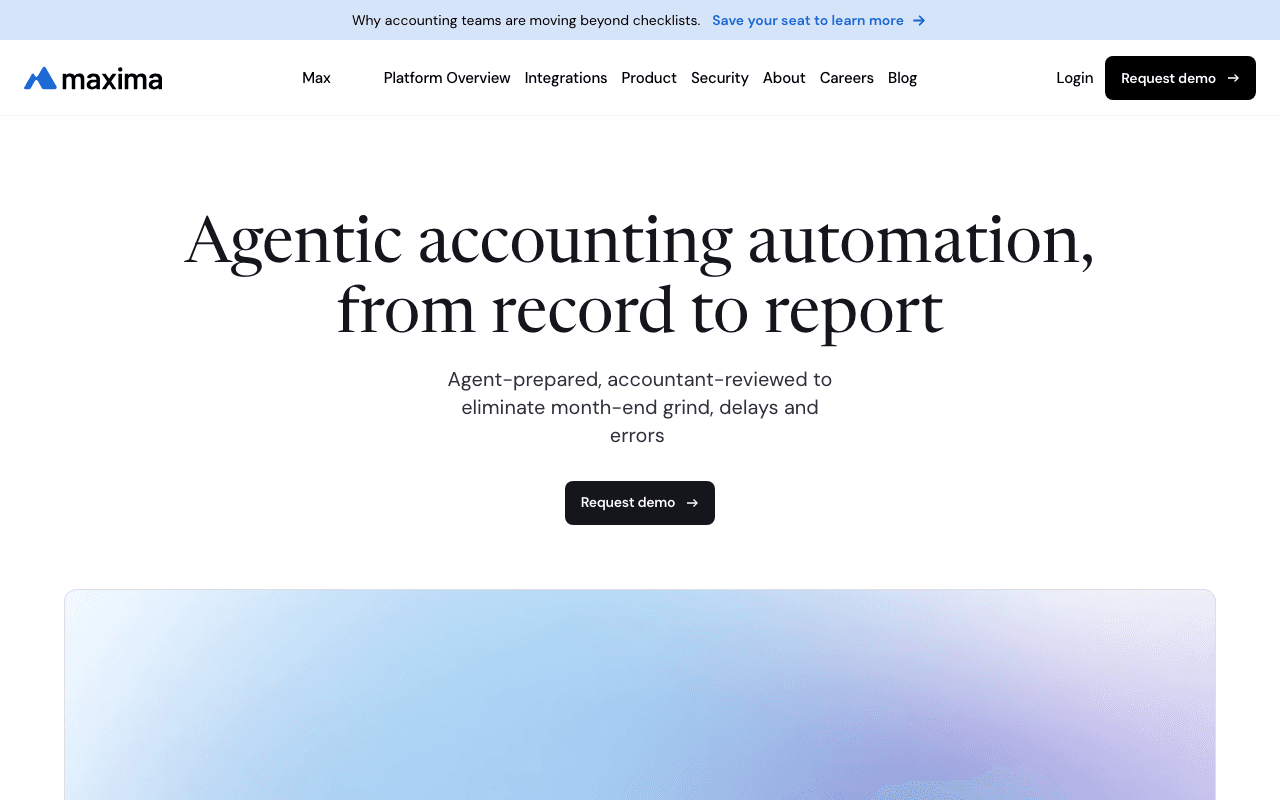
Maxima is an AI-native accounting platform where agents prepare reconciliations, journal entries, transaction matching, and flux analysis continuously, and accountants review and approve the output. It works at transaction level rather than trial-balance level, connecting to ERPs, banks, payroll, billing, and BI systems, then posting finished work back into the ERP with full source-to-GL linking. NetSuite is the deepest native integration, with direct posting and transaction linking; other systems connect through file-based transfer. Work is prepared daily as data arrives, so day one of close starts with reconciliations already built rather than blank templates.
Why it stands out
AI agents prepare the reconciliation end to end: GL detail auto-populates, ending balances compute and tie back to the ERP, evidence attaches automatically, and immaterial items clear against configured thresholds.
Transaction-level lineage and a review-first workflow mean every reconciliation is re-performable from source data through logic, validation, and approval.
Matching handles one-to-one, one-to-many, many-to-many, and three-way scenarios, including many-collections-to-one-deposit batch matching across processors, with unreconciled items carried forward with lineage intact.
Best fit
Multi-entity, multi-currency teams that want daily preparation across ERP, bank, payroll, billing, and subledger data.
Controllers who want accountants reviewing exceptions instead of rebuilding reconciliations every month.
Teams where reconciliations, matching, and journal entries should live in one system with SOX-aligned segregation of duties.
Watchouts
If your main need is basic bank recs or close task tracking, the platform is broader than required.
Broader automation depth only helps if prep work is the actual bottleneck. If your reviewers are the constraint, solve that first.
Pricing and implementation notes
Pricing is quote-based: a platform fee scaled to company size plus per-module fees, with no consultant-heavy services layer.
Ask for a live walkthrough of bank-to-GL matching, reconciling item carryforward, evidence attachment, and ERP posting approvals in one flow. Deployment is finance-owned and typically measured in weeks.
2. Trintech Cadency
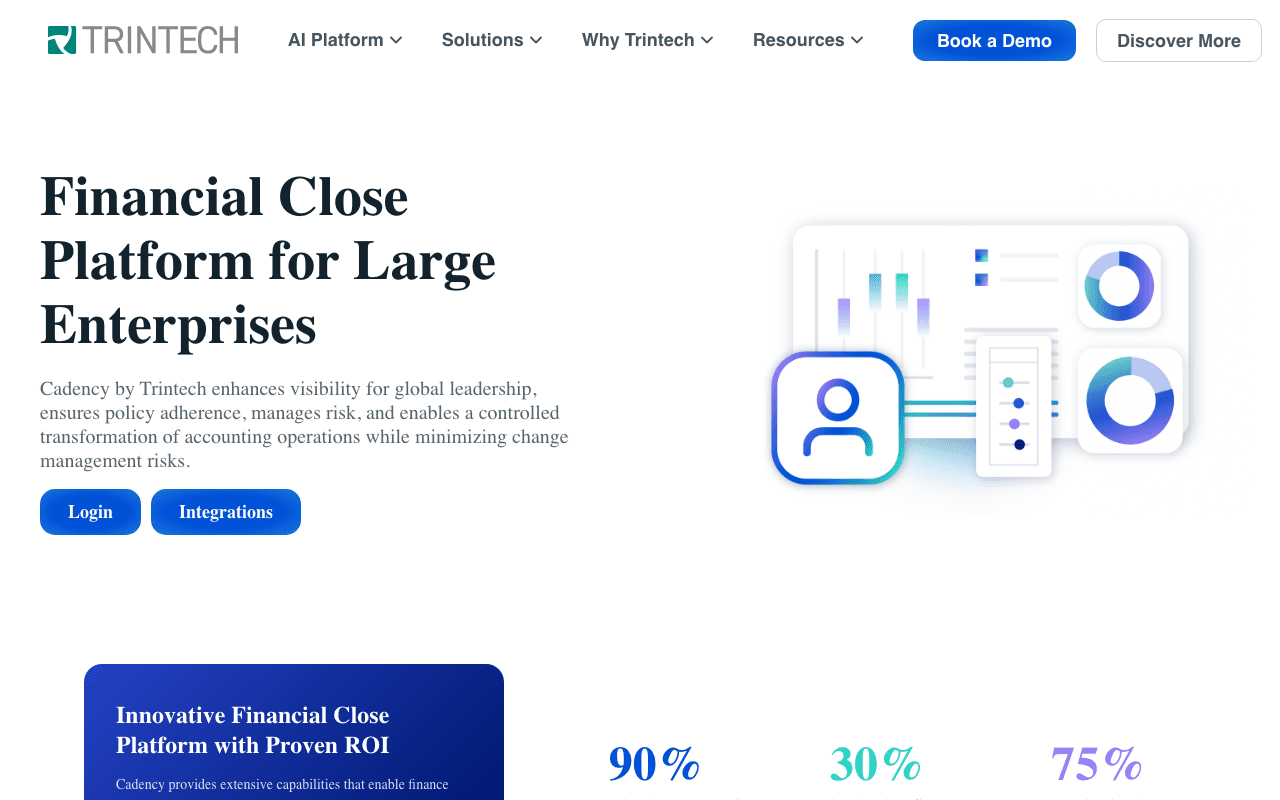
Cadency is Trintech’s enterprise record-to-report platform, covering account reconciliation, high-volume transaction matching, intercompany, journal entry management, and close governance in one controlled environment. It is built for organizations where reconciliation is inseparable from compliance evidence, and Trintech now positions the platform around agentic AI that predicts and executes close tasks. Public materials cite over 99% auto-match rates and up to 75% reduction in time to close.
Why it stands out
Depth in high-volume matching: retail, healthcare, and financial services environments with millions of transactions per period are the design target.
Governance is architectural rather than bolted on, with risk-based controls tied to the record-to-report process rather than individual worksheets.
The 99% auto-match claim holds in clean, structured data. Validate it against your processor, payroll, and intercompany mix.
Best fit
Enterprise teams with large reconciliation volumes, complex matching patterns, and formal governance obligations.
Companies needing multi-entity, multi-currency, high-volume matching inside a single vendor stack.
Finance organizations that want one vendor for close controls and reconciliation-heavy operations.
Watchouts
Cadency is rarely the lightest option if you only want faster account recs. Enterprise depth comes with more design decisions and broader transformation scope.
Compare Cadency separately from Adra. Same vendor, meaningfully different fit and cost profile.
The agentic positioning is recent. Ask which capabilities are generally available today versus roadmap, and what a customer in your industry is running in production.
Pricing and implementation notes
Expect enterprise pricing and a longer evaluation cycle. Market estimates put annual costs from roughly $60,000 for mid-enterprise deployments to $300,000 or more at scale, driven by seats, modules, and throughput.
Ask for live evidence of many-to-many matching, exception routing, and how the system handles balances that change after certification.
3. BlackLine
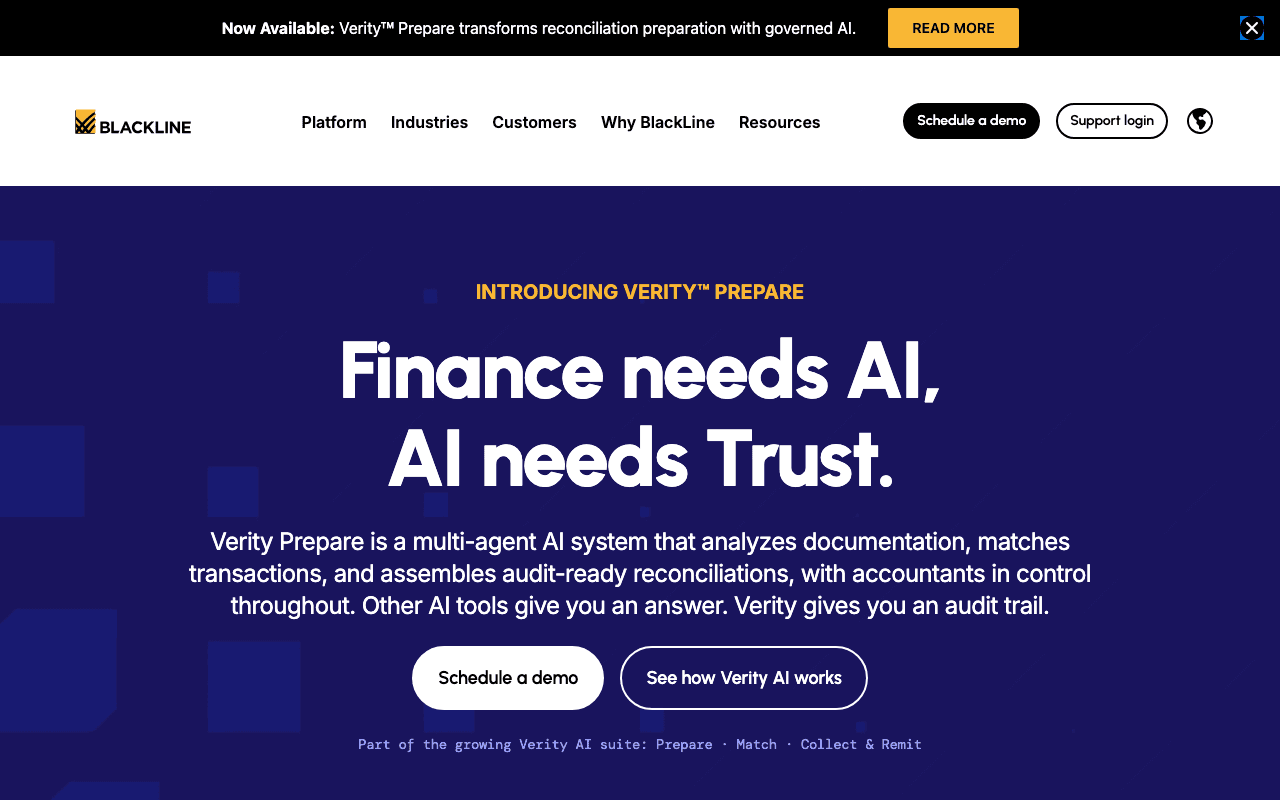
BlackLine is the platform most enterprise shortlists get benchmarked against, largely because it has been in the category longest. Its reconciliation module covers standardized templates, certification workflow, risk-rated accounts, and substantiation at scale. The company now positions Verity AI across the close, including Verity Prepare as an agent that executes reconciliation preparation. Public claims include 8x reconciliation efficiency, 50% less time on account reconciliations, and a 70% faster close.
Why it stands out
Established controls tooling: role-based certification, risk rating, auto-certification rules, and documentation depth that SOX teams already recognize.
Verity Prepare targets the preparation stage, which is a departure for a platform built to orchestrate human-prepared work.
Published benchmarks give you a yardstick for demos, provided you separate governance workflow from how much prep work actually leaves your team.
Best fit
Large enterprises needing standardized substantiation and certifications across hundreds or thousands of accounts.
Organizations already invested in BlackLine for close, journals, intercompany, or matching.
SOX-heavy environments that value established role controls above speed of change.
Watchouts
The platform is heavy compared with newer point solutions if you want narrow scope and fast iteration.
Test how much analyst effort still sits in data prep, support assembly, and exception cleanup after go-live. Orchestration platforms organize work; they do not always reduce it.
Verity Prepare is new. Ask for a customer running it in production on accounts like yours, and confirm what percentage of preparation it actually removes rather than what the demo shows.
Pricing and implementation notes
Pricing is bespoke and enterprise-led, typically an annual subscription driven by modules, entity count, transaction volume, and users. No public tiers.
Ask about implementation ownership, template rollout timelines, and what Verity Prepare changes in day-to-day reviewer workload versus in the demo.
4. FloQast Reconciliation Automation
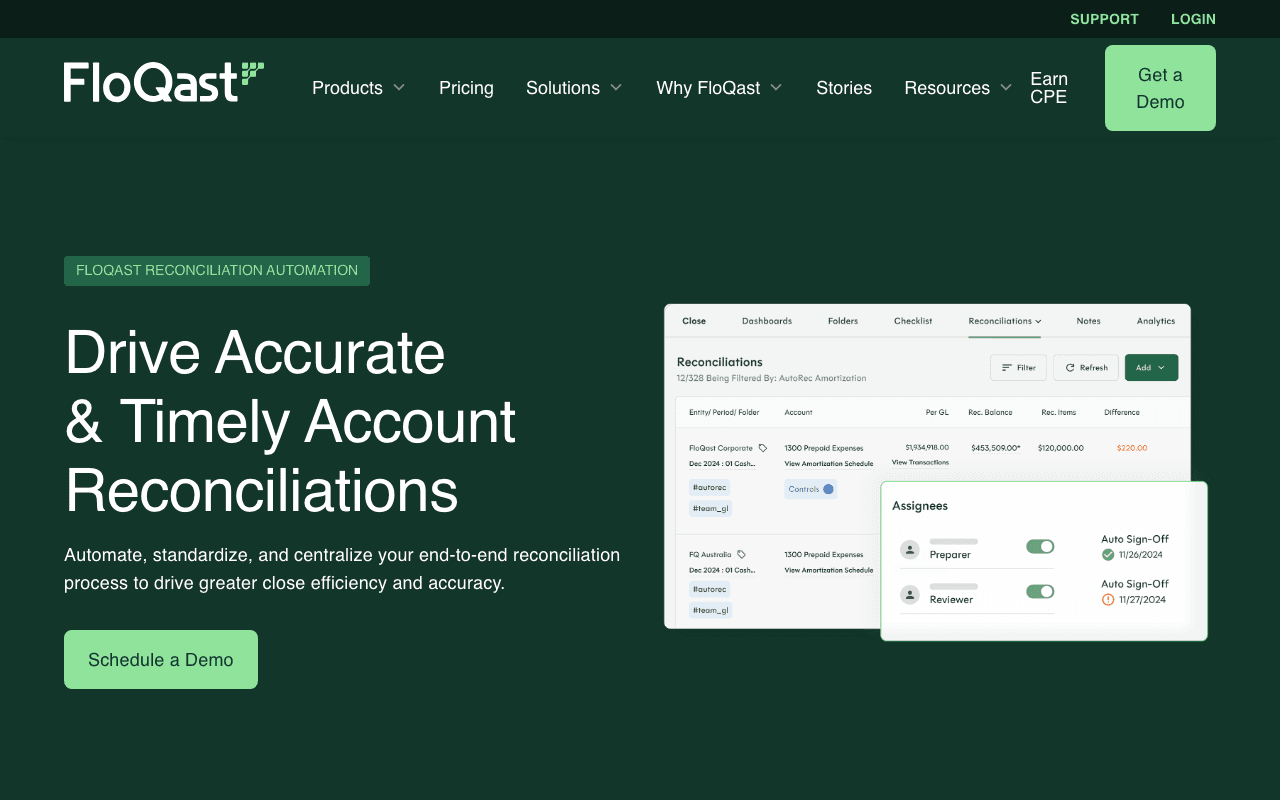
FloQast built its product around close management and checklist discipline, then extended into reconciliation automation with AI transaction matching, tie-out against supporting documentation, and evidence collection inside the same workspace. It works natively with Excel and cloud storage, which is why teams adopt it quickly: the operating model looks familiar. The company has recently repositioned around agentic AI, so separate what is generally available from what is announced.
Why it stands out
Reconciliation automation is coupled to close workflow, so status, ownership, and evidence live in one place.
AutoRec-style matching handles recurring bank and subledger tie-outs without forcing teams off their existing workpaper structure.
Strong at process consistency and reviewer visibility, which is a different problem from preparation volume. Know which one you are buying.
Best fit
Teams that want reconciliation automation tied to checklist management, evidence, and close analytics.
Organizations standardizing review workflow before attempting deeper end-to-end automation.
Accounting groups that value fast adoption and a spreadsheet-friendly operating model.
Watchouts
If the real pain is high-volume prep across banks, processors, and subledgers, test automation depth with your worst account first.
The platform functions primarily as an organizer of work rather than the system doing the bulk of preparation. That is a scope distinction worth naming before you buy.
The agentic messaging is ahead of what most customers are running. Ask which agentic capabilities are generally available, which are in limited release, and what a reference customer has in production today.
Pricing and implementation notes
Pricing is custom with no per-user fees. Reconciliation-related modules commonly land between roughly $20,000 and $120,000 per year depending on module mix and scale.
Request a demo that starts with an unreconciled account and ends with attached evidence, reviewer sign-off, and reconciling item tracking.
5. OneStream
OneStream ties account reconciliations directly to trial-balance and reporting data inside a unified corporate performance management platform. Reconciliation sits next to consolidation, financial reporting, and planning, with continuous anomaly monitoring and traceable audit trails supporting a risk-based approach to which accounts get scrutiny. For teams already standardized on OneStream, the value is architectural rather than feature-level.
Why it stands out
Reconciliations draw on the same trial-balance data that drives reporting, so drill-from-report-to-reconciliation traceability is native.
Continuous anomaly monitoring shifts effort from period-end scramble toward ongoing control, with AI-assisted reconciliations supporting faster certification.
The differentiator is platform unification, not standalone reconciliation innovation, which is a real advantage when finance architecture is the decision driver.
Best fit
Large enterprises already standardized on OneStream for close, consolidation, or reporting.
Teams that value report-to-reconciliation traceability and risk-based reporting.
Organizations that prefer suite consolidation over adding another point tool.
Watchouts
If reconciliation is the urgent pain and OneStream is not already strategic, a suite-led purchase is more than you need.
Platform fit and finance architecture often drive this decision as much as reconciliation functionality does.
Pricing and implementation notes
Expect enterprise pricing and platform-level implementation scope. Third-party review sites list per-user cloud figures, but official pricing is not publicly detailed and rarely reflects real deployment cost.
Decide honestly whether you are buying OneStream for reconciliation specifically or for a broader finance platform agenda.
6. Oracle Fusion Cloud EPM Account Reconciliation
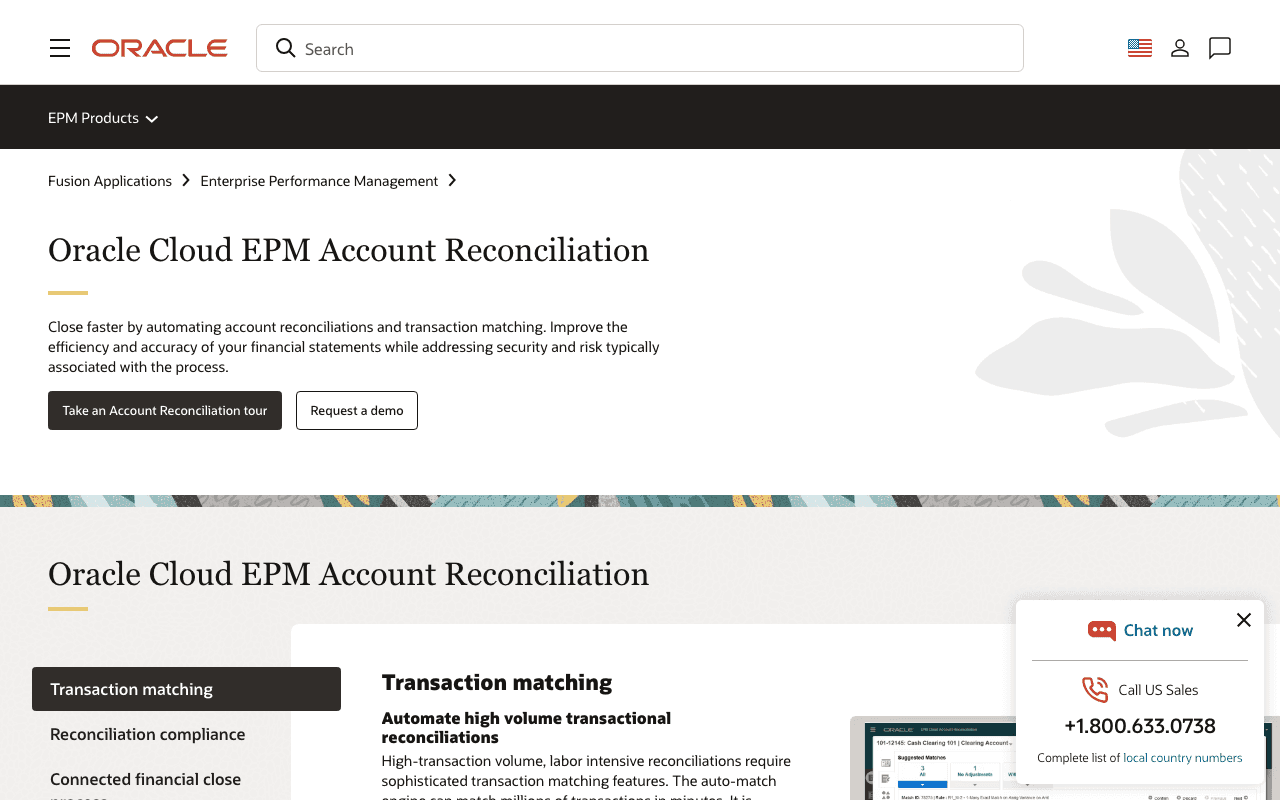
Oracle offers a dedicated Account Reconciliation service inside Fusion Cloud EPM, covering reconciliation compliance workflow and transaction matching with configurable formats, risk ratings, and automated period rollover. For Oracle ERP and EPM shops, it removes a vendor relationship and keeps security, data integration, and administration inside a familiar stack. The tradeoff is that ecosystem alignment, not reconciliation innovation, is the primary reason to choose it.
Why it stands out
Native integration with Oracle ERP and EPM data pipelines, with reconciliation and matching delivered as one service.
Established workflow constructs: preparer and reviewer roles, aging profiles, risk-rated accounts, and auto-reconciliation rules for low-risk balances.
Treat it as an ecosystem choice first and a best-of-breed reconciliation choice second.
Best fit
Finance teams already running Oracle ERP or Oracle EPM.
Organizations that prioritize native stack alignment over adding a separate vendor.
Companies comfortable with enterprise suite administration and IT-supported change management.
Watchouts
Non-Oracle shops should weigh the overhead of joining the Oracle stack against the value they actually need from reconciliation.
Test reviewer efficiency and day-to-day usability, not just functional completeness on the requirements matrix.
Pricing and implementation notes
Oracle’s global price list carries Account Reconciliation Cloud Service at $120 per hosted named user per month, typically billed under a three-year subscription term.
Ask how much configuration effort sits with finance versus IT for setup, integrations, and ongoing rule changes.
7. CCH Tagetik Account Reconciliation & Transaction Matching
CCH Tagetik from Wolters Kluwer positions account reconciliation and transaction matching as an extension of its consolidation, close, and performance management platform. Reconciliations draw on the same harmonized data model used for group reporting, with certification workflow, aging analysis, and matching for high-volume subledger activity. It fits buyers who want consistency across adjacent finance processes rather than a narrow bank-rec tool.
Why it stands out
A shared data model across consolidation, close, and reconciliation reduces the reconciliation-to-reporting gap that affects bolt-on tools.
Transaction matching is treated as a first-class capability, not an afterthought behind certification workflow.
Sits between point tools and full finance platforms, a useful middle position if you are consolidating vendors but not rebuilding your stack.
Best fit
Enterprises already leaning toward CCH Tagetik for close, consolidation, or performance management.
Teams that want harmonized data and process across accounts rather than a narrow bank reconciliation solution.
Buyers who care about transaction matching as much as certification workflow.
Watchouts
Verify whether this is the best reconciliation tool for you or the best fit for a wider suite decision you have already made.
Implementation scope expands quickly if you try to solve multiple finance-stack problems in one project.
Pricing and implementation notes
Pricing is quote-based, driven by modules, users, entities, data volume, and implementation scope.
Ask for a demo of transaction matching, workflow approvals, and how completed reconciliations feed the rest of the close and consolidation cycle.
8. Xelix Statements
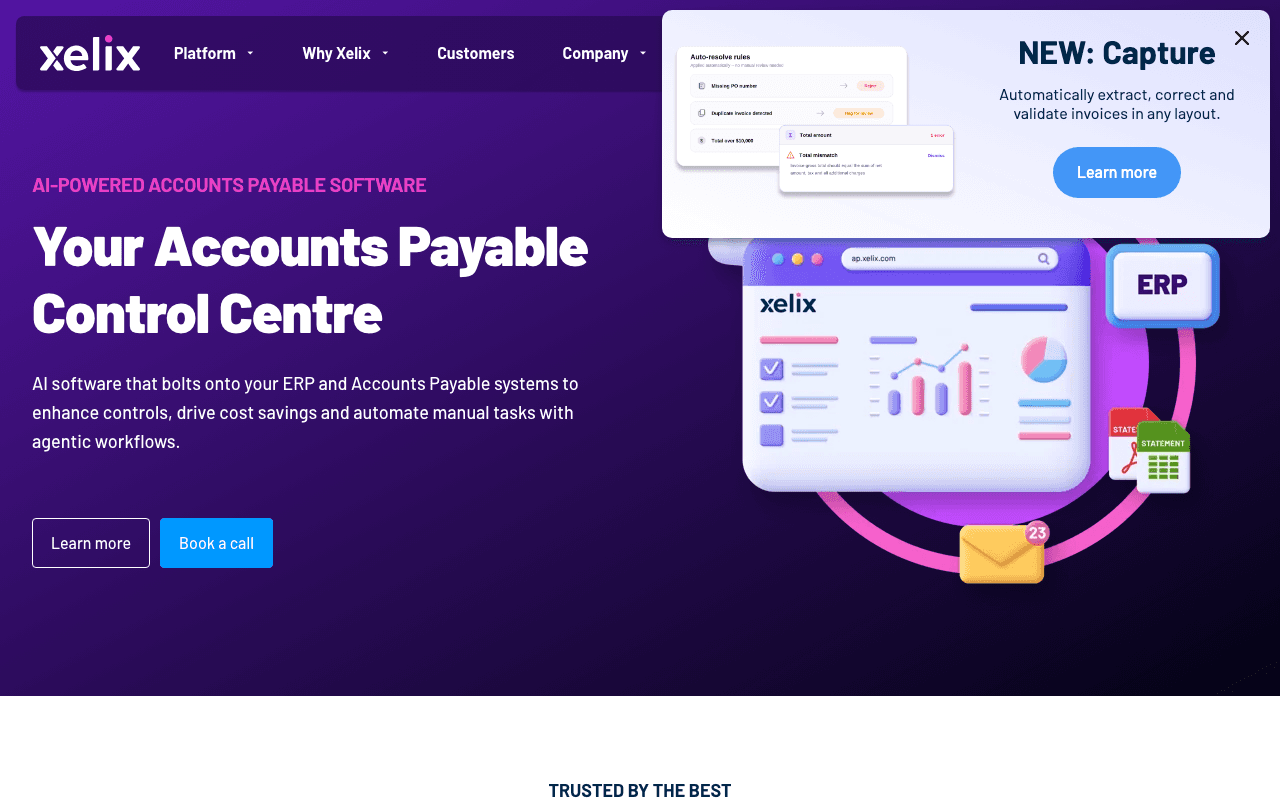
Xelix Statements handles supplier statement reconciliation inside an AI-powered accounts payable control center. It ingests statements in any format, reconciles them against ERP records, identifies missing invoices, unapplied credits, and duplicate payments, and produces audit trails plus supplier-ready outputs. This is a deliberately narrow product, and that focus is why it works: supplier statement reconciliation is one of the last genuinely manual AP tasks at most large organizations.
Why it stands out
End-to-end statement workflow: reads the statement, matches to ERP, categorizes discrepancies, and generates follow-up documentation.
Recovers value that general close tools never touch, particularly missed credits and duplicate payments sitting in supplier accounts.
Xelix is not trying to be the universal answer for every balance sheet account, and it says so. That scope honesty is useful during evaluation.
Best fit
AP teams reconciling high supplier statement volume and trying to reduce missed credits, vendor disputes, and manual follow-up.
Organizations that want reconciliation tied to AP controls rather than general close management.
Teams seeking fast value in a focused area without replacing the wider finance stack.
Watchouts
Do not mistake supplier statement reconciliation for full account reconciliation coverage across the close.
If cash, payroll, intercompany, or balance-sheet-wide recs are the main issue, other tools here fit better. Xelix is usually an addition to your stack, not a replacement.
Pricing and implementation notes
Custom enterprise pricing based on AP scope and volume. Public marketplace and public sector listings suggest full-suite deals around $150,000 over 36 months, with standalone statement reconciliation licensing near £40,000 per year in some UK public sector agreements.
Ask how statement ingestion, ERP matching, and supplier communication work with your actual statement formats.
9. Prophix One Account Reconciliation
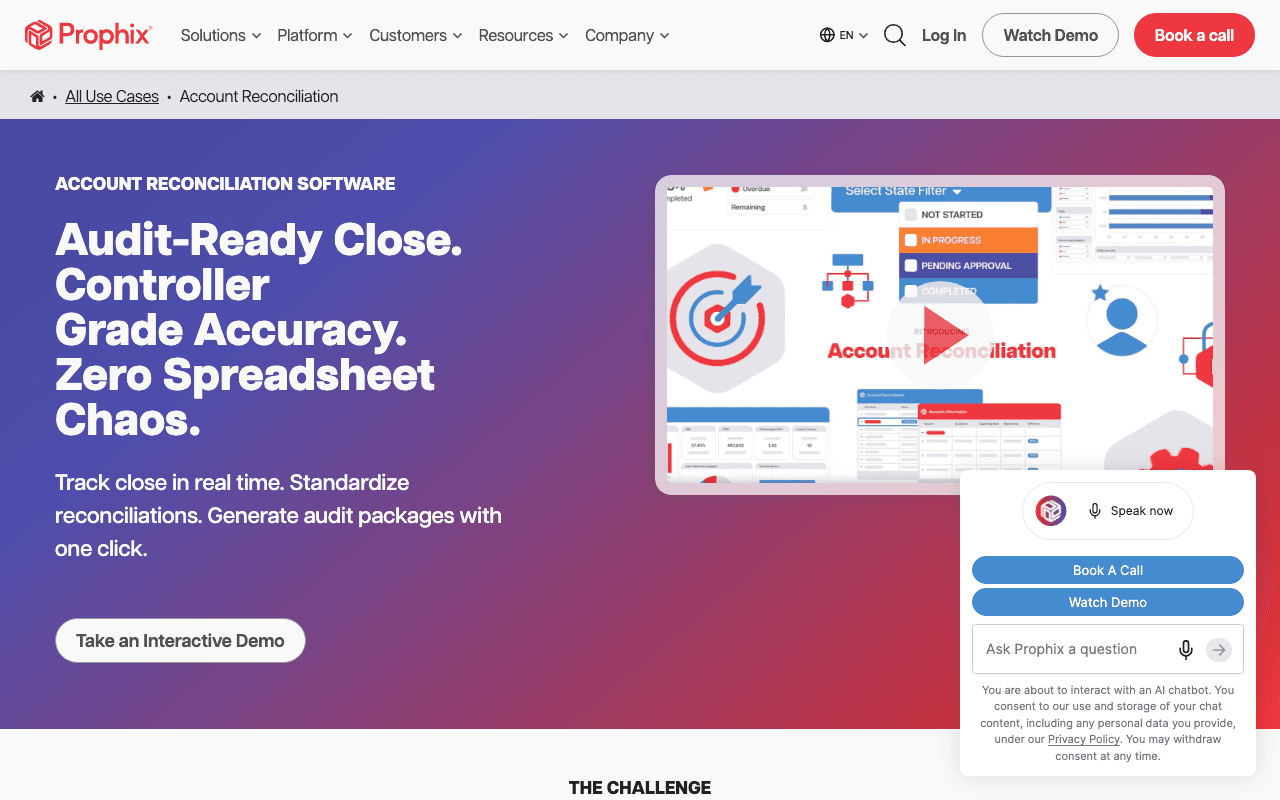
Prophix One delivers account reconciliation as a module inside its financial performance platform, combining close dashboards, standardized templates, transaction matching, reconciling item tracking, and one-click audit package export. It targets mid-market and upper-mid-market teams still running reconciliations in Excel with email-based review. The value is guided workflow and standardization rather than deep autonomous preparation.
Why it stands out
Template-driven reconciliations with built-in reviewer workflow replace the folder-and-email pattern most mid-market teams still use.
One-click audit package export removes a task that quietly consumes days every quarter.
Reconciliation lives inside a connected plan-to-close environment, which appeals to teams consolidating FP&A and accounting tooling.
Best fit
Teams replacing spreadsheet-driven reconciliations with standardized templates and formal reviewer workflow.
Finance groups that want reconciliation inside a connected planning and close environment.
Organizations where audit package assembly is still painfully manual.
Watchouts
Test transaction-level automation depth against AI-native and reconciliation-specialist platforms before assuming parity.
If your pain is extreme transaction complexity, compare Prophix against deeper matching engines. The tradeoff is strong standardization, less autonomous preparation.
Pricing and implementation notes
Pricing is quote-based. Marketplace listings put Close Management, which includes account reconciliation, around $50,000 for a 12-month contract, subject to scope.
Ask how much of the workflow finance users configure themselves versus what requires an admin or implementation partner.
10. Vena
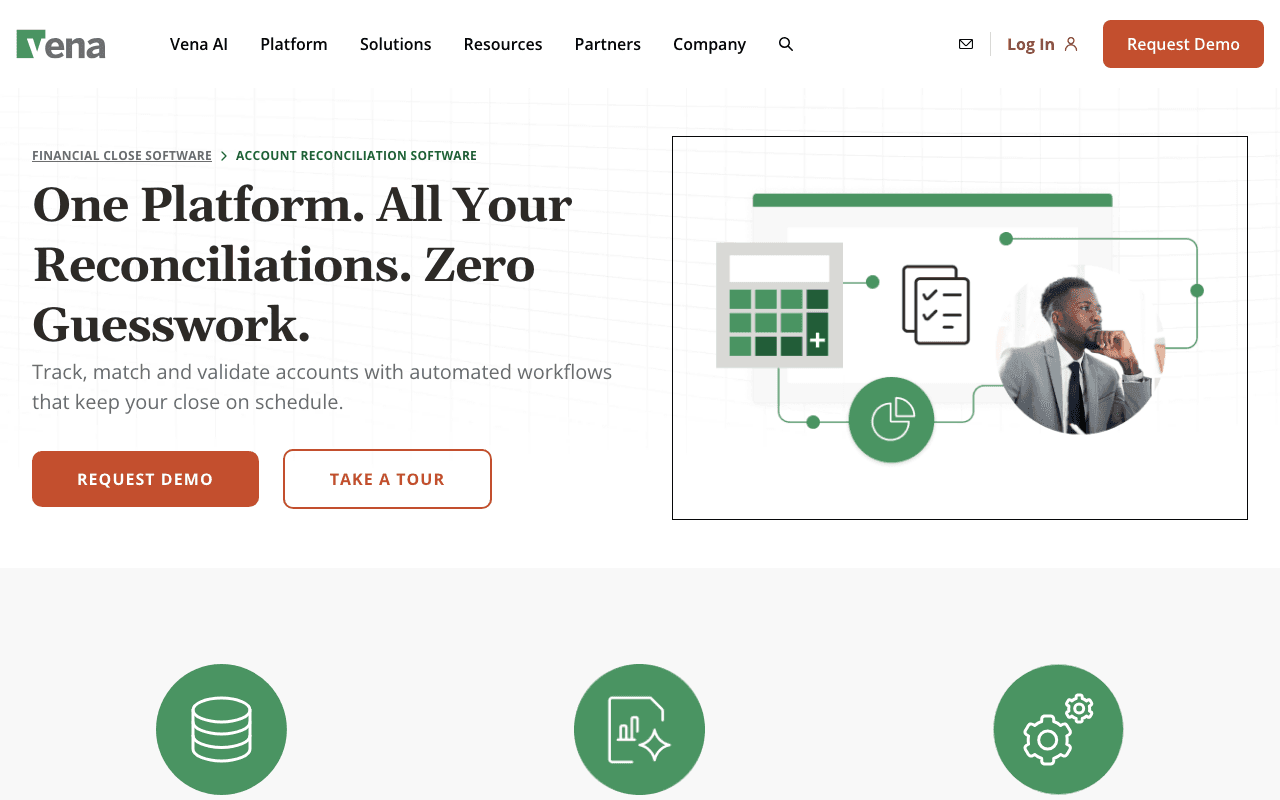
Vena delivers account reconciliation on a centralized database with a native Excel interface, ERP and GL connectivity, workflow routing, reusable templates, and support for specialized reconciliations like intercompany and payroll. Teams that live in spreadsheets get structure and version control without abandoning the tool they know. Reconciliation sits alongside planning, reporting, and consolidation in the same platform.
Why it stands out
An Excel-native experience with database-backed control is a different adoption curve for teams resisting new interfaces.
Templates plus centralized documentation address the two most common audit findings in spreadsheet environments: inconsistency and missing support.
Appeals to finance organizations that want reconciliation plus adjacent planning and reporting from one vendor.
Best fit
Teams standardizing reconciliations without jumping to a heavy close-only enterprise suite.
Organizations already considering Vena for broader finance transformation.
Groups that value centralized templates, version control, and documentation.
Watchouts
Compare Vena’s reconciliation depth against platforms singularly focused on record-to-report automation.
If your team’s constraint is transaction volume rather than process consistency, keep looking.
Pricing and implementation notes
Pricing is customized by user types, modules, and services. Mid-market subscriptions commonly land in the $130,000 to $260,000 annual range, with enterprise tiers substantially higher. Implementation can add 0.6x to 1.2x year-one subscription.
Ask how account reconciliation fits the rest of the Vena stack and what a phase-one delivery includes.
11. Planful
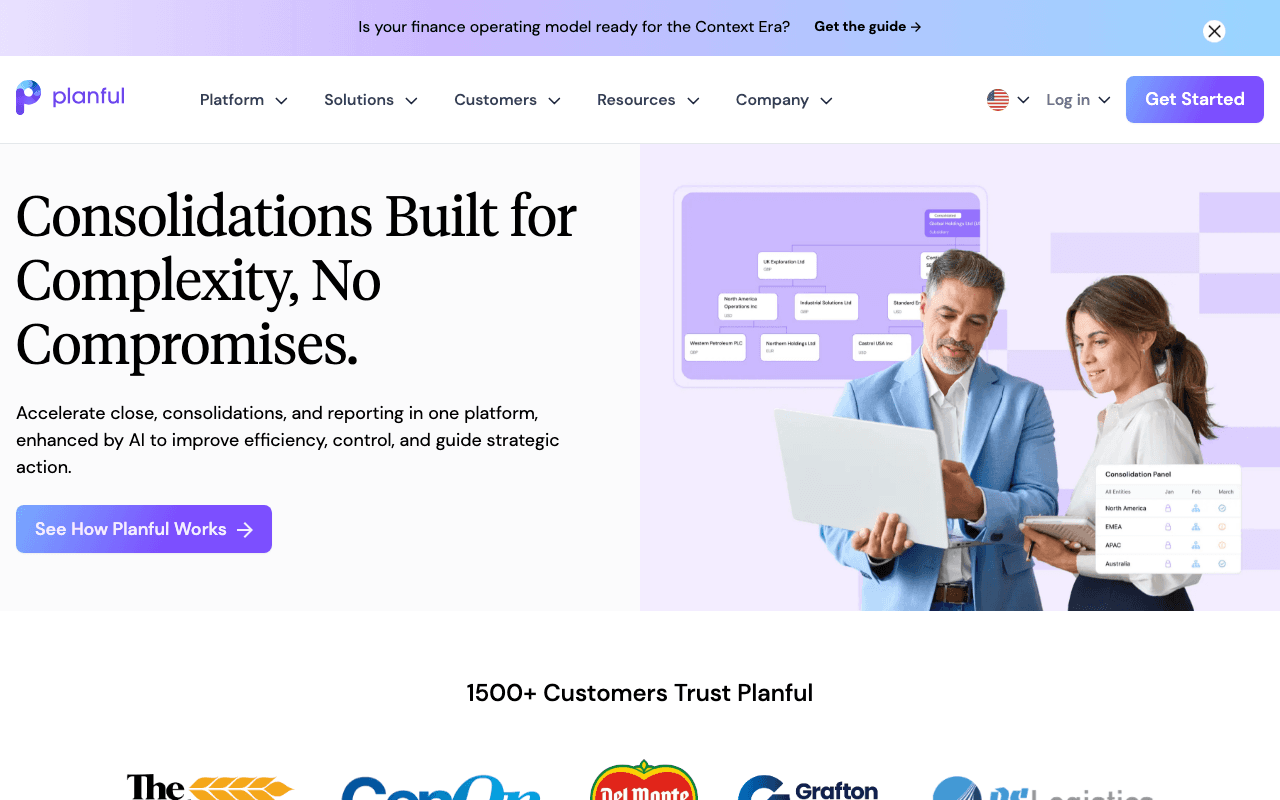
Planful connects account reconciliations to close, consolidation, reporting, and planning in a single platform, which makes it a suite-oriented choice rather than a reconciliation specialist. Reconciliations run against consolidated data with workflow, thresholds, and status tracking that roll into close visibility. Buyers usually arrive here because they are already evaluating Planful for consolidation and planning, not because reconciliation drove the search.
Why it stands out
Reconciliations sit adjacent to consolidation and reporting, which reduces handoff friction between close and reporting teams.
Fits organizations trying to reduce tool sprawl across CFO workflows.
Framing this as a workflow adjacency decision helps you decide whether you want a specialist or a multi-use platform.
Best fit
Finance teams already evaluating Planful for close and consolidation alongside planning.
Organizations that prefer fewer vendors across CFO workflows.
Teams that want reconciliations to live close to reporting and consolidation.
Watchouts
If reconciliation automation is the single urgent problem, compare Planful against focused products before assuming platform breadth solves it.
Suite consolidation does not always equal the best operational fit for close teams.
Pricing and implementation notes
Pricing is quote-based by module, user count, and company size. Estimated annual contract values range from roughly $15,000 to $50,000 for smaller deployments up to several hundred thousand for enterprise scope.
Confirm whether account reconciliation is enabled in your edition and how much setup work it requires.
12. SolveXia
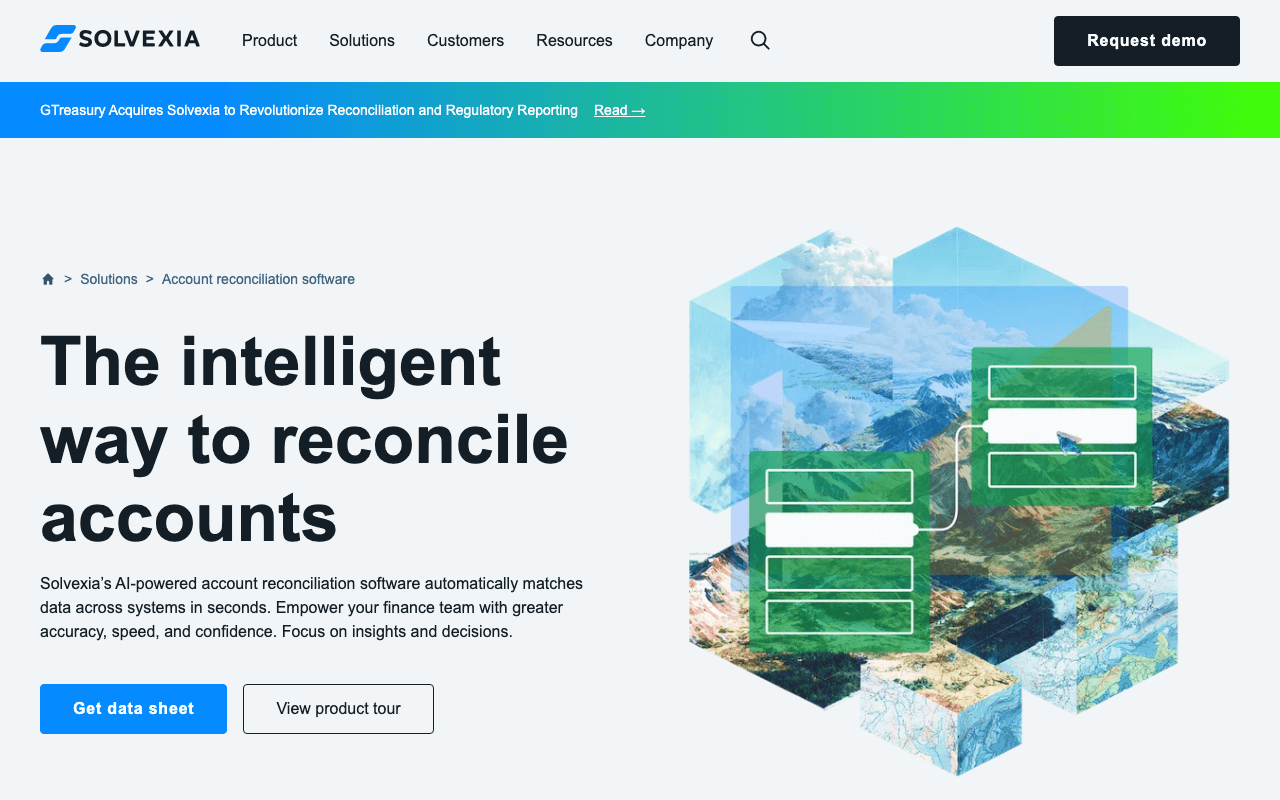
SolveXia is a no-code finance automation platform aimed at data-heavy, reconciliation-adjacent processes: multi-source data ingestion, transformation, matching, and reporting across files and systems that were never designed to talk to each other. If your reconciliation problem is really a data wrangling problem, this is a different and often better answer than a close suite. The buying lens is process automation, not accounting workflow.
Why it stands out
Handles high-volume, multi-format data transformation that accounting-native tools push back to Excel.
Automation extends beyond reconciliation into any repeatable finance process, which spreads the investment across use cases.
Compare workflow automation depth against close-suite governance depth. They solve different halves of the problem.
Best fit
Teams with reconciliation pain spread across many files, systems, and operational data sources.
Organizations that want no-code automation beyond one narrow accounting use case.
Finance functions comfortable owning process automation as the core buying lens.
Watchouts
Test how naturally the product handles reviewer workflow, sign-off, certification, and ongoing close discipline compared with accounting-native tools.
A strong automation platform is not automatically a strong accounting operating model, and no-code still means someone owns the logic.
Pricing and implementation notes
Pricing is customized on a subscription basis driven by users and required resources. No public tiers or free trial.
Ask for a demo built on your real source systems, not a simplified file-import example.
13. Adra by Trintech
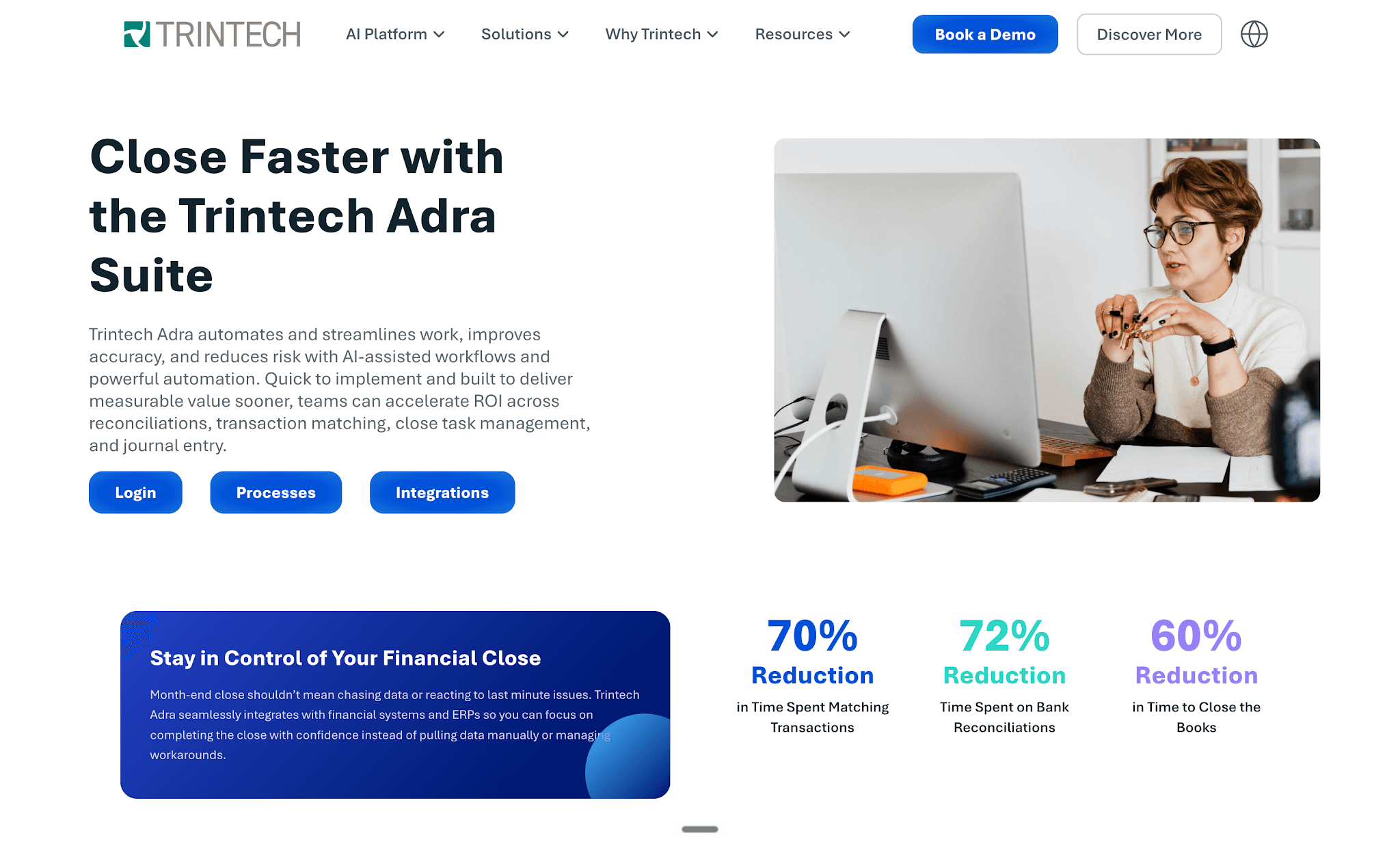
Adra is Trintech’s mid-market suite: Balancer for balance sheet reconciliations, Matcher for transaction matching, Task Manager for close tasks, and Analytics for close reporting. It delivers Trintech-style controls and workflow without the design scope of Cadency, which is why many teams moving off Excel land here. Time to value is measured in weeks, and the module structure lets you start narrow.
Why it stands out
Purpose-built for teams that outgrew spreadsheets but are not ready for an enterprise record-to-report transformation.
Balance sheet reconciliation and transaction matching come from the same vendor with a shared control model.
The Cadency-versus-Adra choice is mostly about company size, complexity, and operating style, not capability tiers alone.
Best fit
Mid-market and upper-mid-market teams that want a dedicated close and reconciliation suite with faster time to value.
Organizations moving off Excel but not buying a larger enterprise finance stack.
Buyers who want balance sheet recs and matching from one vendor.
Watchouts
Compare Adra against both close-first tools and AI-native automation platforms, because its sweet spot matches neither exactly.
Module structure means scope creep is easy. Price the full configuration you will actually need in year two.
Pricing and implementation notes
Quote-based and module-sensitive. Benchmarks suggest core Balancer plus Task Manager runs roughly $40,000 to $200,000 per year. Matcher is volume-tiered.
Ask which components your use case requires and whether recs, matching, and task management must be bought together.
14. IBM Cognos Controller
IBM Cognos Controller is a financial consolidation and close product with reconciliation support inside a controller-centric environment. Buyers choose it for continuity: if consolidation already runs here, keeping reconciliation adjacent avoids a new integration and a new vendor. It is not the most modern reconciliation specialist on this list, and shortlisting it purely on familiarity is a mistake worth naming directly.
Why it stands out
Reconciliation stays close to consolidation and group reporting, which matters when intercompany and elimination work drive your reconciliation load.
Established controller workflows and reporting continuity for organizations already invested in the IBM stack.
Candid positioning helps serious buyers self-select rather than discover the gap in month three.
Best fit
Organizations already running IBM Cognos Controller and wanting to stay in that ecosystem.
Finance teams prioritizing continuity with established controller workflows.
Buyers whose reconciliation needs are tightly coupled to consolidation processes.
Watchouts
Compare user experience, flexibility, and automation depth against newer platforms before shortlisting on legacy familiarity alone.
If prep work is your bottleneck, this is unlikely to be the tool that removes it.
Pricing and implementation notes
Pricing varies by environment and partner model. Public sector schedules have listed 12-month license plus support around $112,000 for Standard Edition and $225,000 for Enterprise Edition.
Ask how reconciliation workflows behave in the current web experience, not just in legacy documentation and screenshots.
Choosing the right account reconciliation software for your close
The shortlist gets simple once you name where the work still happens. If your team spends the first four days assembling data before anyone reviews anything, buy close automation. If your reconciliations are already prepared but review, evidence, and certification are chaotic, buy orchestration and controls. Suite modules make sense when finance architecture drives the decision, not when reconciliation is the fire. And if the pain is concentrated in one place, like supplier statements, a focused tool beats a platform every time.
Best account reconciliation software by company size
Operating model matters more than headcount, but company size is a reasonable proxy for transaction volume, entity complexity, and governance requirements. Here is how the tools on this list map to each tier.
Enterprise (1,000+ employees, multi-entity, SOX or audit-heavy): Maxima fits when the priority is removing preparation work rather than adding certification workflow. Trintech Cadency and BlackLine are the established governance reference points, carrying the role controls and reconciliation volume capacity large organizations expect. OneStream, Oracle Fusion Cloud EPM, and CCH Tagetik make sense when reconciliation is part of a broader finance architecture decision.
Mid-market (100 to 1,000 employees, growing complexity, moving off spreadsheets): Adra by Trintech is the most direct fit, offering Trintech-style controls without Cadency’s transformation scope. Maxima fits mid-market teams with high transaction volume across multiple source systems, where preparation rather than coordination is the constraint. FloQast works when close visibility and process consistency are the immediate pain. Prophix One and Vena suit teams that want reconciliation inside a broader planning and close platform.
SMB and single-entity teams (fewer than 100 employees, straightforward close): QuickBooks Online covers basic bank and credit card reconciliation natively for teams that do not yet need formal reviewer controls or multi-source matching. Adra by Trintech is the natural first step up when you need documented sign-off and balance sheet substantiation. The honest signal for moving beyond native ERP reconciliation: when your team spends more time building reconciliations than reviewing them, the SMB tools have reached their natural boundary.
Summary by need:
Best for AI-native preparation automation: Maxima, for multi-entity teams that want agents preparing reconciliations, matching, and journal entries daily with transaction-level lineage and SOX-aligned review.
Best for enterprise governance-heavy close: Trintech Cadency and BlackLine, with Adra as the mid-market path into the same control model.
Best for finance-suite buyers: OneStream, Oracle Fusion Cloud EPM, CCH Tagetik, Vena, Planful, and IBM Cognos Controller, chosen on architecture fit.
Best for AP supplier statement reconciliation: Xelix Statements, with SolveXia when the problem is data wrangling across many sources.
FAQs about account reconciliation software
What is account reconciliation software actually supposed to do?
It should pull source data, match transactions, compute and validate the ending balance, attach evidence, track reconciling items across periods, and route the result through preparer and reviewer approval. Tools that only track completion status are close management software, a different and complementary category. The category covers bank reconciliation, balance sheet reconciliation, intercompany reconciliation, subledger tie-outs, payment processor reconciliation, and supplier statement reconciliation. The best platforms handle all of these from one data model rather than requiring a separate tool per reconciliation type.
How is AI-native reconciliation software different from legacy close platforms?
Legacy platforms orchestrate work your team prepares. AI-native platforms prepare the reconciliation itself and hand your team a completed workpaper to review. The practical test: on day one of close, does the system show an empty template with a due date, or a finished reconciliation with exceptions flagged?
Can I trust vendor claims like 99% auto-match rates?
Those numbers hold under favorable data conditions. Trintech publishes 99%+ auto-match and up to 75% faster close, BlackLine publishes 8x efficiency and 50% less reconciliation time, and insightsoftware references up to 95% automation. Validate each against your own processor, payroll, and intercompany accounts during the demo, using your data.
How much does account reconciliation software cost?
Mid-market dedicated suites often run from roughly $40,000 to over $300,000 annually. Per-user options exist, including Oracle at $120 per hosted named user per month. Most enterprise vendors quote custom pricing only.
How long does implementation take?
It depends on operating model, not vendor size. Finance-owned platforms with native connectors go live in weeks. Enterprise suites with template design, partner-led rollout, and IT-managed integrations typically span one to three quarters. Ask specifically who owns configuration after go-live.
Do I still need reconciliation software if my ERP has reconciliation features?
Usually yes, once you have multiple entities, high transaction volume, or formal reviewer controls. ERP features work at the GL and trial-balance level. Reconciliation platforms work at the transaction level across banks, processors, payroll, and subledgers, which is where batch deposits and partial matches actually get resolved.
What should I bring to a reconciliation software demo?
Bring your payment processor clearing account, your intercompany account, and one payroll reconciliation. Then ask the vendor to change a balance after certification and show you what the system flags. Those three accounts and one test separate the tools that prepare work from the tools that track it.
What types of reconciliations can these tools handle?
The tools on this list collectively cover bank reconciliation, balance sheet reconciliation, intercompany reconciliation, subledger tie-outs (AR, AP, fixed assets, payroll, deferred revenue), payment processor reconciliation, supplier statement reconciliation, and cash and credit card reconciliation. Not every tool handles all types. Xelix is purpose-built for supplier statements. Maxima, Trintech Cadency, and BlackLine cover the full range. Match the tool’s supported reconciliation types to your actual account mix before shortlisting.
What affects implementation time the most?
Three factors drive the gap between weeks and quarters. First, who owns configuration: finance-owned platforms with native connectors go live faster than IT-dependent setups requiring custom integrations. Second, how many accounts and entities you are rolling out at once: a phased rollout by account type is almost always faster than a big-bang launch. Third, whether your source data is clean enough for automated matching to work on day one. Dirty GL data, inconsistent vendor naming, and missing subledger history add weeks regardless of the platform. Ask every vendor specifically who owns configuration after go-live and what a phase-one delivery includes.

Move closer to an audit-ready, continuous close

Request demo
Insights, news and content
The latest
See all