If you have ever closed the books with a spreadsheet on one monitor and three bank portals on the other, you already know the real question is not which accrual accounting software is objectively best. It is which layer of your stack is breaking. The answer depends on whether you need basic accrual books, ERP depth, close automation across existing systems, or an AI-native preparation layer that builds the work before your team reviews it.
This list ranks eight tools by fit, not by one-size-fits-all superiority, and applies the same comparison lens to each one: what it prepares, what it stores, and where it stops. Here is who each recommendation is written for:
First-system buyers who need clean accrual-basis books, invoicing, and reporting without an implementation project.
Scale-up finance teams that have outgrown small-business software and need multi-entity structure, dimensional reporting, and revenue management.
Enterprise controllers with an acceptable ERP but a close that still runs on manual reconciliations, journals, and tie-outs.
SOX-compliant accounting teams that need review-first controls, evidence, and audit-ready lineage on everything that posts.
What is accrual accounting software?
Accrual accounting software records revenue when it is earned and expenses when they are incurred, regardless of when cash moves. That is the core distinction from cash-basis accounting, where transactions only hit the books when money changes hands. For any business with subscriptions, deferred revenue, inventory, or multi-period contracts, cash accounting produces a misleading picture of financial health.
SaaS companies, inventory businesses, and funded startups typically need accrual accounting because GAAP requires it above certain revenue thresholds, investors expect it, and cash-basis books cannot accurately represent deferred revenue, prepaid expenses, or multi-period contracts. If your business collects payment before delivering a service, or incurs costs before paying them, accrual accounting is not optional.
Best accrual accounting software at a glance
Use this table to orient yourself before reading the full reviews. Each row links to the detailed section below.
Tool | Best fit | Pricing model | Multi-entity support | Key limitation |
Maxima | Enterprise teams with an ERP and manual close prep | Platform + module fees (custom quote) | Yes, native | Requires an existing GL; not a starter system |
QuickBooks Online | US small businesses and early-stage teams | Published tiers from $38/month | Limited | Revenue recognition requires Advanced tier |
Xero | Small businesses, especially outside the US | Published tiers from $25/month | Limited | Depth often requires third-party apps |
Zoho Books | Budget-conscious SMBs needing real accounting admin | Published tiers from $20/month; free tier available | Limited | Full value depends on wider Zoho ecosystem |
Sage Intacct | Mid-market multi-entity and SaaS accounting | Custom quote; ~$10K–$75K/year | Yes, native | Implementation requires real project effort |
Oracle NetSuite | Multi-subsidiary, complex revenue, full ERP | Custom quote; partner estimates ~$999+/month base | Yes, native (OneWorld) | More breadth than needed if GL is already acceptable |
Business Central | SMB and mid-market teams on Microsoft stack | Published; from $80/user/month | Yes, with partner configuration | Implementation quality varies by partner |
BlackLine | Enterprise teams needing close control across ERPs | Custom quote; ~$40K–$77K/year typical | Yes, ERP-agnostic | Prep work still performed by humans before workflow starts |
How to choose the best accrual accounting software for your team
Before comparing products, get clear on which part of the accrual process is actually costing you days. Most shortlists go wrong because buyers compare feature lists across categories that were never designed to solve the same problem.
What accrual accounting software should actually solve
The core requirement is period matching. Accrual software should help you recognize revenue and expenses in the periods they belong to, not just record when cash moved. For subscription and B2B SaaS models especially, that means automated revenue recognition, real-time reporting rather than month-end-only visibility, and the ability to handle multiple entities as the org chart grows.
The month-end reality is narrower than the marketing. Recurring accruals, deferred revenue schedules, bank and subledger reconciliations, and reviewer support are the first things that break when transaction volume climbs. When you are hand-keying bank activity, tying out payment processor deposits line by line, or discovering a cash coding error on day six of close, the stack has already outgrown you.
The practical test: compare what a system prepares, validates, and posts against what it merely stores, tracks, or reports.
Manual bank and credit card tie-outs that consume the first days of close
Recurring accrual and prepaid schedules rebuilt by hand every month in Excel
Deferred revenue rollforwards that no one can trace back to source transactions
Many-to-one deposit matching across processors, the GL, and internal tools
Flux explanations written from memory instead of from transaction-level detail
Late error discovery, where issues surface at review instead of on the day they occur
The three software categories buyers often lump together
"Accrual accounting software" is a shopping phrase, not a product category. Three distinct operating models sit behind it, and each one performs a different type of work.
Traditional accounting systems. They keep the books, run invoicing and AP, and produce accrual-basis reports for smaller teams. They break at multi-entity consolidation and complex revenue.
ERP and financial management platforms. They add entity structure, dimensional reporting, deeper controls, and operational scope. They break when the issue is not the ledger but the manual prep feeding it.
Close automation platforms. They sit on top of the ERP to standardize reconciliations, journals, matching, and control workflows. They break when the underlying work still has to be prepared by a human first.
The evaluation criteria used in this list
Every product below is judged against the same seven criteria, plus adoption fit: who prepares the work, who reviews it, and whether the workflow matches how your close already runs.
Automation depth. Good: the system prepares and validates output, then routes for approval. Warning sign: "automation" means a template or a reminder. Why it matters: prep work, not tracking, is where close days disappear.
Recurring accrual support. Good: schedules, reversals, allocations, and amortization run without rebuilds. Warning sign: accruals live in an off-system workbook. Why it matters: period matching fails quietly when schedules drift.
Reconciliations and matching. Good: one-to-many and many-to-many matching with evidence and thresholds. Warning sign: only bank feed matching at the balance level. Why it matters: high-volume deposits and subledgers break simple matching.
Multi-entity and multi-currency. Good: native consolidation, intercompany, and FX revaluation. Warning sign: separate files per entity and a manual roll-up. Why it matters: entity sprawl multiplies every manual step.
Integrations. Good: direct APIs to ERP, banks, payroll, billing, and warehouse. Warning sign: CSV export as the primary path. Why it matters: manual exports are the hidden cost of month-end.
Auditability. Good: transaction-level lineage, immutable logs, and re-performable evidence. Warning sign: screenshots and email approvals. Why it matters: auditors test the evidence, not the summary.
Pricing transparency. Good: published tiers or a clear scope-based structure. Warning sign: quote-only with undefined module scope. Why it matters: total cost of ownership decides shortlist viability.
Use these criteria to rule things out in both directions, so you do not buy an underpowered tool for an enterprise close or an overbuilt ERP when the real bottleneck is preparation.
1. Maxima
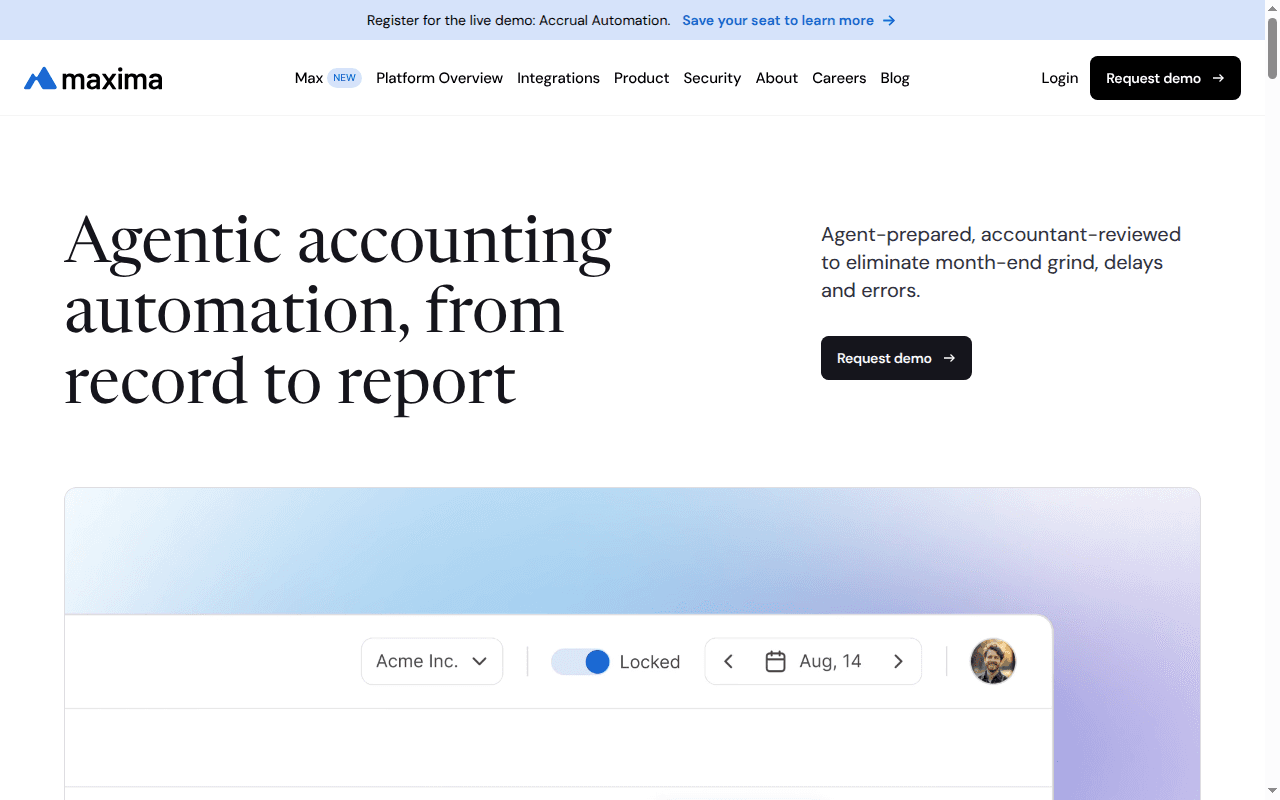
Maxima is best for accounting teams whose ERP can record accruals but cannot prepare, validate, reconcile, and document them without significant spreadsheet work. It is an AI-native platform that sits on top of your existing ERP and covers the full accrual lifecycle: pulling source data from banks, payroll, billing, BI, and the ERP; determining what belongs in the period; preparing the accrual and its supporting calculation; routing the work for human review; posting and reversing under controlled rules; reconciling the estimate against actuals; and preserving transaction-level evidence for audit.
AI agents build formula-intact work papers and route finished output for approval before anything touches the general ledger. Controls such as segregation of duties, approval routing, exception handling, and immutable audit logs are enforced architecturally rather than by policy. It belongs on this list because it targets the layer the other tools mostly leave alone: not the ledger, and not task status, but the preparation work that consumes the first week of close.
Best fit
Maxima fits teams that already have a capable GL but still burn days on the work that sits between source data and a posted, reconciled, audit-ready accrual entry.
Enterprise accounting teams with an ERP in place and heavy manual prep in accruals, reconciliations, matching, and flux commentary
Multi-entity, multi-currency, high-volume environments that need review-first controls before anything posts
SOX-compliant organizations that need evidence, maker-checker separation, and re-performable lineage
Teams whose bottleneck is the preparation layer, not the absence of a general ledger
What it automates well
The platform runs structured work through a deterministic engine and judgment-heavy work through its accounting agent, Max.
Journal entry preparation from bank, billing, payroll, BI, and ERP data, including accruals, cash coding, allocations, intercompany, payroll, PTO, and auto-reversals
Account reconciliations for cash, credit card, deferred revenue, fixed assets, payroll, and payment processors, with evidence, per-account thresholds, rollforwards, and reviewer status
Transaction matching at scale, including one-to-many and many-to-many deposit matching, with manual matches promotable to permanent rules
Flux analysis with transaction and vendor-level anomaly detection, materiality thresholds, duplicate JE detection, and drafted variance commentary
Prepaid, fixed asset, commission, and lease subledgers with amortization schedules and short-term and long-term reclasses
Close orchestration that updates from actual agent output, so status reflects posted entries and certified reconciliations instead of manual trackers
Where it reaches its boundary
It is an overlay on your finance stack, not a starter bookkeeping system for a company standing up its first GL.
If your needs are simple invoicing, basic AP, or low-volume books, it is more system than the problem requires.
Because the preparation layer is deep, workflow fit should be validated module by module rather than assuming you need everything on day one.
Value concentrates where third-party data must be compared against the GL, so accounts that already tie cleanly inside the ERP see less lift.
None of that should rule it out for enterprise teams whose close is slow because humans are still building the work from scratch.
Buying notes
Pricing is not published. Maxima uses a platform fee plus module-based fees shaped by transaction volume, entity count, and system complexity, so compare total scope rather than hunting for a seat price. Implementation is included and led by former Big Four forward-deploy strategists, which matters when you are modeling total cost of ownership against legacy platforms that require ongoing services.
In diligence, ask about source-system coverage across your banks and subledgers, approval routing and segregation of duties, evidence export and data portability, and certifications including SOC 1 Type II, SOC 2 Type II, and ISO 42001. Decide explicitly whether you want AI to draft work, execute deterministic rules, or do both.
2. QuickBooks Online

QuickBooks Online is the default small-business accounting system in the US, and it handles accrual-basis reporting inside the core product by letting you switch report basis between cash and accrual. It is widely recommended as the first system for startups because of its flexibility, accountant familiarity, and app ecosystem, and it is a common fit for SaaS and eCommerce businesses in their early years. It earns its place here as the entry point to accrual accounting software, not as an enterprise close platform. Independent reviews note it is the strongest traditional accounting option in the US market while flagging limitations in expense management and user experience.
Best fit
QuickBooks Online works when you need real accrual books fast, with minimal implementation and a large pool of accountants who already know the product.
US small businesses and early-stage teams that want core books plus accrual-basis reporting
Companies that need invoicing, AP, and straightforward reporting without an ERP project
Subscription and deferred-revenue workflows only if you are evaluating QuickBooks Online Advanced
Startups whose complexity is still low enough that spreadsheets can carry the exceptions
What it automates well
Automation here is bookkeeping automation, which is the right scope for the segment it serves.
Accrual-basis financial reporting in the core product, switchable at the report level
Revenue recognition schedules in QuickBooks Online Advanced
Bank feeds, transaction categorization rules, and basic reconciliation
Recurring transactions and invoicing across tiers
A large third-party app ecosystem for payroll, expenses, and billing
Where it reaches its boundary
Revenue recognition is not universal across plans, so do not assume lower tiers cover advanced accrual workflows.
Multi-entity consolidation and intercompany work typically require either an ERP upgrade or an added close layer.
Reviewer controls, evidence management, and preparation automation are shallow relative to enterprise needs.
Fast-growing companies often outgrow it and move toward NetSuite or a mid-market platform as complexity rises.
If you are a sub-50-person company with clean revenue, none of these boundaries should push you toward a heavier system prematurely.
Buying notes
QuickBooks publishes pricing, which makes entry cost easy to screen. As of 2026, Simple Start runs about $38 per month, Essentials about $85, Plus about $140, and Advanced about $340, with a limited free tier available for very small operations.
Verify whether you need Advanced for revenue recognition before comparing QuickBooks to Xero or Zoho Books on price alone. The tier that supports your accrual workflows, not the entry tier, is the real comparison point.
3. Xero
Xero is a cloud-native accounting system built around bank connectivity, reconciliation, and a broad app marketplace. Independent comparisons consistently position it as the strongest option for non-US businesses, with comprehensive features that support both cash-basis and accrual-basis operations. It serves the same segment as QuickBooks Online but with different regional strengths and a heavier reliance on connected apps for depth. It belongs on this list as the cloud-first small-business alternative for teams that value simplicity and integrations over enterprise close controls.
Best fit
Xero is a strong pick when daily bank feeds and clean reconciliation matter more than deep close governance.
Small businesses wanting a cloud-native ledger with strong bank connectivity
Teams outside the US, or with international operations, where Xero's regional coverage is stronger
Companies expecting to build capability through connected apps rather than one monolithic platform
Cross-border operations that will need multi-currency on a higher tier
What it automates well
Xero's automation centers on the bank-to-ledger loop.
Secure direct bank feeds with daily updates from many banks
Automated bank reconciliation with suggested matches and rules
Recurring invoices and repeating journal templates
Multi-currency support on higher plans
App-based extensibility for inventory, expenses, and reporting as the business grows
Where it reaches its boundary
Official positioning remains small-business accounting, and the product design reflects that.
Heavy multi-entity close processes, SOX-level review requirements, and complex accrual preparation need more than the base platform.
Depth often arrives through third-party apps, which adds integration and vendor management overhead.
US-specific workflows and accountant familiarity can favor QuickBooks depending on your market.
Simplicity and ecosystem flexibility are the point here, so do not rule Xero out just because it is not a close command center.
Buying notes
Xero publishes plan pricing and plan differences, which makes shortlist comparison faster than with quote-based ERP vendors. US plans run roughly $25 per month for Early, $55 for Growing, and $90 for Established, with multi-currency on the top tier.
Before choosing Xero over QuickBooks, compare accountant familiarity in your region, US-specific tax and payroll workflows, and how many apps you will need to reach parity on reporting.
4. Zoho Books
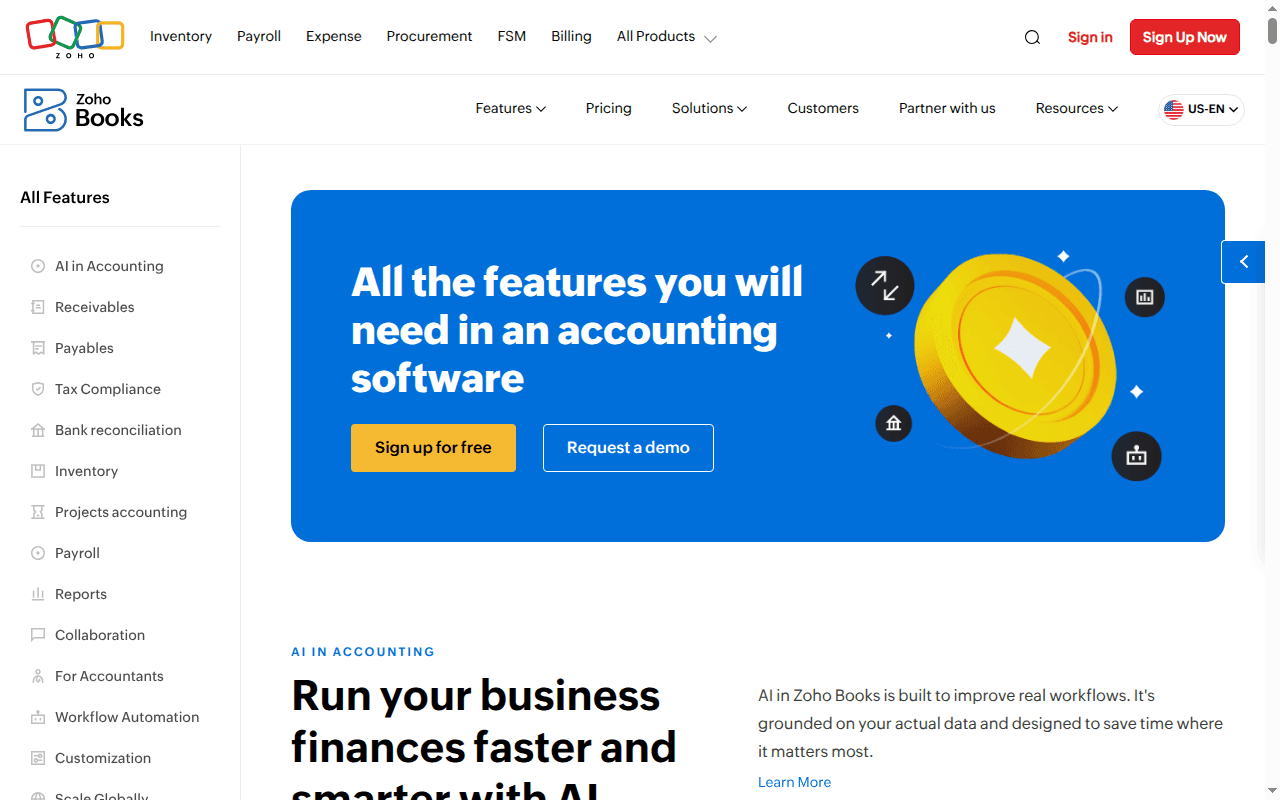
Zoho Books is a core accounting system that delivers accrual reporting, journals, fixed assets, budgets, and bank reconciliation at a lower price point than most competitors. Its differentiator is connectivity with the wider Zoho suite, which matters if you already run Zoho CRM, Inventory, or Expense. For inventory-linked businesses, the accounting and inventory integration reduces the manual cost-of-goods work that otherwise lands on the controller. It belongs here as the value option for smaller teams that still need real accounting administration, not just invoicing.
Best fit
Zoho Books suits budget-conscious teams that need accounting depth rather than a lightweight invoicing tool.
Smaller businesses needing solid accrual accounting with low pricing friction
Buyers already using other Zoho apps, or planning inventory-linked accounting
Teams that require journals, fixed assets, budgets, and currency adjustments in the base product
Operations with high banking transaction volume but simple entity structure
What it automates well
The banking and rules engine does most of the heavy lifting.
Bank and credit card reconciliation with intelligent matching
Bank rules that automatically create transactions or entries for repetitive activity
Cash and accrual reporting views in the product
Core accounting administration including journals, budgets, fixed assets, and currency adjustments
Recurring invoices, payment reminders, and multi-currency handling
Where it reaches its boundary
Positioning is squarely SMB, so it should not be treated as enterprise close governance.
Full workflow value often depends on adopting the wider Zoho ecosystem.
Reviewer workflows, evidence retention, and preparation automation are thin compared with dedicated close tools.
Complex revenue recognition and multi-entity consolidation exceed its design intent.
It is a capable core accounting system at a fair price, which is exactly what many teams need before they need anything else.
Buying notes
Zoho publishes pricing openly. A free plan covers one user plus an accountant for businesses under $50,000 in annual revenue, and paid tiers run from $20 per month for Standard up to $275 per month for Ultimate, with discounts for annual billing.
Model total stack cost rather than the Books line item. If you expect to add Zoho Inventory or other companion apps, compare that bundle against a single system that covers the same ground natively.
5. Sage Intacct
Sage Intacct is a cloud financial management platform for organizations that have outgrown small-business accounting but do not want a full operational ERP footprint. It is consistently highlighted alongside NetSuite as a leading choice for multi-entity management and SaaS accounting, with strong automation around accrual workflows and dimensional reporting. Current product pages also market AI-assisted finance workflows, including close and assurance agents. Sage positions it toward organizations with roughly 20 or more employees, which is a useful signal that this is a scale-up decision rather than an entry-level purchase.
Best fit
Intacct fits when reporting structure and entity complexity, not transaction volume alone, are driving the move.
Growing and mid-market organizations needing accounting depth beyond SMB tools
Companies with multiple entities, funds, or locations that need real consolidation
Teams that want dimensional reporting instead of a bloated chart of accounts
Organizations that need accounting depth without the broadest ERP scope
What it automates well
Intacct's strength is structured financial management in the cloud.
Cloud financial management with real-time reporting visibility
Multi-entity reporting, consolidation, and intercompany support
Revenue recognition and contract-based billing for subscription models
Hundreds of integrations across the finance and operations stack
AI-assisted close and assurance workflows on current product pages
Where it reaches its boundary
It is heavier and more specialized than QuickBooks, Xero, or Zoho Books, which is a natural result of its market segment, not a criticism.
Pricing is quote-led, so budget screening takes more work and more partner conversations.
Implementation requires real project effort, including chart of accounts and dimension redesign.
If manual close preparation is your only issue, an overlay on your current ERP may deliver faster payback than a system replacement.
Teams that genuinely need entity and dimension depth should still shortlist it, because that is the problem it solves best.
Buying notes
Sage does not publish standard pricing. Entry-level core financial subscriptions typically start around $10,000 to $15,000 per year, with typical annual deals landing between $25,000 and $75,000 depending on modules, entities, and user types.
Validate entity design, reporting dimensionality, and integration requirements early, because those are the reasons teams move up to Intacct in the first place. Treat it as a step-up decision with an implementation plan attached, not a casual tool swap.
6. Oracle NetSuite

NetSuite is a full cloud ERP where accounting sits alongside order management, inventory, procurement, and operational workflows. For finance teams, the relevant depth is in NetSuite OneWorld for multi-subsidiary and legal-entity management, plus revenue management for complex recognition and multi-book accounting. It is frequently the destination system for startups that outgrow QuickBooks, and it appears repeatedly among the leading options for multi-entity SaaS accounting. It belongs on this list as the system-of-record choice for companies that want accounting, revenue, and entity structure standardized inside one suite.
Best fit
NetSuite fits when the ledger architecture itself is the constraint.
Companies needing ERP-level depth across accounting, subsidiaries, reporting, and operations
Multi-subsidiary, multi-currency, or globally distributed finance operations
Businesses where revenue management and multi-book accounting are core buying criteria
Organizations replacing several point tools with one suite
What it automates well
Consolidation and revenue are the standout areas.
Multi-subsidiary and legal-entity management through NetSuite OneWorld
Multi-currency consolidation, FX revaluation, and roll-up reporting
Revenue management for complex recognition requirements and multi-book accounting
Intercompany transactions and eliminations
Financial reporting plus broader ERP process coverage across order-to-cash and procure-to-pay
Where it reaches its boundary
As a full ERP, it can be more breadth than you need if the real pain is manual close prep on top of an otherwise acceptable GL.
Implementation timelines and customization costs are substantial, and often partner-dependent.
Reconciliation, matching, and evidence workflows still commonly get supplemented by an overlay at enterprise volume.
This is a system-of-record decision first, not an accrual tool add-on.
Separate the ERP replacement question from the close-efficiency question, and NetSuite becomes much easier to evaluate honestly.
Buying notes
Oracle does not publish list prices. Pricing is customized per customer and typically combines a base platform fee with per-user fees and optional modules, billed annually. Partner estimates commonly cite a base platform fee near $999 per month equivalent before users and modules, so treat that as directional only.
Compare NetSuite when you want core accounting, revenue, and entity management unified in one suite rather than solved by multiple point tools. Then quantify ERP implementation value separately from close-cycle improvement, because those two returns arrive on very different timelines.
7. Microsoft Dynamics 365 Business Central
Business Central is Microsoft's ERP for small and midsize businesses, covering finance, inventory, projects, sales, and operations in one environment. Its differentiator is ecosystem alignment: work continues inside Outlook, Excel, Teams, and Power Platform, with Copilot-assisted support across processes. It is sold and implemented through a partner channel, and partners extend it with industry-specific functionality. It belongs on this list for teams whose decision is as much about the Microsoft stack as it is about accounting depth.
Best fit
Business Central fits when operational data and finance data need to live together, inside tools your team already uses daily.
Small and midsize businesses wanting ERP capability with Microsoft ecosystem alignment
Companies where finance, inventory, project, and operational data should share one system
Teams already working heavily in Outlook, Excel, Teams, or Power Platform
Organizations with a trusted implementation partner already in place
What it automates well
Breadth across business processes is the value, with finance as one pillar.
Finance and ERP workflows spanning accounting, inventory, and operations
AI and Copilot-assisted process support inside familiar interfaces
Workflow continuity with Microsoft 365 apps to reduce context switching
Project costing, job tracking, and partner-tailored industry extensions
Reporting through Power BI on shared data models
Where it reaches its boundary
It is sold and supported through partners, so implementation quality and scope vary by partner.
It is an ERP choice, not a purpose-built accounting-close specialist.
Advanced consolidation and dimensional accounting depth should be compared directly against Sage Intacct and NetSuite.
Some capabilities arrive through customization rather than native configuration, which creates ongoing services dependency.
If your organization is already standardized on Microsoft, that ecosystem fit is a legitimate buying factor, not a rounding error.
Buying notes
Microsoft publishes pricing. Essentials runs $80 per user per month and Premium $110 per user per month when paid yearly, with a light-access Team Members license at $8 per user per month and a 30-day free trial.
Ask your prospective partner exactly what is native, what requires customization, and what becomes a recurring services line. That answer, more than the license price, determines your real cost.
8. BlackLine

BlackLine is an enterprise close automation platform that sits on top of existing ERPs to standardize reconciliations, journal governance, transaction matching, and close visibility. Its positioning is ERP-agnostic by design: data flows in from one or many source systems, and the platform enforces templates, approvals, support retention, and controls across them. Current product marketing adds AI-assisted agents for reconciliations, accruals, transaction matching, and variance analysis. It belongs on this list for organizations whose primary problem is control-heavy close execution, not ledger capability.
Best fit
BlackLine fits enterprise teams that need process standardization and audit defensibility across a fragmented system landscape.
Enterprise teams whose bottleneck is close execution across existing ERPs, not setting up a ledger
Organizations where reconciliations, journal governance, and matching are the real constraints
Companies that need ERP-agnostic process standardization across acquired entities
Finance leaders prioritizing compliance posture and close visibility
What it automates well
Governance and orchestration across the record-to-report cycle.
Account reconciliations with templates, approvals, support storage, and auto-certification rules
Transaction matching and journal entry workflow automation
AI-assisted agents for reconciliations, accruals, transaction matching, and variance analysis
Close task visibility, dependencies, and status reporting across entities
Audit support through centralized documentation and control evidence
Where it reaches its boundary
It is not the accounting system of record. Its positioning assumes ERP data flows into the platform.
It improves the close layer, not basic small-business bookkeeping.
Much of the value depends on how much preparation your team still performs before the workflow starts.
If your core problem is revenue model complexity or legal-entity structure inside the GL, an ERP decision matters more.
Enterprise teams with SOX-heavy requirements and multiple ERPs should absolutely evaluate it on those strengths.
Buying notes
Pricing is quote-based and scoped by modules, entity count, transaction volume, and organization size. Third-party estimates put annual contracts from roughly $17,500 on the low end to more than $340,000, with small and mid-market deployments often averaging $40,000 to $77,000 per year.
Evaluate BlackLine when control, standardization, and ERP-spanning orchestration matter more than replacing the ledger. Then compare that value against AI-native preparation depth, which is exactly why BlackLine and Maxima can appear on the same shortlist for different reasons: one standardizes how human-prepared work moves through controls, the other prepares the work first.
FAQs buyers ask when comparing accrual accounting software
Here are the questions that come up most often in shortlist conversations.
What is accrual automation?
Accrual automation is software that assembles the accrual population from source systems, calculates or confirms the estimate for each item, produces the journal entry with supporting evidence, and handles the reversal and true-up in the following period. It sits on top of a general ledger rather than replacing one, because the ledger can record an accrual but cannot work out what the accrual should be.
Is accrual automation the same as accrual accounting software?
They overlap but they are not the same purchase. Accrual accounting is a method of recognizing revenue and expense when they are incurred rather than when cash moves, and every general ledger supports it. Accrual automation is the layer that prepares the accrual entries themselves. If you do not yet have a ledger you need the first. If you have one and still spend the first week of close building accruals by hand, you need the second.
Why are open purchase orders not enough to book the accrual?
Because the open purchase order report describes commitments, not economic activity in the period. A complete population also includes goods received not invoiced, invoices still in approval when the books close, partially billed purchase orders, and services consumed where no purchase order was raised. In practice a reconciled population differs from the open PO list in both directions.
Do I need separate accrual software if I already have an ERP?
It depends on which layer is failing. If your ERP records accruals correctly but people still prepare reconciliations, journals, and explanations manually, compare overlay tools before considering an ERP replacement. The signals: prep time rather than posting accuracy is what makes your close slow, reconciliations and schedules still live in Excel outside the ERP, and auditors keep asking for evidence your current system cannot produce. If instead entity structure, consolidation, or revenue management is the actual limitation, that points to an ERP move.
What is the 2.5 month rule for accrued expenses?
It is a tax timing rule rather than a GAAP one. Under the recurring item exception in the US tax regulations, an accrual-basis taxpayer may deduct certain accrued expenses in the current year if economic performance occurs within 8.5 months of year end, with the commonly cited 2.5 month variant applying to related-party compensation accruals that must be paid within two and a half months after year end to be deductible in the accrual year. It affects the tax treatment of an accrual, not whether the accrual is recorded for financial reporting.
How do you accrue for an expense nobody can calculate?
You ask the person who knows. Marketing, events, and professional services accruals frequently depend on what a business owner knows about work performed rather than on anything in a system. The workflow question is whether your tool reaches that person, chases them, and records their answer as evidence, or whether it hands the gap back to accounting.
Can an agent decide the accrual amount?
It can prepare it. An agent can assemble the population, apply the estimate basis you have approved, request confirmations, and draft the entry with support attached. What stays with the accountant is the policy, the materiality threshold, whether a difference is a change in estimate or an error, and the approval before anything posts.
Can accrual accounting software handle recurring accruals without spreadsheets?
Only if it prepares the schedule, not just stores the entry. Look for systems that build accrual, prepaid, and amortization workbooks from source data, apply materiality thresholds, and post with auto-reversals after approval.
What is the difference between cash and accrual accounting, and which do I need?
Cash accounting records transactions when money moves. Accrual accounting records them when they are earned or incurred. If you carry inventory, recognize revenue over time, or have investors or lenders reviewing your financials, you almost certainly need accrual. GAAP requires it for most companies above $25 million in annual revenue, and most audit-ready financial statements are prepared on an accrual basis.
What is ASC 606, and which tools support it?
ASC 606 is the GAAP revenue recognition standard that requires companies to recognize revenue when performance obligations are satisfied, not when cash is received. For SaaS and subscription businesses, that means matching revenue to the period it is earned across contract terms. QuickBooks Online Advanced, Sage Intacct, and NetSuite all include revenue recognition features aligned to ASC 606. Enterprise teams with high-volume billing complexity often layer a dedicated revenue subledger or an AI-native preparation tool on top to handle the matching and reconciliation work at scale.
The right accrual accounting software depends on your bottleneck
There is no universal winner here, and any list that names one is ignoring how differently these tools operate. Diagnose whether you need a first accounting system, a step-up ERP, a close-control layer, or an AI-native preparation layer, then shortlist inside that category.
Best for a first accrual accounting system: QuickBooks Online, or Xero if you operate primarily outside the US
Best for budget-conscious SMBs needing real accounting admin: Zoho Books
Best for mid-market multi-entity accounting depth: Sage Intacct
Best for full ERP and complex revenue in one suite: Oracle NetSuite, or Business Central for Microsoft-standardized teams
Best for enterprise teams with an ERP but a manual close: Maxima for AI-prepared journals, reconciliations, matching, and flux, or BlackLine when control orchestration matters most

Move closer to an audit-ready, continuous close

Request demo
Insights, news and content
The latest
See all