
Once you cross three or four legal entities, spreadsheet consolidation stops being a process and becomes a liability. Intercompany balances drift, FX rates get keyed twice, and the late adjustment never makes it into the pack that goes to the board.
This list compares 12 financial consolidation software tools by operating model, consolidation depth, close automation, and implementation fit, so you can build a real shortlist in an afternoon instead of a quarter.
Who this is for: controllers, accounting managers, and finance leaders running multi-entity, multi-currency closes under audit or SOX pressure.
How these tools were evaluated: consolidation depth, close execution support, integration and controls, and implementation fit.
What is included: enterprise CPM suites, mid-market cloud platforms, ERP-native multi-entity consolidation, and AI-native close automation layers.
What Is financial consolidation software?
Financial consolidation software automates the process of combining financial data from multiple legal entities into a single, accurate set of group financials. It handles the mechanics that break down at scale: collecting trial balances from each entity, applying FX translation, eliminating intercompany transactions, adjusting for ownership percentages, and producing consolidated statements your auditors can trace. The distinction from reporting software is important: consolidation software governs how the numbers get there, not just how they are displayed.
Entities: Rolls up multiple legal entities, subsidiaries, and joint ventures into one group view.
Currencies: Applies rate types by account and posts cumulative translation adjustments automatically.
Eliminations: Removes intercompany balances and transactions so they do not inflate group numbers.
Ownership: Handles partial ownership, minority interest, and tiered entity structures.
Reporting: Produces consolidated statements, disclosure packages, and audit-ready evidence trails.
How to compare financial consolidation software
Every vendor demo shows a clean elimination and a beautiful roll-up. The differences that matter show up later, in who owns the model, how data arrives, and how much manual prep still sits upstream of the consolidation run.
What financial consolidation software actually has to do
Consolidation software turns separate entity ledgers into one reliable set of group numbers. The underlying process is consistent across vendors: data collection, standardization, intercompany eliminations, adjustments, aggregation, statement preparation, review, and compliance checks. A platform earns its keep by governing how numbers move through those eight steps, not just by displaying the result.
Manual consolidation breaks on volume, not complexity alone. At 5 entities you can survive a workbook. At 15 entities across 4 currencies with monthly intercompany activity, the linked-file model fails every close.
The pain points are always the same. Spreadsheet stitching, late adjustments that never propagate, unreconciled intercompany balances, and audit trails that live in email threads.
Reporting software is not consolidation software. If the tool cannot govern eliminations, FX translation, and ownership percentages, it is presenting numbers someone else assembled.
Consolidation, close management, and EPM are three different jobs. Consolidation rolls entities into group numbers. Close management governs task execution, reconciliations, and certification. EPM/CPM adds planning, budgeting, and management reporting.
Self-select by symptom. Elimination and FX pain points to a consolidation engine. Missed tasks and reconciliation backlog points to close management. Scenario modeling and board packs points to EPM.
The three buying categories you will see in this market
Category | Typical tools | What they do well | Where they reach their boundary | Best fit |
|---|---|---|---|---|
Enterprise and complex multinational platforms | OneStream, Oracle Fusion Cloud EPM, SAP S/4HANA group reporting, CCH Tagetik | Deep legal-entity structures, statutory and disclosure reporting, enterprise governance | Long implementations, admin skill dependency, slow to first value | Global groups with 25+ entities and formal external reporting |
Mid-market and growing multinational platforms | Oracle NetSuite, Sage Intacct, Workday Adaptive Planning, Planful, Anaplan | Finance-owned administration, faster deployment, usable reporting | Top-end entity complexity, heavy statutory depth, upstream prep work | Companies scaling from spreadsheets into structured group reporting |
AI-native close automation layers | Maxima, HighRadius, BlackLine (close management adjacent) | Transaction prep, reconciliations, journal entries, anomaly handling before consolidation | Not planning suites, not a full CPM replacement | Teams whose bottleneck is prep work, not consolidation logic |
Buyers routinely compare these categories side by side even though they solve different parts of the problem. That is fine, as long as you know which part of your close is actually broken.
The four criteria used to rank the tools in this list
Consolidation depth. Entity hierarchies, FX translation, partial ownership and minority interest, elimination rules, and statutory output. Depth is labeled deep, moderate, or basic rather than scored, because a group with 8 wholly owned subsidiaries does not need what a 60-entity group needs.
Close execution. How much work the platform prepares before consolidated reporting starts: reconciliations, journal entries, transaction matching, and variance review. This is where most close-cycle days actually disappear.
Integration and controls. ERP connectivity, transaction lineage back to source, approval gates, segregation of duties, and immutable audit trails your auditor can re-perform.
Implementation fit. Whether the platform is finance-owned, IT-heavy, CPM-first, ERP-native, or best deployed as an automation layer on top of what you already run.
What these tools cost and how long implementation really takes
Almost no vendor here publishes list pricing. Expect quote-based deals shaped by entity count, module selection, user types, and transaction volume, with implementation billed separately.
Enterprise CPM suites: highest platform cost, with observed OneStream annual license fees in the $178,000 to $400,000 range and CCH Tagetik deployments commonly starting near $50,000 per year. Budget 4 to 9 months, an SI partner, and a named internal admin.
Mid-market cloud platforms: typically 8 to 16 weeks, largely finance-owned. Planful contracts commonly run $50,000 to $500,000+ annually with services at roughly 0.8 to 1.5 times subscription.
ERP-native consolidation: bundled or a module add-on. NetSuite runs about $999 per month for the base platform plus roughly $99 to $199 per user, and Sage Intacct typically lands between $15,000 and $60,000+ per year. Configuration is days to weeks.
AI-native automation layers: deploy in weeks on top of existing ERPs, with cost tied to transaction volume, entities, and scope.
Price year one fully: license, implementation, sandbox, integrations, and admin training. The second-year number is usually the honest one.
All 12 tools at a glance
Tool | Category/operating model | Best for | Typical implementation effort |
|---|---|---|---|
Maxima | AI-native close automation layer | Close prep feeding consolidation | Weeks, finance-owned |
OneStream | Enterprise CPM | Large multinational groups | Months, IT and partner-led |
Oracle Fusion Cloud EPM | Enterprise CPM | Oracle-aligned enterprises | Months, partner-led |
CCH Tagetik | Enterprise CPM, disclosure-first | Statutory and disclosure-heavy groups | Months, partner-led |
BlackLine | Close management and reconciliations | Record-to-report governance | Weeks to months, finance-owned |
SAP S/4HANA group reporting | ERP-native enterprise | SAP-standardized enterprises | Months, ERP-program-like |
Workday Adaptive Planning | Mid-market CPM, planning-first | Growing multinationals | 8 to 16 weeks, finance-owned |
Anaplan Financial Close and Consolidation | Mid-market CPM, model-driven | Connected planning environments | Months, model-builder led |
Planful | Mid-market cloud CPM | Spreadsheet replacement | 8 to 16 weeks, finance-owned |
Oracle NetSuite | ERP-native mid-market | Multi-subsidiary inside the ERP | Days to weeks to configure |
Sage Intacct | ERP-native mid-market | Multi-entity accounting near the GL | Days to weeks to configure |
HighRadius Financial Consolidation | AI-native automation | Multi-ERP AI-led consolidation | Weeks to months, vendor-led |
Read the table by column, not by row: pick your operating model first, then check whether the depth and stopping point match your actual entity structure.
1. Maxima
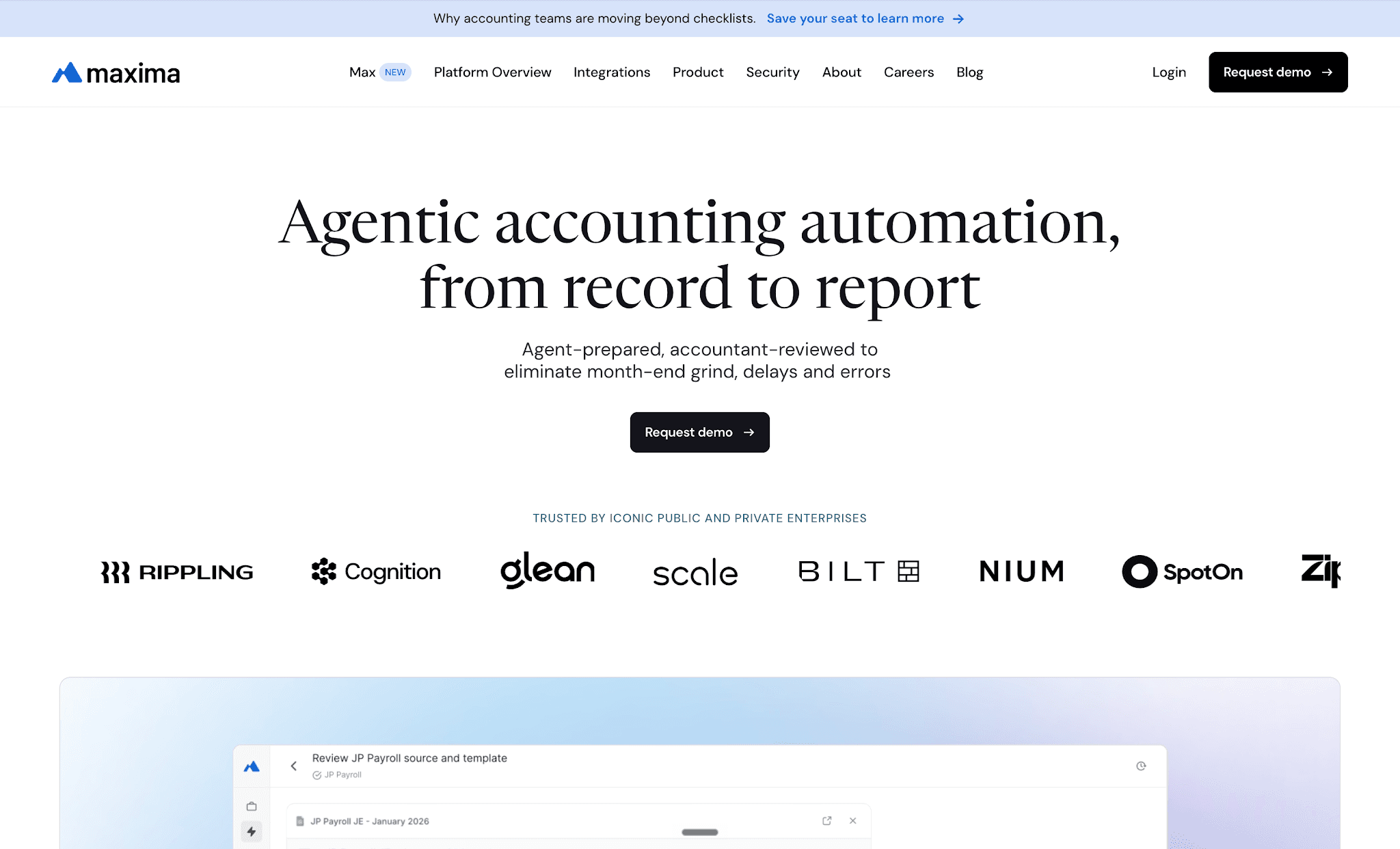
Maxima is an AI-native accounting platform that prepares the work feeding consolidation instead of orchestrating humans who prepare it. AI agents pull transactions from native connectors across ERPs, banks, payroll, billing, and BI systems, then draft journal entries, run transaction matching, certify reconciliations, and produce flux commentary with source-to-GL lineage.
Accountants review and approve; nothing posts to the general ledger without human sign-off. It sits on top of your existing ERP rather than replacing it, which is why it appears on consolidation shortlists even though it is not a CPM suite.
Core consolidation strengths
Agent-prepared journal entries, reconciliations, transaction matching, and flux analysis, delivered as finished work rather than suggestions.
Transaction-level lineage across journals, matching, and reconciliations, with 95%+ auto-matched transactions so teams touch only true exceptions.
Continuous preparation as data arrives daily, instead of compressing everything into a month-end batch.
Review-first control model with maker-checker workflows, materiality thresholds, segregation of duties, and immutable audit trails.
The consolidation run gets easier when the inputs arrive already reconciled and explained.
Tradeoffs and natural boundaries
Maxima is not a classic CPM suite for planning, budgeting, and broad management reporting.
Its strength is the accounting execution layer before and during close, not statutory consolidation modeling or FP&A.
If board planning or scenario modeling is your primary need, a CPM platform fits better.
Pair it with a consolidation engine if you need both; do not expect one tool to do both jobs well.
What to validate in your demo
Which ERPs, banks, payroll providers, billing systems, and subledgers connect natively in your stack.
How intercompany entries, entity-level close tasks, and supporting reconciliations flow into the review queue.
What audit evidence, source-to-GL lineage, and maker-checker controls look like on your own data.
Ask for a run against last month's actual bank and subledger files, not a sandbox dataset.
Best fit
Enterprise accounting teams whose bottleneck is prep work, not consolidation logic.
Controllers running multi-entity, multi-currency closes with heavy reconciliation and journal entry volume.
Organizations that need an automation layer above existing ERPs rather than a replacement program.
Pricing model and typical implementation: custom SaaS subscription with a base platform fee plus per-module fees tied to transaction volume, entity count, and system complexity; deployment in weeks, finance-owned, with no IT program required.
2. OneStream
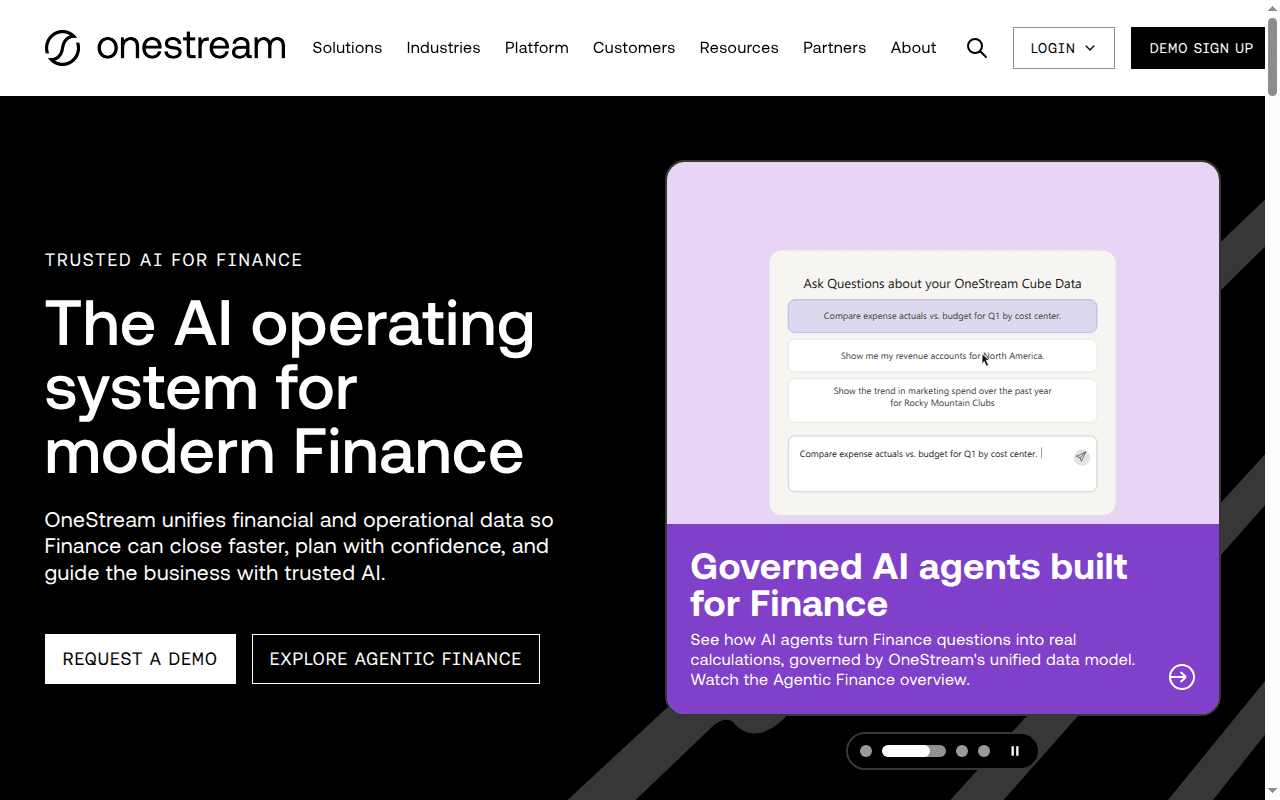
OneStream is a unified CPM platform that consolidates financial close, consolidation, reporting, and adjacent finance processes into one environment. It consistently appears among top-rated products in close and consolidation market coverage, alongside Oracle EPM and CCH Tagetik. Buyers usually reach it after outgrowing a fragmented mix of legacy consolidation tools, spreadsheets, and departmental reporting layers. The tradeoff is that it is a platform decision, not a tool purchase.
Core consolidation strengths
Strong enterprise positioning across financial close, consolidation, and reporting in a single environment.
Useful when consolidation should live inside a broader performance management model rather than beside it.
Handles global groups that need depth more than lightweight simplicity.
Frequently chosen by teams retiring fragmented legacy consolidation setups.
Tradeoffs and natural boundaries
Broader CPM scope means more implementation effort and more internal ownership complexity.
It is more platform than a lighter mid-market team usually needs.
If transaction prep and reconciliation work is your real constraint, it will not address the earliest bottleneck.
Separate "enterprise depth" from "speed to first value" before you sign.
What to validate in your demo
How your entity hierarchy, minority ownership, and elimination rules are modeled.
What internal admin skills you need to maintain the application after go-live.
How reporting, disclosure, and close task management connect to the consolidation model.
Insist on seeing the admin experience, not just the reporting output.
Best fit
Large multinational groups wanting one platform for consolidation, reporting, and adjacent finance processes.
Organizations with complex legal entity structures, high reporting rigor, and formal governance requirements.
Teams willing to fund structure and configurability in exchange for scale.
Pricing model and typical implementation: custom-quoted platform and module licensing with per-user interactive licenses listed near $99 per user per month and observed annual license fees roughly $178,000 to $400,000; 4 to 9 months, SI partner plus internal admin.
3. Oracle Fusion Cloud enterprise performance management (EPM)
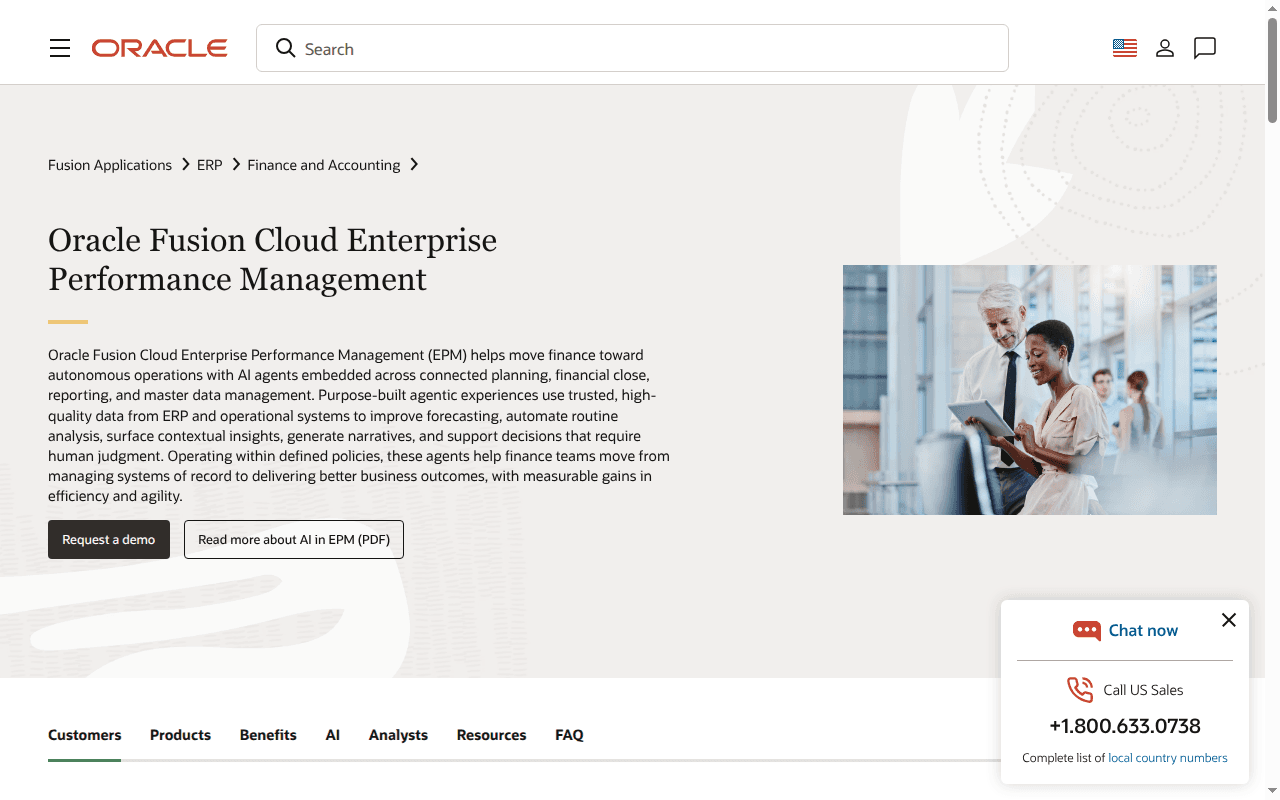
Oracle Fusion Cloud EPM is the category-standard enterprise choice for organizations already running Oracle across finance. It covers consolidation, close, reporting, and planning within a single cloud suite and is regularly listed among top-rated close and consolidation solutions. Teams migrating off legacy Oracle HFM often evaluate it first by default, and fit quality tracks closely with how Oracle-aligned the rest of your stack already is.
Core consolidation strengths
Recognized as a major option in financial close and consolidation market coverage.
Strong when consolidation, reporting, and enterprise governance must stay tightly coordinated.
Suits large organizations that value vendor breadth and enterprise structure.
Predictable, well documented, and supported by a large partner ecosystem.
Tradeoffs and natural boundaries
The best-fit case weakens when your source systems are largely non-Oracle.
It demands more process discipline and specialist support than finance teams expect at kickoff.
It is heavier than necessary if you only need straightforward multi-entity close and reporting.
Buy it for ecosystem alignment, not because the logo feels safe.
What to validate in your demo
How easily non-Oracle source systems feed the consolidation process.
What the close workflow looks like for an entity-level reviewer, not just a corporate admin.
How the platform handles your actual legal structure, FX policy, and intercompany volume.
Bring your real org chart and make them model a messy branch of it.
Best fit
Enterprise finance organizations already invested in the Oracle ecosystem.
Global teams needing formal consolidation, compliance, and structured reporting workflows.
Buyers who want a recognized, category-standard EPM and consolidation platform.
Pricing model and typical implementation: per-user, per-month subscription, with independent pricing data indicating roughly $250 per user for EPM Standard and $500 per user for EPM Enterprise; multi-month, partner-led with meaningful IT involvement.
4. CCH Tagetik
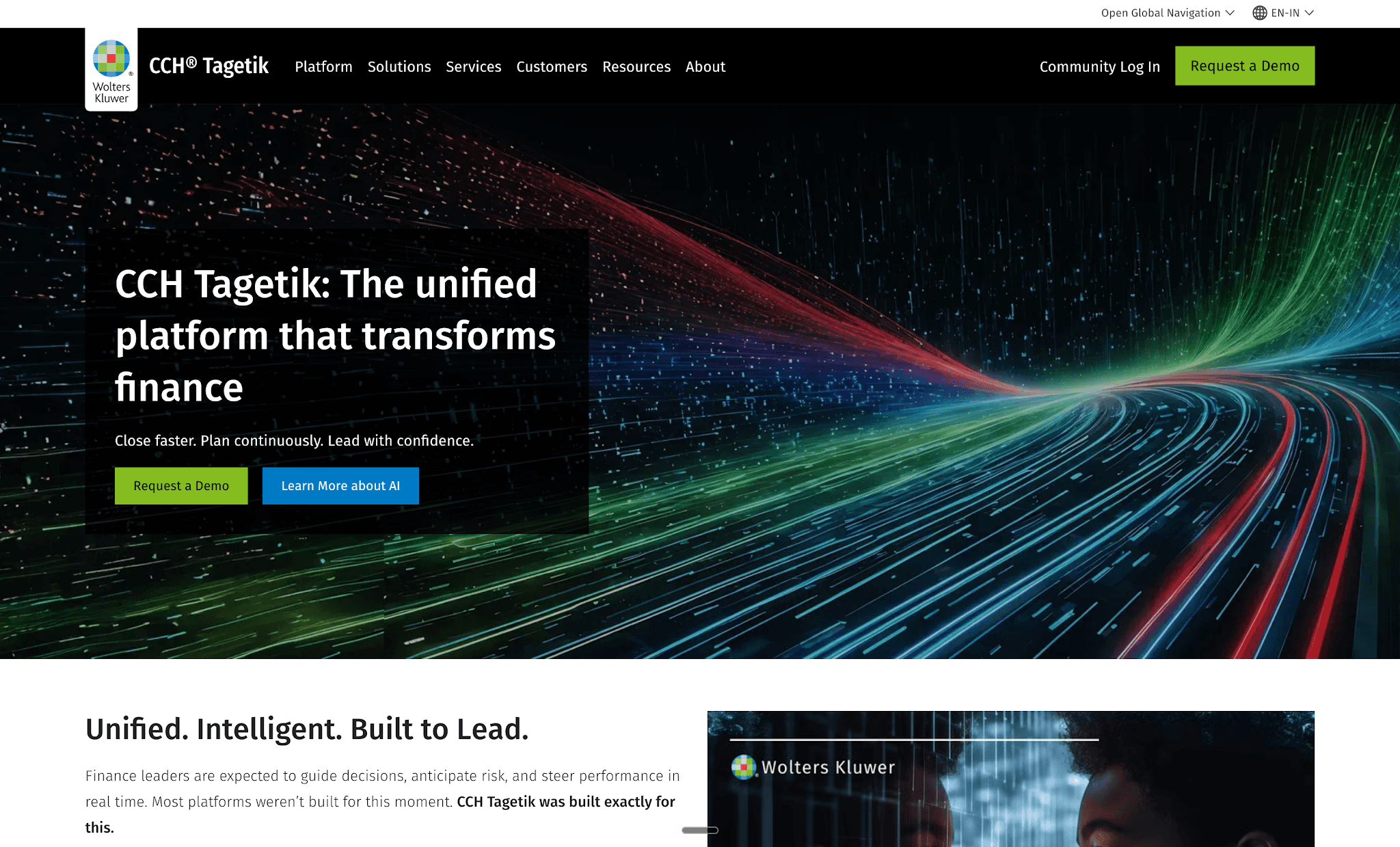
CCH Tagetik, from Wolters Kluwer, is the specialist choice when consolidation output has to survive external scrutiny. Its close and consolidation suite spans account reconciliation, financial reporting, integrated reporting, intelligent disclosure, profitability analysis, and iXBRL filing automation with AI tagging. Wolters Kluwer publishes customer stories from organizations including Agfa, Breitling, and Scandinavian Airlines, which reflects the profile it attracts: complex groups with real statutory obligations.
Core consolidation strengths
Account reconciliation, financial reporting, integrated reporting, intelligent disclosure, profitability analysis, and iXBRL coverage in one suite.
AI-assisted iXBRL tagging that removes a genuinely painful manual filing step.
Especially strong when consolidation output must feed formal external reporting.
The disclosure-to-consolidation handoff is where it separates from generalist platforms.
Tradeoffs and natural boundaries
Platform breadth exceeds what a simpler mid-market group actually needs.
Disclosure strength only pays off if disclosure is a real part of your process.
It is a fit for rigor, not the lightest operational footprint available.
Decide whether you need statutory-depth workflows or just a faster internal consolidation.
What to validate in your demo
How close, consolidation, and disclosure handoffs work in one continuous flow.
What account reconciliation looks like against your current month-end process.
How much model administration and external support the team will need annually.
If nobody in the room can name a filing that needs iXBRL, reconsider the category.
Best fit
Global finance teams needing close, consolidation, reporting, and disclosure in one managed environment.
Organizations with heavy statutory reporting demands and active audit scrutiny.
Teams that want a specialist platform designed around complicated consolidation work.
Pricing model and typical implementation: custom enterprise quotes, with deployments commonly starting near $50,000 per year and user-based estimates in the $50 to $200 per user per month range; multi-month, partner-led, implementation quoted separately.
5. BlackLine
BlackLine is the close management and reconciliation benchmark most controllers already know by name. It governs record-to-report execution: task checklists, reconciliation certification, approval routing, exception tracking, and process visibility across entities. It appears in close and consolidation market coverage even though it is not a legal-entity consolidation engine, which is exactly why buyers keep landing on it mid-evaluation. The value is discipline and evidence, not group-level math.
Core consolidation strengths
The recognized reference point for close management and reconciliation governance.
Most relevant when the problem is closing discipline, certification, and status visibility.
Appears in Gartner-style close and consolidation market conversations for good reason.
Strong control layer over a close that people still perform.
Tradeoffs and natural boundaries
Close management is not deep legal-entity consolidation.
If eliminations, FX logic, and ownership structures are the main pain, you need a dedicated consolidation engine.
Workflow visibility does not remove prep burden when work is still assembled manually upstream.
Tracking a slow task and eliminating it are different outcomes.
What to validate in your demo
Which pieces of close work are automated versus simply tracked and certified.
How reconciliations, approvals, and exceptions roll up across entities to corporate.
How much spreadsheet preparation still lives outside the system after go-live.
Count the workbooks that remain; that number is your real automation gap.
Best fit
Teams whose real bottleneck is close orchestration, reconciliations, and control over human-prepared work.
Organizations modernizing record-to-report without committing to a full CPM decision.
Finance groups needing stronger governance and checklist discipline around the close calendar.
Pricing model and typical implementation: quote-based modular subscription driven by modules, users, entities, and volume. G2 buyer data puts typical annual contracts from roughly $13,500 to over $100,000 with a median near $40,560, and enterprise contracts exceeding $500,000. Implementation services are quoted separately and often run into the tens of thousands.
6. SAP S/4HANA finance for group reporting
SAP S/4HANA Finance for group reporting delivers consolidation inside the SAP finance operating model, working from the same underlying ledger data as core accounting. For groups already standardized on SAP, it removes an entire integration layer and keeps group reporting aligned to ERP structures. For everyone else, it raises a legitimate question about how much of your landscape sits outside SAP.
Core consolidation strengths
Strong shortlist option for SAP-centric organizations evaluating enterprise-grade consolidation.
Real-time ledger alignment is the differentiator, with no separate extract layer to govern.
Anchors consolidation decisions inside the broader SAP finance architecture.
Useful benchmark for teams weighing ERP-native against specialist consolidation.
Tradeoffs and natural boundaries
The native advantage narrows quickly when your landscape is mixed outside SAP.
Implementation and ownership feel ERP-program-like, with IT and basis dependencies.
Not the simplest route if you want fast deployment with minimal platform change.
Native is an advantage only where native actually applies.
What to validate in your demo
How non-SAP data sources are integrated, mapped, and governed.
What entity, intercompany, and reporting workflows look like for your group structure.
How much internal SAP expertise you need after launch to change anything.
Ask who makes a hierarchy change in month three, and how long it takes.
Best fit
Large enterprises already standardized on SAP for core finance processes.
Global groups wanting consolidation tightly aligned to SAP-led reporting and control structures.
Teams prioritizing ecosystem fit over best-of-breed tool variety.
Pricing model and typical implementation: custom-quoted subscription based on users, deployment model, activated modules, and consolidation units; timelines and ownership resemble an ERP program more than a finance tool rollout.
7. Workday Adaptive Planning
Workday Adaptive Planning is a cloud planning platform with consolidation capability attached, aimed at finance teams that want usability over architectural depth. It is a common mid-market and upper-mid-market option, especially for groups graduating from spreadsheet-driven close and reporting. The planning heritage shows: modeling and reporting are approachable, and finance can usually administer the environment without technical help.
Core consolidation strengths
A common mid-market choice with a well-established presence in this category.
Useful when planning, reporting, and consolidation should stay connected for finance users.
Solid step up for teams moving off manual, spreadsheet-heavy processes.
Fast to learn, which matters more than it sounds during a live close.
Tradeoffs and natural boundaries
Not the first choice for the most complex legal structures or highest-control global closes.
Planning-led tools leave upstream transaction accounting manual when that is the core issue.
The tradeoff is depth versus accessibility, and you should name which you need.
Accessible now can become constraining at scale.
What to validate in your demo
How consolidation workflows coexist with planning workflows in one environment.
What the platform handles natively for FX translation, intercompany, and reporting packages.
How quickly finance can administer structural changes without a technical bottleneck.
Model your projected entity count, not today's.
Best fit
Growing multinational teams wanting an approachable planning-and-consolidation environment.
Finance groups that value cloud usability and connected planning alongside close reporting.
Organizations that do not need the heaviest enterprise consolidation architecture.
Pricing model and typical implementation: quote-based subscription tiered by planning and planning-plus-consolidation scope, with a 30-day free trial available and no published rates; typically 8 to 16 weeks and largely finance-owned.
8. Anaplan financial close and consolidation
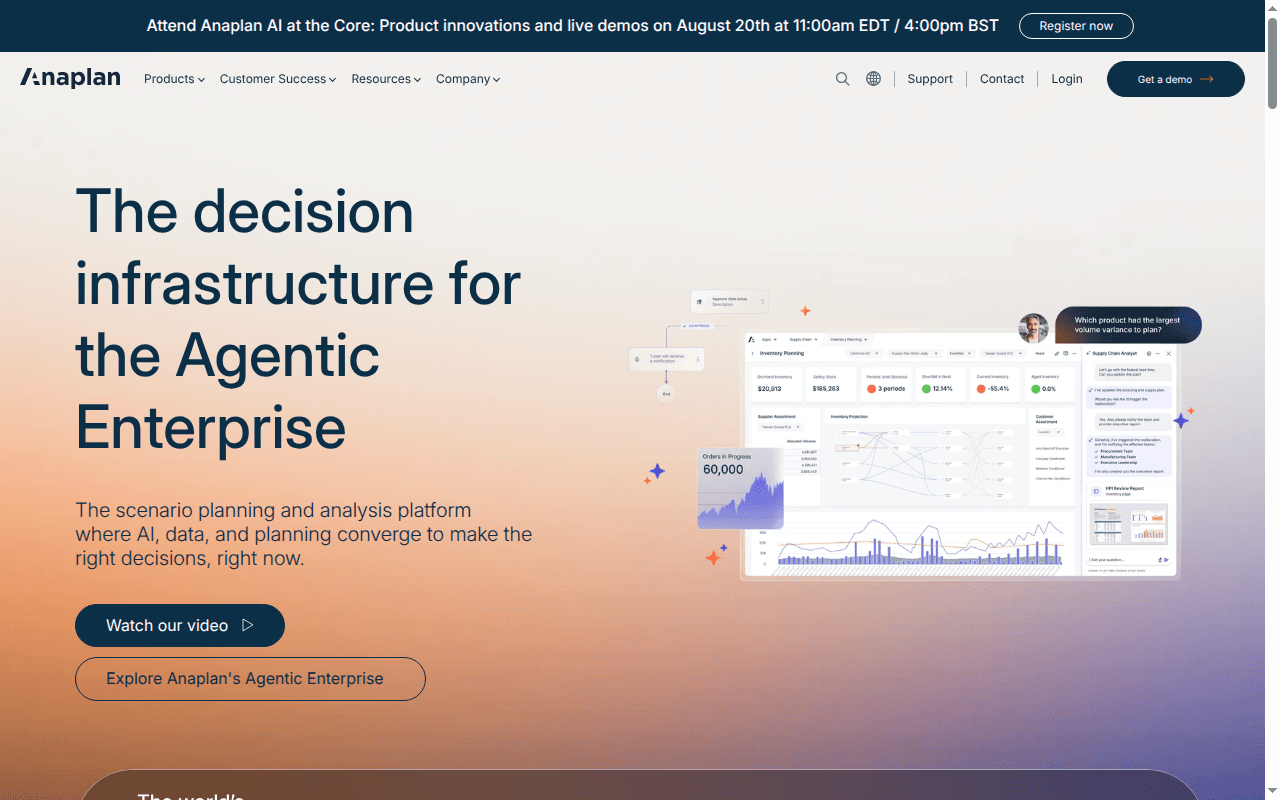
Anaplan brings its connected planning approach to close and consolidation, giving finance a highly configurable model layer rather than a fixed consolidation application. That flexibility is the attraction and the risk: you can shape it around unusual structures, but someone has to own and maintain the model. Teams already running Anaplan for planning often extend it rather than buy a separate consolidation tool.
Core consolidation strengths
Represents the flexible, connected-planning approach in this market.
Useful when consolidation outputs should feed operational modeling and planning cycles.
Offers more model flexibility than rigid legacy consolidation systems.
Relevant when reporting needs extend well beyond the close itself.
Tradeoffs and natural boundaries
Flexibility raises configuration, documentation, and governance demands.
Adaptability only helps if your team can maintain the model cleanly year over year.
Not every finance organization wants to own a configurable model layer.
Ask whether flexibility becomes speed or becomes admin overhead in your team.
What to validate in your demo
How close and consolidation workflows are packaged versus configured from scratch.
What finance can self-serve after implementation without vendor or partner help.
Who owns the model, by name, once the implementation team leaves.
Get the maintenance answer in writing before you sign.
Best fit
Teams that want consolidation connected to a broader planning and modeling environment.
Organizations comfortable owning a configurable, model-driven finance platform.
Buyers that value flexibility and connected planning across finance processes.
Pricing model and typical implementation: custom-quoted subscription with no published tiers; unofficial user reports point to roughly $100,000 per year as a starting point, which you should confirm with a formal quote. Implementation is model-builder led over multiple months.
9. Planful
Planful is a cloud CPM platform positioned between spreadsheets and heavyweight enterprise suites, covering consolidation, planning, and reporting in a finance-owned environment. It is a common landing spot for companies replacing linked-workbook close processes without committing to a multi-quarter implementation. Administration is designed for finance, which keeps change requests out of an IT queue, and depth is practical rather than statutory.
Core consolidation strengths
A lighter-weight cloud option that fits comfortably on a mid-market shortlist.
Balances usability with structured finance process coverage.
More purpose-built for finance than a plain ERP reporting module.
Practical breadth without an enterprise program attached.
Tradeoffs and natural boundaries
Not the first choice for the most complex multinational structures or compliance-heavy closes.
Deep statutory, disclosure, or extreme entity complexity is better served elsewhere.
Assess how far it scales before process workarounds start reappearing in spreadsheets.
Know your ceiling before you build the process around it.
What to validate in your demo
How it handles your real close calendar, entity rollups, and reporting packs.
Which integrations exist for your ERP and operational systems, and whether they are native.
Whether finance can operate the platform without a dedicated specialist admin.
Have them load your trial balances and rebuild last quarter's pack.
Best fit
Growing finance teams wanting cloud consolidation and planning without a heavyweight enterprise suite.
Organizations replacing spreadsheet-based close and reporting processes.
Mid-market teams that need finance-owned administration and realistic time-to-value.
Pricing model and typical implementation: quote-based subscription by user type and module, with typical annual contracts from roughly $50,000 to over $500,000 depending on scope; implementation services usually run 0.8 to 1.5 times subscription over 8 to 16 weeks.
10. Oracle NetSuite
NetSuite handles multi-subsidiary consolidation inside the ERP where daily accounting already happens, with native multi-book, multi-currency, and intercompany functionality. For growing multinationals with moderate complexity, that is often enough for several years and avoids introducing a second platform prematurely. It is the natural comparison point when someone asks whether you need a specialist consolidation tool yet.
Core consolidation strengths
ERP-native multi-entity consolidation is a legitimate part of this buying journey, not a consolation prize.
Keeps consolidation close to daily accounting operations and subsidiary management.
Avoids adding another platform before complexity genuinely demands it.
One system, one data model, fewer handoffs.
Tradeoffs and natural boundaries
ERP-native does not mean best-in-class for advanced consolidation requirements.
Growing entity complexity, audit expectations, and cross-system volume push teams past the native approach.
Planning, disclosure, and advanced close automation still require adjacent tooling.
Plan the exit criteria now, not during a restructuring.
What to validate in your demo
How the native setup handles your actual intercompany and FX translation requirements.
What gaps remain for reconciliations, reporting packages, and close controls.
How painful a future migration becomes if complexity outpaces your forecast.
Ask specifically about elimination reporting at period close, not just the roll-up view.
Best fit
Growing multinational companies wanting multi-subsidiary consolidation inside their existing ERP.
Finance teams that prefer ERP-native workflows over a separate specialist consolidation stack.
Organizations with moderate complexity and a strong preference for one core cloud system.
Pricing model and typical implementation: modular, quote-based licensing, with market estimates around $999 per month for the base platform plus roughly $99 to $199 per user per month and additional fees for modules and multi-subsidiary capability; days to weeks to configure.
11. Sage Intacct
Sage Intacct is a finance-first cloud ERP with strong multi-entity accounting and dimensional reporting, popular with mid-market groups moving beyond basic accounting systems. Consolidation lives close to the general ledger, which keeps the close process in one place and administration in finance's hands. It regularly appears in mid-market shortlists alongside NetSuite, and the boundary is scale, not capability.
Core consolidation strengths
A practical ERP-native option that shows up constantly in growing-company shortlists.
Keeps consolidation capability close to the general ledger instead of in a separate platform.
Good fit for moderate scale and limited appetite for heavy implementation.
Dimensional reporting removes a surprising amount of spreadsheet work.
Tradeoffs and natural boundaries
Very large or highly complex multinational groups will need adjacent systems.
Intense statutory complexity, frequent entity restructuring, or high-volume close prep fits other tools better.
This is a scale boundary, not a feature criticism.
Convenience is real until the workbook count starts climbing again.
What to validate in your demo
How entity rollups, intercompany entries, and reporting structures behave in your scenario.
Which downstream close tasks still live in spreadsheets afterward.
How much headroom you have before a specialist platform becomes necessary.
Two years of headroom is the minimum worth buying.
Best fit
Mid-market organizations wanting multi-entity accounting with a finance-friendly ERP operating model.
Teams graduating from basic accounting systems into structured group reporting.
Buyers needing more than small-business accounting software but less than enterprise EPM.
Pricing model and typical implementation: quote-based subscription priced by modules, user types, and entity count, with typical annual costs from about $15,000 for a small single-entity deployment to $60,000+ for larger multi-entity setups; days to weeks to configure, finance-owned.
12. HighRadius financial consolidation software
HighRadius positions its consolidation product around AI-led automation rather than traditional CPM modeling. The vendor reports data consolidation 95% faster with 99% accurate intercompany eliminations, driven by 190+ AI agents that synchronize data in real time across multiple ERPs. It also covers multi-entity and multi-currency aggregation, built-in custom reporting, and ERP write-back with GAAP and IFRS-oriented outputs.
Core consolidation strengths
Represents the AI-forward segment of this market beyond classic CPM tools.
Covers multi-entity, multi-currency aggregation, intercompany governance, and ERP write-back.
Publishes concrete performance benchmarks: 95% faster consolidation and 99% elimination accuracy.
The multi-ERP synchronization story is the most differentiated part.
Tradeoffs and natural boundaries
Separate AI-led messaging from proven operational fit in your own environment.
Verify whether it covers your full close and reporting scope or only the automation-heavy portions.
Compare carefully before assuming an automation platform equals a mature CPM suite.
Ask the vendor to reproduce its benchmarks on your data, not a reference dataset.
What to validate in your demo
Which ERP and source-system integrations are production-ready for your specific stack.
How intercompany eliminations, auditability, and reviewer controls behave with real data.
Whether the platform reduces manual prep work or mainly accelerates downstream reporting.
Track the hours removed from your close calendar, not the percentages in the deck.
Best fit
Organizations prioritizing AI-led automation, multi-ERP synchronization, and faster intercompany consolidation.
Finance teams that want a modern automation narrative instead of a legacy consolidation program.
Buyers comparing newer AI-oriented record-to-report options against traditional suites.
Other tools you will see on shortlists
These names come up often enough that you should decide about them deliberately rather than by omission.
LucaNet: Statutory consolidation for European mid-market groups, with strong local GAAP handling. The ecosystem and partner network thin out considerably outside EMEA.
Workiva: Reporting, disclosure management, and SOX documentation with strong collaborative controls. It assumes consolidated numbers already exist, so it solves the reporting layer rather than the consolidation itself.
Vena: An Excel-native planning and reporting layer for teams that will not leave spreadsheets. Useful for adoption, but consolidation depth is limited compared with a purpose-built engine.
Datarails: Similar Excel-first positioning aimed at smaller finance teams consolidating workbooks. Fine for reporting consistency, thin on eliminations, ownership structures, and statutory output.
Board and Prophix: Planning-first platforms with consolidation modules attached. Teams almost always select them for the planning capability first.
Legacy Oracle HFM and SAP BPC: The systems many readers are actively replacing. Still capable for complex consolidation, but on constrained support paths and dependent on increasingly scarce administrator skills.
Treat these as fit decisions, not rankings. Adding or dropping a name should follow from your entity structure and reporting obligations.
Financial consolidation software FAQs
How long does implementation actually take, by category and team size?
Enterprise CPM suites like OneStream, Oracle EPM, CCH Tagetik, and SAP group reporting typically run 4 to 9 months with a systems integrator and at least one dedicated internal admin. Mid-market cloud platforms such as Planful and Workday Adaptive Planning land in the 8 to 16 week range and are mostly finance-owned. ERP-native consolidation in NetSuite or Sage Intacct is days to weeks of configuration. AI-native automation layers deploy in weeks on top of your existing ERP.
What does financial consolidation software cost, and what is hidden in year one?
Nearly every vendor here is quote-based. Observed ranges include roughly $178,000 to $400,000 annually for OneStream licenses, about $250 to $500 per user per month for Oracle EPM, and $15,000 to $60,000+ per year for Sage Intacct. The hidden costs are implementation services (often 0.8 to 1.5 times subscription), sandbox environments, integration builds, and admin training. Price the second year, because that is when discounts unwind and services stop.
Do we need a consolidation tool if our ERP already handles multi-entity?
Not immediately. ERP-native consolidation in NetSuite or Sage Intacct handles moderate complexity well and keeps everything near the general ledger. You outgrow it when partial ownership, statutory reporting in multiple jurisdictions, or high intercompany volume forces recurring spreadsheet workarounds. The practical signal is the number of manual workbooks that reappear each close despite the ERP.
What is the difference between consolidation software and close management software?
Consolidation software rolls entity ledgers into group numbers using FX translation, elimination rules, and ownership percentages. Close management software governs execution: task checklists, reconciliation certification, approvals, and status visibility. BlackLine is the well-known example of the second category, OneStream and CCH Tagetik of the first. Many teams need both, and buying one expecting the other is the most common evaluation mistake in this market.
How do these tools handle multi-currency translation and intercompany eliminations?
Enterprise platforms apply rate types by account, translate at the entity level, and post cumulative translation adjustments automatically, with elimination rules driven by ownership percentages and intercompany partner codes. Mid-market and ERP-native tools usually handle straightforward wholly owned structures well and struggle with tiered ownership or minority interest. Ask every vendor to demonstrate a partial-ownership elimination and a retroactive rate change using your own data. For the underlying accounting process, see intercompany reconciliation.
What does the auditor actually want to see?
Three things: transaction-level lineage from source system to posted journal entry, documented approval evidence showing maker-checker separation, and controls your auditor can re-perform independently. Screenshots and email approvals fail this test at scale. Platforms with immutable audit logs, enforced segregation of duties, and evidence attached automatically to each reconciliation and entry shorten fieldwork materially.
Choosing the right financial consolidation software for your close
There is no universal winner in this category, only a right answer for your entity structure, reporting obligations, and available implementation capacity. Match the operating model first, then verify depth against your actual legal structure rather than the demo dataset.
Be honest about where your close actually breaks. If the consolidation run is clean but the two weeks before it are chaos, the consolidation engine is not your constraint.
Best for enterprise consolidation depth: OneStream, with Oracle Fusion Cloud EPM and CCH Tagetik as strong alternatives when ecosystem fit or disclosure depth drives the decision.
Best for SAP-centric teams: SAP S/4HANA Finance for group reporting.
Best for mid-market growth: Planful, Workday Adaptive Planning, or Anaplan, depending on how much planning connectivity and model flexibility you need.
Best for ERP-native simplicity: Oracle NetSuite and Sage Intacct.
Best when close prep is the real bottleneck: Maxima, with HighRadius worth comparing if multi-ERP data synchronization is your dominant problem.

Move closer to an audit-ready, continuous close

Request demo
Insights, news and content
The latest
See all