
If you have ever spent close day two splitting a single Stripe payout into gross revenue, processor fees, refunds, and a chargeback from the prior period, you know where manual reconciliation breaks. At a few hundred settlement lines a month, spreadsheets hold. At several thousand across multiple processors, banks, and entities, they stop tying, and the variance you could not explain in March resurfaces in audit sampling in September. The cost is measurable: two to four close days consumed by cash and settlement matching, plus reviewer hours hunting evidence across processor portals, bank files, and tabs nobody owns.
Automated payment reconciliation software matches bank, processor, ERP, billing, and GL activity so your team works true exceptions instead of rebuilding tie-outs by hand. This comparison focuses on operating models, not feature checklists, because the operating model determines what your team still does manually after go-live. This guide is especially relevant to:
Controllers who own cash and settlement accounts and lose close days to matching
VPs of Accounting weighing a payment-ops tool, a reconciliation suite, or a preparation platform
Finance operators at high-volume SaaS, e-commerce, marketplace, and fintech companies with multi-processor, multi-entity complexity
How automated payment reconciliation software works
Before comparing vendors, it helps to understand the workflow these tools run. The five stages below map to the buyer pain points that drive most evaluations.
Connect sources. The software pulls live data from banks, payment processors, ERPs, billing systems, and internal tools. No manual CSV exports. Connection depth here determines whether you stop chasing files or just organize them faster.
Normalize data. Raw feeds arrive in different formats, currencies, and reference conventions. The platform standardizes them into a common data model so a Stripe payout, a bank deposit, and a NetSuite GL line can be compared on the same terms.
Match transactions. The matching engine applies rules and tolerances to pair records across sources. One-to-one, one-to-many, and many-to-many logic all run here. A fee-netted Stripe payout, for example, gets split into gross revenue, processor fees, a refund, and a chargeback from the prior period before it can tie to the bank deposit and the GL. For the mechanics of this step, see transaction matching.
Route exceptions. Unmatched items go to a queue with an assigned owner, aging, and supporting evidence. The best tools flag the likely cause, whether it is a timing difference, a missing reference, or an FX variance, so reviewers resolve rather than investigate.
Post approved journals. Once a reviewer approves, the platform writes the correcting or closing entry back to the ERP with full source-to-GL lineage. For the standard behind this step, see journal entries. The ERP stays the system of record. Nothing posts without human sign-off.
How to compare automated payment reconciliation software
Most evaluations compare match-rate claims across tools that are not doing the same job. Some products stop at match status and exception routing. Others prepare the journal entries and reconciliations the matching feeds. Start by naming which layer is your bottleneck.
The operating models behind these tools
Operating model | What it automates | Natural boundary | Best fit |
|---|---|---|---|
Payment-ops platform | Processor, acquirer, gateway, and bank matching across rails | Stops at match and exception status; limited close prep | Payment-rail and settlement complexity is the core problem |
Reconciliation suite | Account substantiation, transaction matching, reviewer workflow, controls | Heavier configuration; process discipline required | Large, multi-entity enterprises buying standardization |
Close-management-first | Checklist orchestration, rec certification, exception routing | Organizes human-prepared work more than it prepares work | Teams already running a structured close |
AI-native accounting platform | Matching plus journal entry preparation, reconciliations, evidence | Platform-scope purchase, not a narrow point fix | Manual prep work, not sign-off, is the constraint |
If processor and bank fragmentation is the bottleneck, prioritize deep multi-source matching. If month-end preparation is the bottleneck, prioritize tools that also build the entries and reconciliations downstream of the match.
Your non-negotiable evaluation checklist
Matching that handles one-to-one, one-to-many, and many-to-many logic. One deposit covering 400 invoices is the normal case at volume.
Centralized data across ERP, bank, processor, and billing systems. Reviewers should not open three portals to substantiate one break.
Configurable rules and tolerances you can change without a vendor ticket. Fee structures change faster than implementation cycles.
Exception workflows, audit trails, and approval controls. SOX reviewers want owner, aging, evidence, and approver on every unmatched item.
Daily or intraday reconciliation, not month-end-only runs.
Integration depth plus multi-entity and multi-currency scale. Integrations that reduce exports beat integrations that organize them.
The payment scenarios that separate these tools
Fee-netted lump-sum deposits split back to gross revenue, processor fees, and refunds before the bank rec can close.
Refunds and chargebacks settling in a different period than the original sale.
FX variance between transaction, settlement, and GL posting rates on the same event.
Multi-rail settlement timing across ACH, card networks, RTP, and wires, each with different cutoffs and formats.
Vague bank memos and missing reference fields that force human judgment.
Many-to-many matching where one payout covers hundreds of transactions.
What to measure after go-live
Auto-match rate by account and data source, monthly. Aim for 90%+ on card and bank accounts, and watch for decay when a processor changes its file.
Days to reconcile cash and settlement accounts. Target day one to two, not day four.
Exception aging. No unmatched item older than 30 days without a documented owner and plan.
Reviewer hours per close spent preparing versus approving. The ratio should invert within two closes.
Benefits of automated payment reconciliation software
The business case for payment reconciliation automation is straightforward when you tie each benefit to a metric your team already tracks.
Faster close. Continuous matching means cash and settlement accounts are ready to certify on day one or two instead of day four. Target: days to reconcile drops by 50% or more within two close cycles.
Fewer errors. Deterministic matching rules and pre-posting validations eliminate the manual rekeying errors that surface in audit sampling months later. Target: auto-match rate above 90% on card and bank accounts, tracked monthly.
Real-time visibility. Exceptions surface within a day of settlement instead of on close day three. Controllers see what is reconciled, delayed, or at risk before the crunch starts.
Better audit support. Every matched item carries owner, evidence, approval log, and lineage. Auditors can re-perform the work without a separate evidence-gathering sprint. Target: exception aging under 30 days with documented owners.
Lower manual effort. Reviewer hours shift from preparation to approval. The ratio should invert within two closes: less time building tie-outs, more time on true exceptions and judgment calls.
The seven tools at a glance
The vendor set has split into distinct operating models rather than converging, which is why this comparison groups by operating model first.
Tool | Operating model | Best fit | Standout strength | Pricing model |
|---|---|---|---|---|
Maxima | AI-native accounting platform | Multi-entity teams where prep volume is the constraint | Agent-prepared entries and recs | Custom quote |
HighRadius | Reconciliation suite | Large ERP-heavy finance organizations | Published automation benchmarks | Quote-based |
Ledge | Payment-ops platform | Processor-fragmented digital businesses | Cross-system payment matching | Custom, platform fee |
BlackLine | Reconciliation suite | Global enterprises buying standardization | Governance and process control | Quote-based |
FloQast | Close-management-first | Teams standardizing an existing close | AI-written matching rules | Custom, module-based |
AutoRek | Payment-ops platform | Regulated payments and e-money firms | Multi-rail settlement depth | Custom |
SolveXia | Finance automation platform | Operations-heavy mid-market teams | Data aggregation and rule-based matching | Custom quote |
1. Maxima
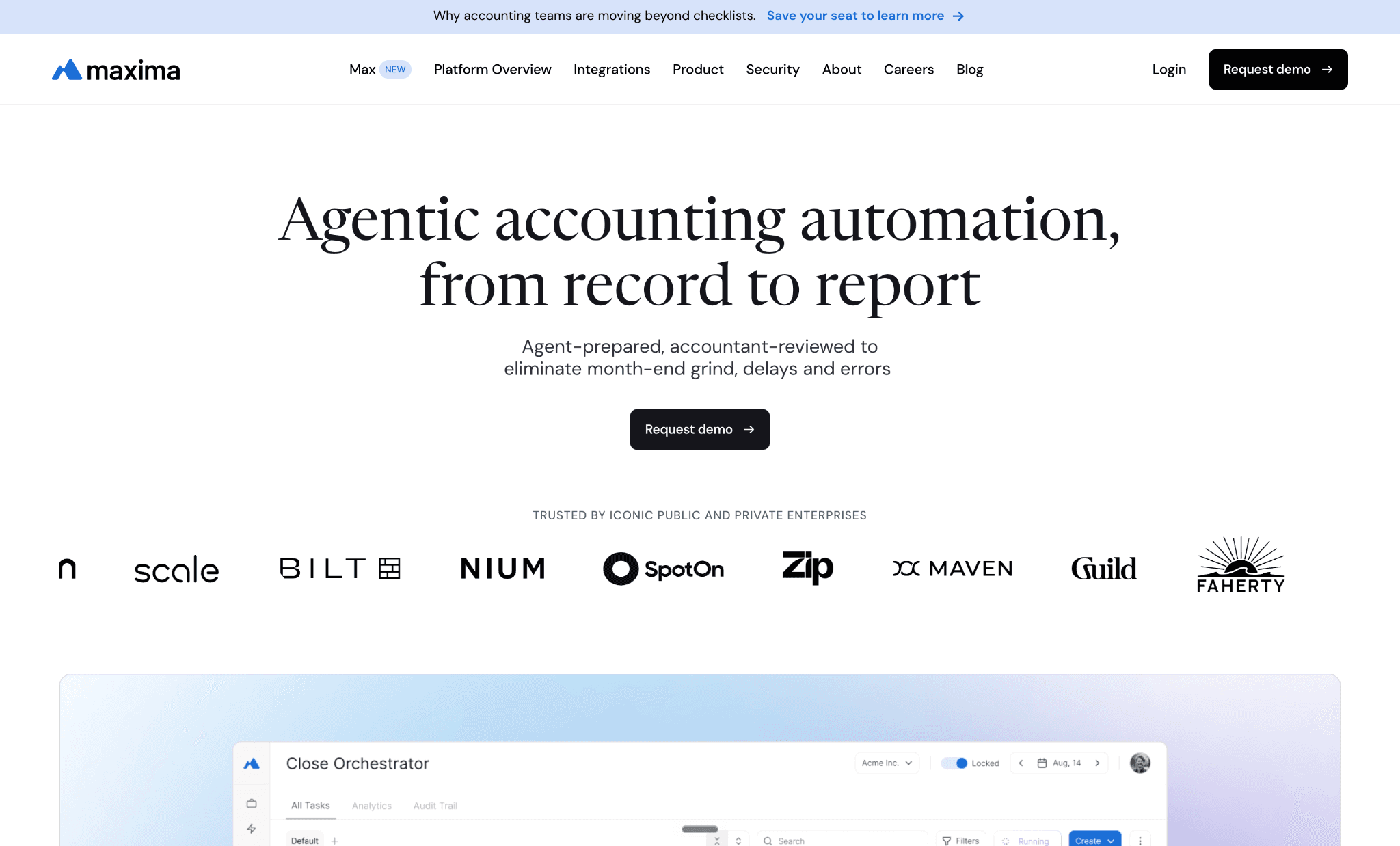
Maxima is an AI-native accounting platform where agents prepare work continuously and accountants review and approve it. Transaction matching, cash-to-GL reconciliation, and the journal entries that come out of settlement breaks all live in one system with transaction-level lineage. For the broader account-level discipline this feeds, see account reconciliations.
Best fit
Enterprise teams that want payment reconciliation connected to cash accounting, journal entry automation, and account reconciliations.
Multi-entity, multi-currency teams overloaded by manual prep rather than sign-off.
Teams needing a review-first workflow where AI prepares and humans approve before posting.
What it automates well
Cash, credit card, and processor reconciliation with direct bank-feed ingestion, 24/7 normalization, and full source-to-GL traceability.
Many-to-one deposit matching for fee-netted batch payouts, plus one-to-many and many-to-many logic, with 95%+ of transactions auto-matched and reconciling entries proposed automatically.
Upstream journal entry preparation, so a settlement break becomes a drafted correcting entry with evidence attached instead of a note in a queue.
Where it stands out
Prepares accounting work end to end rather than stopping at match status or checklist orchestration.
Transaction-level lineage, maker-checker controls, and re-performable evidence are native, which matters in SOX and external audit environments.
The most complete option here if payment reconciliation regularly triggers JEs, substantiation, and close dependencies.
Tradeoffs and pricing notes
Platform-like rather than point-solution-like, so it fits best when payment reconciliation ties to broader record-to-report pain.
Implementation is finance-owned and typically live in weeks: phase one covers bank and processor feeds plus your highest-volume cash accounts. You own chart-of-accounts mapping and materiality thresholds, configured in plain English, and no dedicated IT process owner is required.
No public price list. Platform fee based on business size plus per-module fees tied to transaction volume and workflows.
2. HighRadius
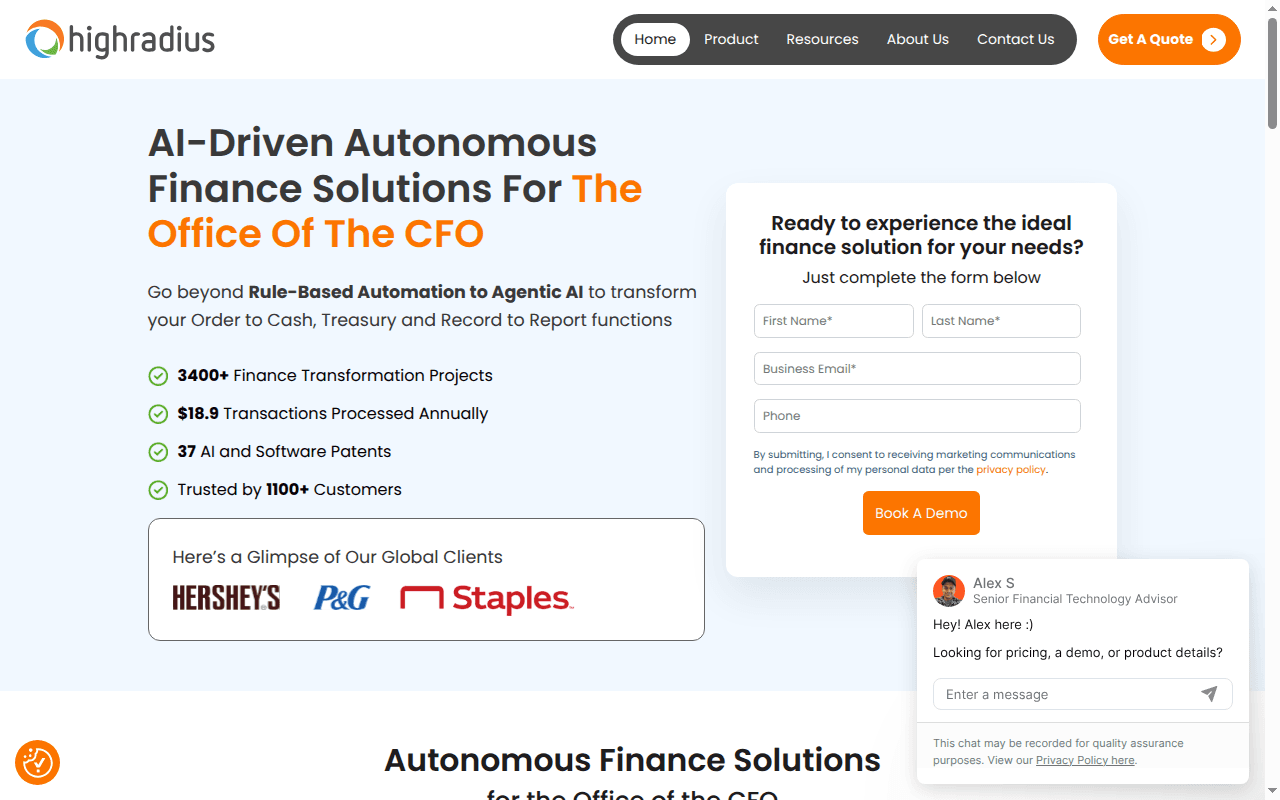
HighRadius is an enterprise order-to-cash and record-to-report suite with distinct bank, account, revenue, and payment reconciliation products, serving more than 1,500 global businesses. Few vendors publish automation numbers this specific for payment matching.
Best fit
Larger finance organizations needing bank, cash, revenue, and account reconciliation coverage at scale.
Environments where ERP breadth and transaction volume matter more than lightweight simplicity.
Teams that want quantified automation targets to build a business case around.
What it automates well
Payment reconciliation with claims of 30% faster reconciliation, 99% accuracy, and 80% automation of payment matching.
Bank reconciliation with stated 90% transaction auto-match and 95% auto journal posting.
Daily revenue and credit card reconciliation, where AI agents flag fee and settlement exceptions and post approved journals back to the ERP.
Where it stands out
The strongest published automation metrics in this comparison, plus real-time dashboards and multi-ERP adaptability.
Coverage extends beyond payment matching into cash application, revenue, and close.
Strongest when your reconciliation environment is already complex and ERP-heavy.
Tradeoffs and pricing notes
The product family is broad. Scope the specific module rather than buying "HighRadius" as one thing.
Expect an enterprise rollout measured in months, module by module, with meaningful mapping and rule-building on your side and a named process owner to maintain rules as processors change.
No public pricing. Annual contracts priced by module, volume, and complexity, plus an outcome-based option that defers fees until agreed results land.
3. Ledge
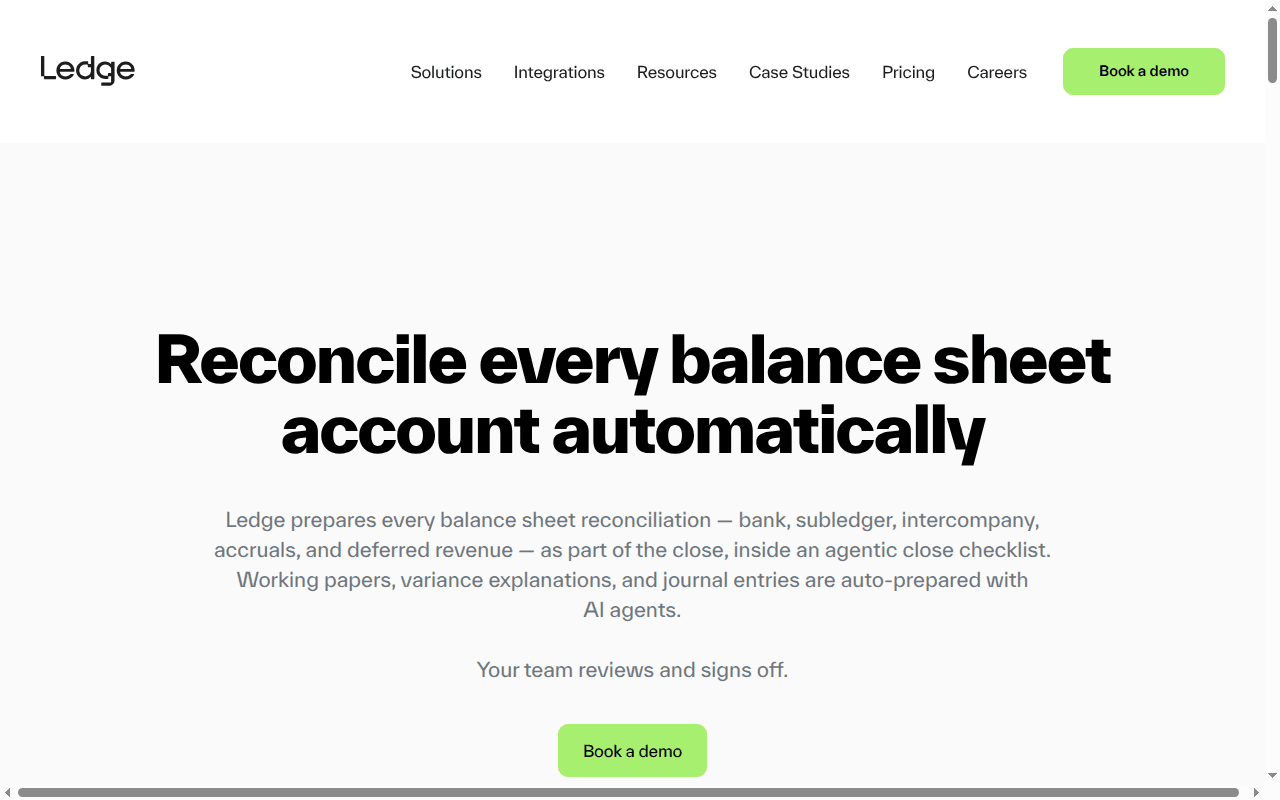
Ledge is a payment-operations platform for finance teams whose reconciliation problem lives between processors, banks, billing systems, and the ERP. It was recognized on the 2024 Fintech Innovation 50 list for AI-driven payment reconciliation, and its focus is real-time cross-system matching rather than full close preparation.
Best fit
Teams reconciling across payment processors, banks, ERP, billing, and internal tools in real time.
SaaS, marketplace, and digital businesses with payouts, refunds, chargebacks, platform fees, and timing differences.
Teams wanting a specialized payment layer without adopting a heavier close suite.
What it automates well
Multi-source payment matching across ERP, banks, processors, and internal systems, including multi-currency activity.
AI-powered exception management for FX variances, timing differences, vague memos, lump-sum deposits, and platform fees.
Continuous oversight of what is reconciled, delayed, or at risk of affecting close timelines.
Where it stands out
The most directly payment-focused option here alongside AutoRek, with clear emphasis on processor-to-bank-to-ERP complexity.
Customer positioning centers on scaling reconciliation volume without adding headcount.
Strong when the ERP cannot handle cross-system payment complexity natively.
Tradeoffs and pricing notes
More specialized in payment reconciliation than in close preparation or broad journal automation.
Plan a rollout around connecting each processor and bank feed first; you own match rules and tolerances, and one analyst-level owner can maintain them.
No published rates. Tiered Track, Execute, and Enterprise plans priced as a single platform fee with unlimited seats.
4. BlackLine
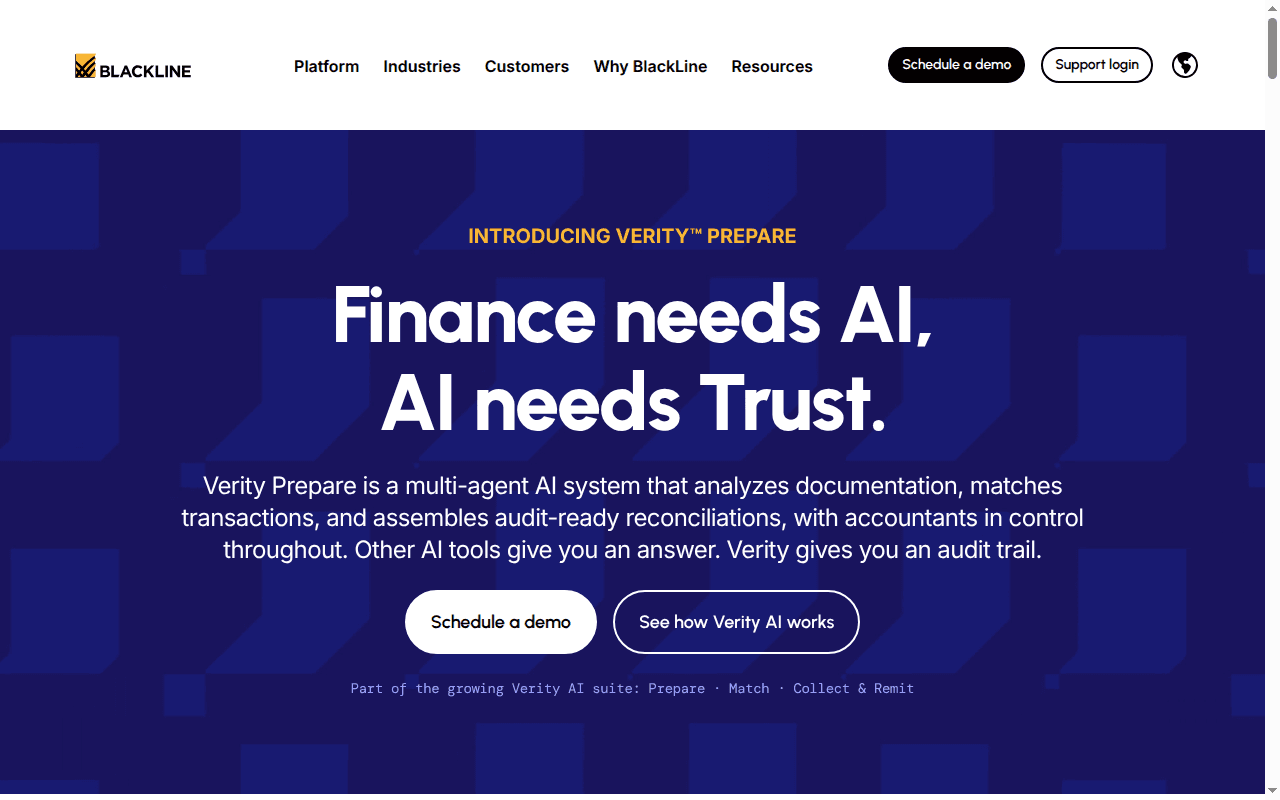
BlackLine is the legacy enterprise benchmark for reconciliation and close control, appearing in Gartner's Financial Reconciliation Solutions market alongside Trintech and Xelix. It is built around standardized templates, configurable workflows, and reviewer controls at global scale.
Best fit
Large enterprises wanting a proven reconciliation and close-control platform with standardized workflows.
Environments where governance, reviewer controls, and global consistency matter as much as the matching engine.
Teams needing high-frequency reconciliations and transaction matching inside a broader close platform.
What it automates well
Account substantiation with standardized templates, configurable workflows, dashboards, and daily or as-needed reconciliation.
Transaction matching at scale, including many-to-one and one-to-many deposit scenarios typical of card settlement.
Broader financial-operations workflows through the wider platform and its Verity AI layer.
Where it stands out
Operational control and standardization across large, distributed accounting teams.
Deep reporting and audit-facing documentation that satisfies mature SOX programs.
A strong option when you are buying global process discipline, not just faster bank matching.
Tradeoffs and pricing notes
Broader and heavier than payment-only point solutions, which can exceed what a lean team needs.
Expect a multi-month, phased implementation with significant template and rule configuration owned by you, plus a dedicated administrator.
No public pricing. Third-party data puts annual contract values from roughly $13,500 to over $500,000 depending on modules, volume, and term.
5. FloQast Reconciliation Management
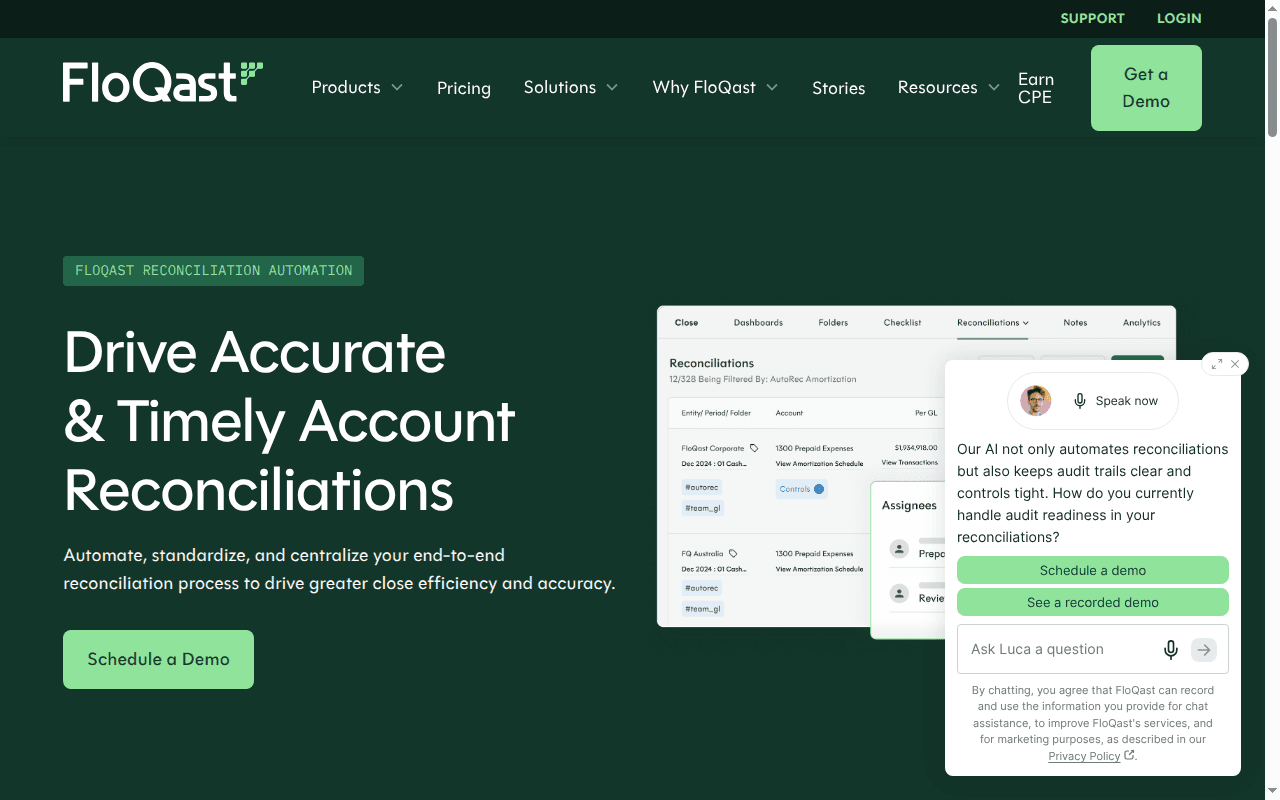
FloQast Reconciliation Management adds AI-driven matching and rec automation inside FloQast's close-management environment, designed for accountants who already run a structured close and want reconciliation automation beside their checklist.
Best fit
Teams that think in close-process terms and want reconciliation automation in a familiar environment.
Teams standardizing reconciliations without the heaviest enterprise footprint.
Organizations valuing accountant-friendly workflows and measurable close-time reduction.
What it automates well
AI writes the matching rules, auto-matches up to 98% of transactions, and can auto-certify reconciliations within tolerance thresholds.
Audit-ready rollforwards, exception routing, and direct ERP journal generation for unmatched fee and timing items.
Reported 31% reduction in time to perform reconciliations for customers using it with FloQast Close, with claims of up to six days back per month.
Where it stands out
The clearest bridge between close management and newer AI-driven reconciliation automation.
Stronger on close workflow context and adoption speed than on processor-specific settlement logic.
Practical when your priority is process visibility across many accounts and preparers.
Tradeoffs and pricing notes
More close-suite-oriented than payment-ops-oriented. If multi-processor settlement logic is your bottleneck, other tools fit more directly.
Rollout is usually weeks per account group; you own tolerance and certification policy setup, and a close owner already exists in most FloQast shops.
No list price. Third-party data suggests small deployments start near $12,000 per year, mid-market setups run $30,000 to $120,000, and the reconciliation module adds $20,000 to $140,000 annually.
6. AutoRek

AutoRek is a payment-operations and regulated-finance platform built for firms whose reconciliation problem is settlement itself, handling high-volume, multi-rail data with flexible message formats and safeguarding controls.
Best fit
Payment firms, e-money businesses, fintechs, and regulated environments with multi-rail settlement and safeguarding complexity.
Teams needing real-time or intraday reconciliation across ACH, Zelle, BACS, CHAPS, SEPA, card networks, or RTP.
Environments where very large data volume and flexible file formats are core buying criteria.
What it automates well
End-to-end payment reconciliation across processors, acquirers, gateways, banks, and internal systems.
Rules-based and probabilistic matching with tolerance handling for multi-rail timing differences, exception categorization, and audit reporting.
Finance reconciliations spanning bank, GL, scheme, and settlement data, with sign-off tracking and complete audit trails.
Where it stands out
The most payment-rail-specific product in this list, and it should be evaluated that way.
Especially strong where regulatory control, settlement reporting, and operational scale are the same problem.
The vendor states customers typically achieve ROI in nine months or less.
Tradeoffs and pricing notes
Specialized for payment operations and regulated finance rather than corporate close transformation.
Expect a data-engineering-flavored implementation: you own file mappings per rail and scheme, and a dedicated reconciliation operations owner is effectively required.
No public pricing. Subscription customized by features, users, and transaction volume.
7. SolveXia
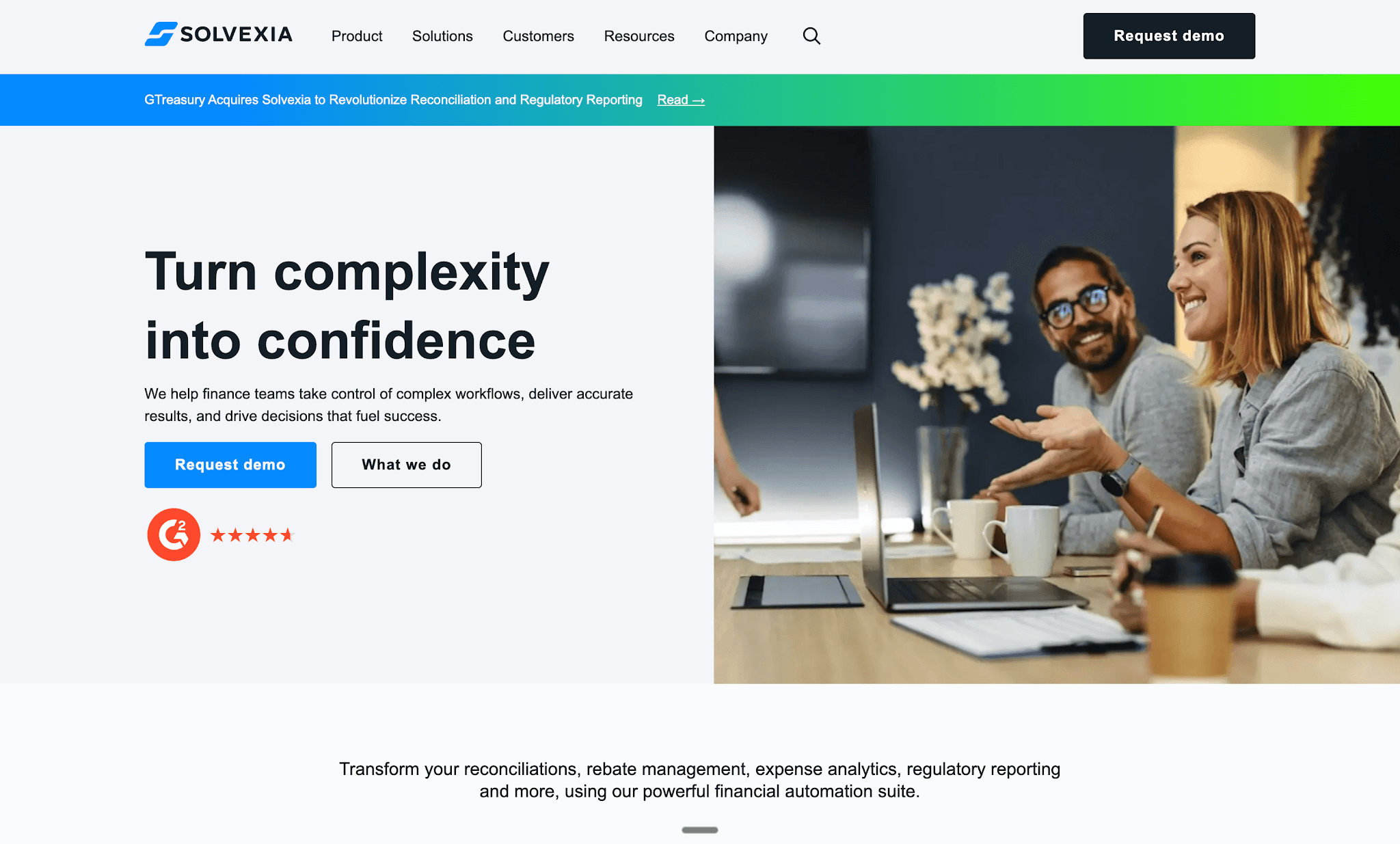
SolveXia is a finance automation platform built around reconciliation, reporting, and data consolidation workflows. It targets operations-heavy finance teams that need to automate high-volume reconciliations across banks, processors, and internal systems without a full enterprise suite rollout.
Best fit
Finance and operations teams running high-volume reconciliations across multiple data sources who want process automation without heavy IT involvement.
Teams whose reconciliation problem is data aggregation and matching logic across spreadsheets, bank files, and ERP exports rather than real-time payment-rail operations.
Mid-market and growth-stage companies wanting structured reconciliation workflows with audit trails and exception routing.
What it automates well
Data ingestion and normalization from multiple sources including bank files, processor reports, ERP exports, and spreadsheets, consolidating them into a single matching environment.
Configurable matching rules for one-to-one and one-to-many scenarios, with exception flagging, aging, and reviewer assignment built into the workflow.
Reconciliation reporting and audit documentation, with approval workflows and evidence capture for each completed reconciliation cycle.
Where it stands out
Strong at consolidating fragmented data sources into a structured reconciliation workflow without requiring a full enterprise platform purchase.
Finance teams can configure and own workflows without ongoing IT dependency, which shortens time to value for teams with limited technical resources.
A practical option when the core problem is manual data aggregation and rule-based matching rather than deep payment-rail or close-preparation automation.
Tradeoffs and pricing notes
Less suited to real-time or intraday reconciliation needs and processor-specific settlement complexity. If multi-rail timing differences, fee-netted payouts, or FX variance are your primary pain, more specialized tools fit better.
Rollout typically involves mapping each data source and configuring matching rules per account type; a finance operations owner is needed to maintain rules as source file formats change.
No public pricing. Subscription-based with pricing customized by workflow count, data volume, and team size.
Security and compliance questions to ask vendors
For enterprise and regulated buyers, controls are not a feature category. They are a purchase condition. Use these questions to pressure-test any shortlist vendor.
Who can approve a journal entry, and can that person also prepare it? Segregation of duties must be enforced architecturally, not just by policy. Maker-checker controls should be non-bypassable.
Is the audit trail immutable? Every match decision, rule change, exception resolution, and approval should be logged with a timestamp and user ID that cannot be edited after the fact.
Can an auditor re-perform the work? Evidence should include source data, matching logic, tolerances applied, exceptions encountered, and the approval chain, not just a status field.
How is access controlled across entities and roles? Role-based permissions should limit what each user can see, prepare, and approve, especially in multi-entity environments where one team should not touch another entity's accounts.
What are the data retention and hosting policies? For SOX-compliant teams, confirm retention periods, data residency, encryption standards, and whether the vendor trains models on your transaction data.
What certifications does the vendor hold? SOC 1 Type II and SOC 2 Type II are the baseline for enterprise finance software. ISO 42001 matters if AI agents are preparing work that posts to the GL.
FAQs: automated payment reconciliation software
What is the difference between bank reconciliation and payment reconciliation software?
Bank reconciliation ties GL cash to the bank statement. Payment reconciliation ties processor, gateway, and settlement data to both, which is where fees, refunds, chargebacks, and settlement timing get resolved. If you cannot split a net payout into its components, your bank rec cannot close cleanly. Most tools do the first job well; fewer do the second. For the first category, see bank reconciliation software; for card-specific workflows, see credit card reconciliation software.
How often should reconciliation run once it is automated?
Daily or intraday for cash and settlement accounts. The point of automation is continuous preparation, not a faster month-end scramble. Done right, exceptions surface within a day of settlement instead of on close day three.
What happens to exceptions the system cannot match?
Unmatched items route to a queue with an assigned owner, aging, and supporting evidence, and AI-powered exception management flags the likely cause. Judge tools by how exceptions are assigned, aged, documented, and re-performed for auditors, not by the headline auto-match percentage. A 95% match rate with an unmanaged 5% still costs close days.
Do these tools replace or sit on top of the ERP?
They sit on top and write approved journals back. The ERP stays the system of record while the reconciliation layer connects banks, processors, and billing systems around it. Integration depth determines whether you stop exporting files or just organize them better.
What data do you need in place before implementation?
Clean chart-of-accounts mapping, bank and processor feed access, defined matching tolerances, and named account owners. Missing or inconsistent reference fields in payment files are the most common cause of low auto-match rates, so audit your file formats before kickoff.
Choosing the right fit
The right choice depends on where your close stalls. If the delay is fragmented payment data, buy matching depth. If the delay is preparation work no tool is doing for you, buy a platform that prepares the entries and reconciliations rather than tracking whether a human did.
Pick based on your operating model, then validate with your two hardest accounts during the trial. Auto-match rate on a clean demo dataset tells you nothing about your fee-netted payouts.
Full accounting-prep automation: Maxima, for multi-entity teams wanting agent-prepared entries, reconciliations, and evidence with human approval before posting.
Payment-ops-heavy complexity: AutoRek for regulated multi-rail settlement, Ledge for processor-to-bank-to-ERP fragmentation.
Legacy enterprise standardization: BlackLine for global process discipline, HighRadius when ERP breadth and published automation targets drive the business case.
Modern close-focused teams: FloQast if the close checklist is your center of gravity, SolveXia if you want structured reconciliation automation across fragmented data sources without a heavy enterprise rollout.

Move closer to an audit-ready, continuous close

Request demo
Insights, news and content
The latest
See all